

.png) 1 day ago
7
1 day ago
7
PROTECT YOUR DNA WITH QUANTUM TECHNOLOGY
Orgo-Life the new way to the future Advertising by AdpathwayPresident Donald Trump stormed out of his “Meet the Press” interview with Kristen Welker, which aired on Sunday, after being asked about the $1.8 billion “Anti-Weaponization Fund” — less than a week after he snapped at CNN’s Kaitlan Collins for asking whether the fund had been killed or put on hold.
“You’re a one-sided, crooked network. Sorry. Let’s call it quits because I’ve had enough. Thank you, darling. Have a good time,” Trump said, before taking off his mic pack.
When Welker tried to keep Trump from leaving the set, Trump said, “I sat in the rain with you for an hour. On and off in the rain, and I’ve given you enough time. You ought to straighten out your press, because you know what? A country can never be great with a dishonest press.” As Trump left his seat, he then patted Welker on the shoulder.
While the entire tantrum has gone viral, one particular line from the interaction has struck a chord: “Thank you, darling.”
Not all sexist language takes the form of explicit insults, linguist Karen Stollznow told HuffPost. Stollznow’s research focuses on the intersection of language, culture and identity. While “darling” is primarily an affectionate nickname, in a professional context like this one, it’s more “patronizing and dismissive,” according to Stollznow.
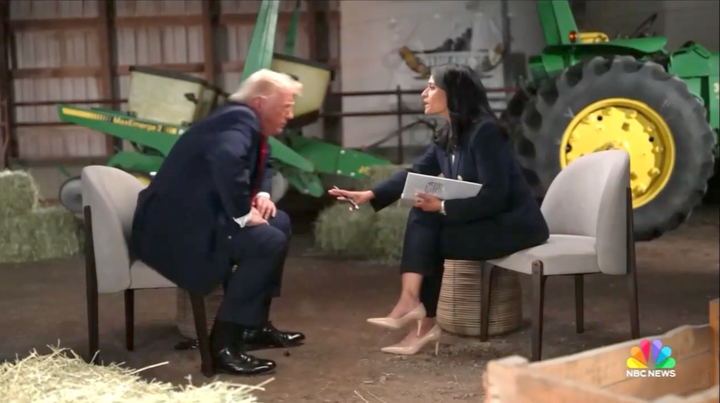
NBC News/"Meet The Press"
“Most people instinctively understand that there is a difference between calling your spouse ‘darling’ and calling a journalist ‘darling’ during a contentious interview,” Stollznow said. “The issue isn’t whether the word is old-fashioned or whether it can be used affectionately. The issue is what it accomplishes in that moment.”
Communication can also be nonverbal, which is why Trump patting Welker on the shoulder as he left the set is another means of him trying to “reinforce the message conveyed by terms such as ‘darling,’” Stollznow added.
NBC and “Meet the Press” did not immediately respond to HuffPost’s request for comment. After the interview aired on NBC, Welker said she spoke with Trump on Saturday and that he had agreed to sit down for another “Meet the Press” interview with her, though it’s not specified when that will happen. The White House also did not respond to HuffPost’s request for comment as of publishing.
“Thank you, darling” is “benevolent sexism,” according to experts.
“It is not difficult to understand the dynamics Trump showed toward Kristen Welker,” Derald Wing Sue, a psychology professor at Columbia University’s Teachers College, told HuffPost. Sue’s research focuses on multicultural and microaggression theory, and he has written several books, including “Microaggressions in Everyday Life: Race, Gender, and Sexual Orientation.”
The use of “darling” and patting Welker on the shoulder as he leaves is an “intentional reminder” to Welker and the viewers that Trump is hierarchically in charge, Sue argued.
“When an older man uses the term ‘darling’ in a dismissive fashion, it is not a term of endearment or politeness,” Sue said. “He exercises power and authority over Welker and informs [the audience] that he is ‘superior.’”
It can be categorized as a form of benevolent sexism, Sue said, which describes when sexist terminology can be subjectively viewed as affectionate or chivalrous.
This form of sexism is particularly prevalent in work environments, and it isn’t new, Stollznow said.
“Historically, women have often been addressed with terms such as ‘sweetheart,’ ‘honey,’ ‘dear,’ and ‘darling’ in workplaces where men would typically be addressed by their titles,” she said. “It’s a form of linguistic condescension rather than outright verbal aggression or abuse.”
Trump claims he got angry during the interview because of the rain.
Welker’s interview was recorded inside a barn at Chippewa Falls, Wisconsin, on Friday, where Trump was visiting to host an agriculture roundtable discussion. Shortly after speaking with Welker, C-SPAN streamed Trump’s roundtable, during which he blamed his behavior toward Welker on the rain.
“I just did an interview in the most beautiful barn I’ve ever seen. … But it was raining, and it was with NBC Fake News,” he said. “And because it was raining, I got a little bit angry at them. I was not happy with them. But we had a good time.”
While “Meet the Press” is sometimes edited for broadcast, NBC publishes full, unedited transcripts on its site. According to the interview transcript, Welker’s question before Trump ended the interview concerned whether he was backing off the $1.8 billion fund or looking for another way to revive it.
Trump transitioned his answer into talking about the “rigged” primary elections happening in California, to which Welker asked him, “Do you have evidence to support that?”
“All I have to do is look,” Trump said. “All I have to do is look.”
“But that’s not evidence,” Welker said.
That’s when Trump decided to end the interview.
This is part of a growing divide between Trump and female journalists.
Last Wednesday, Trump told CNN host Kaitlan Collins to “be quiet” during a press briefing in the Oval Office, and went on to say Collins “never smiles.” In another heated exchange between the two in February, Trump told Collins, “I don’t think I’ve ever seen you smile. … You know why you’re not smiling? Because you know you’re not telling the truth.”
While aboard Air Force One in November, Trump told Bloomberg reporter Catherine Lucey, “Quiet. Quiet, piggy,” when she asked him about the Department of Justice’s investigation files on Jeffrey Epstein. In September, he told NBC’s Yamiche Alcindor to “be quiet” when she asked whether he was trying to start a war with the city of Chicago.
“One recurring pattern [between Trump and female journalists] is that criticism of women is often framed in personal terms, rather than purely professional ones,” Stollznow told HuffPost, referring to the “Quiet, piggy” and “darling” comments. “The result is that attention shifts away from the journalist’s question and onto the woman herself, making the exchange feel personal rather than professional.”
When it comes to male journalists challenging Trump, he usually goes after the outlet they work for rather than commenting on the individual journalist. NPR’s political correspondent Tamara Keith pointed out on the June 4 episode of “All Things Considered” that “[Trump] does go after men sometimes. He did recently call a male reporter from The New York Times — called his reporting treasonous. But that is the exception, not the rule.”
“Whether intentional or not, gender becomes part of the interaction in a way that it otherwise would not,” Stollznow said. “Rather than treating the journalist as an equal participant in a professional exchange, it positions her as someone to be dismissed or talked down to.”
Trump’s recent attacks on Welker and Collins were in response to similar questions about the $1.8 billion fund, which could suggest that dismissiveness and deflection go hand in hand.
“The best thing that we as a press corps could do is to just ask that same question,” Keith said on “All Things Considered.” “Keep following up. Don’t let the president get away.”







.png)





.jpg)



 English (US) ·
  French (CA) ·