

PROTECT YOUR DNA WITH QUANTUM TECHNOLOGY
Orgo-Life the new way to the future Advertising by Adpathway“A museum dedicated to addressing contested histories, even when they are controversial, betrays Palestinians, Jews, truth and their own expressed mandate. That is the real Nakba.”
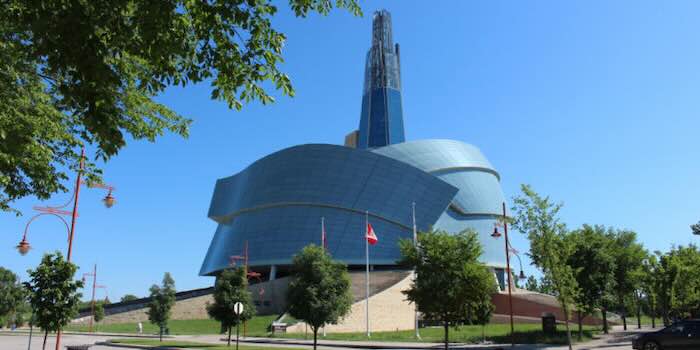
An increasingly controversial exhibit, Palestine Uprooted: Nakba, Past and Present, is planned to be unveiled at Winnipeg’s Canadian Museum for Human Rights (CMFHR) in June 2026.
The Museum is launching a new exhibit examining the Nakba, a period beginning in 1948 when hundreds of thousands of Palestinian Arabs were displaced, either voluntarily or forcibly, in the war over Israel’s creation.
Drawing on the oral histories of the Palestinian diaspora in Canada, the mixed-media display is set to remain part of the Winnipeg-based Museum’s standing galleries for at least two years, its chief executive officer, Isha Khan, told The Globe and Mail.
She said a team of researchers, academics, interpretive planners and designers has been working for several years to curate the exhibit, which will combine different media and materials to recount the Nakba through videos, static art, the written word and interactive presentations.
Some groups and individuals, even a few Jewish ones, have praised the proposed exhibit. Others have been damning it in petitions and appeals to the Museum’s board, the Minister of Canadian Heritage, and even the Prime Minister.
Several prominent Canadian Jewish groups condemned the planned exhibit, stating that it undermines the legitimacy of Israeli statehood. One of them has withdrawn from future collaborations.
The Jewish Heritage Centre of Western Canada (JHCWC) announced it would hold its annual Holocaust Remembrance Day ceremony elsewhere, away from the Museum. The group said it was “tremendously concerned” that the exhibit “will lack balanced scholarly research and will ignore key issues of the historical and current geopolitical reality.”
The JHCWC also expressed concern the exhibit could overlook non-Jewish minorities who are Israeli citizens, including Muslim and Christian Arabs, Druze, Circassians and Samaritans – people who hold positions in the judiciary, parliament, health care and the military, and that their equal rights under Israeli law complicate common interpretations of the Nakba
It also expressed concern about a lack of meaningful consultation with the “organized Jewish community.”
Accordingly, the JHCWC said it is ending its partnerships with the Winnipeg museum, including those for the development of additional Holocaust galleries, due to the new exhibit.
“We are concerned that the museum may present an unbalanced view of history – devoid of scholarly best practices,” the Centre said in a statement.
Likewise, in a post on X by Gustavo Zentner, Vice President for Manitoba and Saskatchewan, the Centre for Israel and Jewish Affairs, issued the following statement:
“When the Centre for Israel and Jewish Affairs learned of the Museum’s intention to profile the experiences of refugees from the 1948 Arab–Israeli War, we immediately engaged with the Museum’s leadership. We offered to convene leading experts to help ensure that any exhibit presents a balanced, fact-based, and comprehensive narrative, one that reflects the experiences of all refugees, including the more than 850,000 Jews forcibly displaced from long-established communities across the Middle East and North Africa. Recent reports regarding an exhibit entitled “Exhibit on Palestine and on Nakba, Past and Present” have heightened our concerns, particularly because our community has not been consulted. This is despite our repeated and explicit offers to contribute historical expertise and lived experience. As currently framed, the proposed direction will deliver an incomplete and unbalanced narrative, one that omits Jewish refugee experiences entirely and will carry reputational consequences for the Museum. To ensure the Museum fulfills its mandate, we have requested information from its leadership about the exhibit’s content, framing, objectives, and development process, before any further steps are taken. We are actively working with our community and with partner institutions across Canada to demand accountability.”
As well, Amir Epstein, executive director of Tafsik Organization, a Canadian civil-rights group fighting antisemitism, is concerned the exhibit will be biased.
“If this is a display that will actually showcase the facts and properly explain what happened in the period around 1948, then I’m all for it,” he said.
“But for that to happen, it will need to include the perspective of many Jews like myself, who celebrate the Nakba. Because for us, it means we got to survive. We got to see Israel, and we got to see it become the gem of the Middle East after all that our people had been through.”
As for the Museum, it originated from the vision of and original funding by Canadian media mogul and philanthropist, the late Israel "Izzy" Asper, a staunch Zionist. David Asper, Izzy’s son and an Asper Foundation trustee, told the National Post that the museum “has allowed itself to become the tool, or dupe, of only one side of the story.”
“I think what you’re seeing with the Jewish Heritage Centre [JHCWC] is the manifestation of a fundamental breach of trust by the Canadian Museum for Human Rights,” said Asper. “The factual, historical context of events surrounding the ‘Nakba’ are not just one story. In my father’s founding vision of the purpose of the Museum he never had a problem with the telling of the whole story, which includes the displacement and expulsion of over 800,000 Jews who were living in Arab countries and, perhaps most importantly, that a lot of what happened was triggered by the fact that many Arab countries declared war and tried to conquer and eliminate Israel in 1948.”
This growing backlash is against an exhibit that is still being fine-tuned.
Partly for that reason, the Globe and Mail’s Marsha Lederman, daughter of Jewish Holocaust survivors, claimed the negative outcry was “not only premature, but preposterous.”
“There is every reason for a museum whose mandate is human rights to install an exhibition about the mass displacement of at least 750,000 people in 1948, during what Palestinians call the Nakba – the catastrophe,” she said.
“This shattering history has affected many Palestinian-Canadians, whose stories will be featured. ‘Most of those who were displaced believed they would return in a few days or weeks,’ the Museum’s description of the exhibition states. “Five generations later, these people and their descendants still live with insecurity and uncertainty and are unable to return home,” she claimed, without supplying any factual, historical, or explanatory context for this “insecurity and uncertainty.”
But her main argument is “There is every reason to trust that the team of professionals at a museum of the CMFHR’s calibre – which relies on federal funds and oversight – will not install a shoddy, biased exhibit that will paint Jews as the devil.”
Lederman’s mocking dismissal of the fear that the exhibit “will lack balanced scholarly research and will ignore key issues of the historical and current geopolitical reality,” thereby erasing “Jewish voices” is easy to dismiss because there is no reason to believe that the exhibit will highlight its crucial context, including the fact that the United Nations sanctioned the creation of the State of Israel with a partition plan intended to create two states – one for the Jews and one for the Arabs in the historical land of Israel – a proposal various Arab enemies of Israel still strongly reject.
The National Post’s Terry Newman has cynically but accurately disputed Lederman’s blind faith in the Museum’s objectivity by arguing, “Apparently, Canadians Jews shouldn’t concern themselves with how they’re going to be represented, because we all know that both Palestinians and museums are infallible, and that the government only funds people who are sensitive to Jewish issues, like Laith Marouf.”
Newman also rightly declared that “‘Nakba’ is already a politically loaded term, as it describes the creation of the world’s only Jewish state in the aftermath of the Holocaust as a ‘catastrophe.’ So, I reached out to the Museum to find out how it intends to define and frame the events.”
According to Newman, “Its spokesperson, Amanda Gaudes, replied that the exhibit would be based on the “lived experiences of Palestinian-Canadians and the human rights impacts of forced displacement that they have experienced over generations from 1948 until today,” and would be “neither a historical retrospective nor an examination of the founding of the State of Israel or current Israel-Palestine relations.”
“It is a multimedia exhibit that will use art, first-person reflections and personal artifacts to share the lived experiences of Palestinian-Canadians –these are their stories,” she said.
Translation: this exhibit is not about verified truths supported by documented historical facts; rather, it is about unsubstantiated “stories” grounded in human grievance and emotion.
Where have we heard Gaudes’ message before? Well, we heard it loud, clear, and ad nauseam from indigenous people during the hearings of Canada’s government-funded Truth and Reconciliation Commission charged with reporting on the history, operation, and legacy of the country’s Indian Residential School system, whose biased six-volume 2015 report and other documents are full of decontextualized and unverified indigenous-only stories.
The mandate of the Truth and Reconciliation Commission was to “reveal to Canadians the complex truth about the history and ongoing legacy of the church-run residential schools, in a manner that fully documents the individual and collective harms perpetuated against Aboriginal peoples.”
By indigenous cultural standards of evidence gathering and storytelling, perhaps it did. By contemporary Western juridical and objective social science standards, however, the report is badly flawed, notably in its indifference to robust evidence gathering, comparative or contextual data, and cause-and-effect relationships. The result is that it tells a skewed, exaggerated, and partial story of life at the residential schools and how this affected its students.
Given Gaudes’ words and other statements, the same biases are sure to be fully featured in the one-sided Nakba museum exhibit, which is also government-funded.
If the Museum were interested in truth-telling, its first observation about the Nakba would be that it was created by “pro-Palestinian” activists as the prevailing legend around the creation of the State of Israel and the displacement of Palestinians during the 1948 independence war.
The exhibit will, of course, frame this history as an ongoing human-rights injustice. Which it is – but not the way the Museum will display it.
The central issue, as one observer sees it, “is less about whether the story of the Nakba should be in a human rights museum than the content of that narrative itself.”
He argues that a Nakba exhibit should certainly belong in a human rights museum, but in a much more nuanced and holistic fashion than the currently proposed one.
If this were done, he says, what follows is the story it would tell.
What the Palestinians call a “catastrophe” is just that. But their “Nakba” is one of the Arabs’ own creation and perpetuation, an eight-decade period of Palestinian statelessness created and maintained by Arab and Palestinian leaders.
After the United Nations democratically voted to partition the British Mandate of Palestine into an Arab and a Jewish state, the Jews began building the infrastructure for an independent state. The Arabs went to war.
That war and its resultant displacement on both sides and statelessness –for the Arabs – resulted from the Arab refusal to live side-by-side with Jews. Given the option of a Palestinian Arab state next to a Jewish one, or neither, the Arabs unanimously opted for the latter.
That is the catastrophe.
But the current statelessness for the Palestinians has not been a Nakba for tyrannical Arab leaders or fanatical terrorist organizations like Hamas and its copycats. For the former, preventing statehood for people who never had a historical state of their own, helps obscure the leaders’ own corrupt and incompetent mismanagement of their countries by blaming the Jews for sins of their own making. For the latter, it allows terrorist militias and other violent groups to enrich themselves while maintaining firm control over ordinary Palestinians, most of whom have been brainwashed to support their genocidal antisemitic mission.
Instead, the exhibit will strengthen the false foundation of the lucrative and powerful Palestinian Propaganda Industry, the global equivalent of Canada’s Indian Industry, thereby ensuring that blame for the conflict and for Palestinian statelessness is explicitly transferred to the Jews and the Jewish state.
As this same observer rightly claims, “A museum dedicated to addressing contested histories, even when they are controversial, betrays Palestinians, Jews, truth and their own expressed mandate. That is the real Nakba.”
Recommended by Canada Free Press

View Comments
Support Canada Free Press










.png)




.jpg)


 English (US) ·
  French (CA) ·