

 15 hours ago
13
15 hours ago
13
PROTECT YOUR DNA WITH QUANTUM TECHNOLOGY
Orgo-Life the new way to the future Advertising by Adpathway
This collection gathers articles, definitions, and maps covering the trade routes, travelers, and networks of exchange related to Unit 2: Networks of Exchange of the AP® World History: Modern curriculum. In here, you will find resources for teachers, providing the materials needed to explore how goods, ideas, and people moved between distant regions of the world during this period.
⬇️ Scroll down to see the collection!
Ideas for Teachers
- Two-way Silk Road trade: Have your students list the goods moving west to east and in the opposite directions, as listed in the Silk Road article. Then discuss why paper and gunpowder had a greater impact on world history than silk itself.
- Mongol Empire flowchart: Ask students to create a flowchart based on the information found in the Mongol Empire and Kublai Khan articles, showing the effect of the Mongols' policies on trade (yam postal system, tax incentives for merchants, paper money, road building, etc.).
- Compare ocean trade networks: Have students read the Kilwa and the Seven Voyages of Zheng He articles side by side and compare what each of them reveals about Indian Ocean trade networks.
- Trans-Saharan gold & salt trade: Based on the articles Mansa Musa I, Timbuktu, and The Camel Caravans of the Ancient Sahara, ask your students to explain the importance of camel caravans for trans-Saharan trade, as well as its importance.
- Primary source analysis: Ask your students to pick either the Ibn Battuta or the Margery Kempe article to identify the primary author's point of view, the purpose of their writing, and who their likely audience would have been.
- Trade routes & the Black Death: Use the Black Death article and the Map of the Trade Networks in the Middle Ages to have students trace how said trade networks may have carried the plague from Asia into Europe.
Browse the collection below to find materials that fit your teaching style and feel free to adapt them to your students. Note that our articles are print-friendly, and there is a PDF export button on each article page.

The Silk Road was a network of ancient trade routes, formally established during the Han Dynasty of China in 130 BCE, which linked...

The Mongol Empire (1206-1368) was founded by Genghis Khan (r. 1206-1227), first Great Khan or 'universal ruler' of the Mongol peoples...

Genghis Khan (aka Chinggis Khan) was the founder of the Mongol Empire which he ruled from 1206 until his death in 1227. Born Temujin...

Kublai Khan (Qubilai-Qan) was the ruler of the Mongol Empire from 1260 to 1294. His accomplishments include establishing Mongol rule...

The Mongol Empire accepted and promoted many other cultures. Historians often talk about cultural exchange across Asia in...
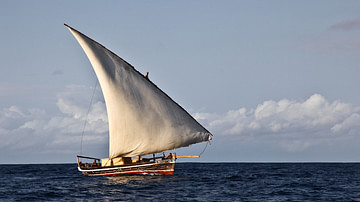
The Swahili Coast on the shores of East Africa was a region where Africans and Arabs mixed to create a unique identity from the...

Kilwa, an island located off the coast of East Africa in modern-day southern Tanzania, was the most southern of the major Swahili Coast...

Admiral Zheng He (aka Cheng Ho, c. 1371-1433 CE) was a Chinese Muslim eunuch explorer who was sent by the Ming dynasty...

Finding a maritime route to the East and gaining access to the lucrative spice trade stood at the root...

The astrolabe is an astronomical instrument used from around the 6th century to measure time and position by determining the altitude...

The Mali Empire (1240-1645) of West Africa was founded by Sundiata Keita (r. 1230-1255) following his victory over the kingdom of...

Mansa Musa I was the ruler of the Mali Empire in West Africa from 1312 to 1337. Controlling territories rich...

Timbuktu (Timbuctoo) is a city in Mali, West Africa which was an important trade centre of the Mali Empire...

The Songhai Empire (aka Songhay, c. 1460 - c. 1591) covered what is today southern Mauritania and Mali. It replaced the Mali Empire...

The camel caravans which crossed the great dunes of the Sahara desert began in antiquity but reached their...

Ibn Battuta (l. 1304-1368/69) was a Moroccan explorer from Tangier whose expeditions took him further than any other traveler of his...

Marco Polo (1254-1324 CE) was a Venetian merchant and explorer who travelled to China and served the Mongol ruler Kublai Khan (l...

Margery Kempe (l. c. 1373 - c. 1438 CE) was a medieval mystic and author of the first autobiography in English, The Book of Margery...

Following the conquest of North Africa by Muslim Arabs in the 7th century CE, Islam spread throughout West Africa...

The Black Death was a plague pandemic that devastated medieval Europe from 1347 to 1352. The Black Death killed an estimated 25-30...

The outbreak of plague in Europe between 1347-1352 – known as the Black Death – completely changed the world of...
About the Author

Jan is the Founder & Chairman of World History Encyclopedia and is the organisation's Director of Design & Technology. He holds an MA War Studies from King's College, and he has worked in the field of history-related digital media since 2006.
Free for the World, Supported by You
World History Encyclopedia is a non-profit organization. Please support free history education for millions of learners worldwide for only $5 per month by becoming a member. Thank you!
World History Encyclopedia is a non-profit organization. Please support free history education for millions of learners worldwide for only $5 per month by becoming a member. Thank you!
World History Encyclopedia is a non-profit organization publishing free history content that has been carefully researched and reviewed. If you liked this content, please consider donating at www.worldhistory.org/donate/. To remove this message from printouts, you can become a supporting member at www.worldhistory.org/membership/. Thank you for supporting our work!









.png)






.jpg)



 English (US) ·
  French (CA) ·