

 7 hours ago
14
7 hours ago
14
PROTECT YOUR DNA WITH QUANTUM TECHNOLOGY
Orgo-Life the new way to the future Advertising by AdpathwayChina’s marine scientific research ships are expanding their operations around Taiwan, and they are not just there to advance the frontiers of human knowledge. Their operations serve to undermine Taiwan’s independent political status and to force international acceptance of Beijing’s claim of sovereignty over the island and its surrounding waters. This pressure campaign by the People’s Republic of China began intensifying in 2022. While media coverage of this development has focused on the activities of the People’s Liberation Army and the China Coast Guard, China’s civilian survey ships operate among them often unnoticed and in unprecedented numbers. Because of the specialized capabilities they offer — and their civilian status — Beijing regards them as useful tools to achieve its military and political objectives. Unlike Chinese military and coast guard forces, these ships are entirely unarmed, and the personnel aboard them are civilian mariners, scientists, and engineers, not members of China’s military. But they serve a significant military purpose: advancing Beijing’s understanding of the marine environment in which conflict could occur. Since June, the activities of Chinese research vessels have expanded to new areas east of Taiwan, including in waters near Japan and the Philippines, most likely prompted by the announcement from Manila and Tokyo that they will begin negotiations to delimit their maritime boundary in their overlapping entitlements east of Taiwan. Beijing was not invited to participate in the talks, and its surveys signal to leaders in Taipei, Tokyo, and Manila that the People’s Republic of China will not accept a delimitation unless it is included in the negotiations and that proceeding without Beijing’s participation risks escalation and confrontation.
Chinese Activity Around Taiwan
The area in question is at the intersection of waters belonging to Taiwan, Japan, and the Philippines. These waters clearly implicate Taiwan’s interests. Since Beijing claims sovereignty over Taiwan and authority over all maritime entitlements, it vehemently denounced the initiative as threatening China’s “maritime rights and interests.” To reinforce its claim, China sent several large coast guard patrol ships to back up its complaints and assert its interests. These coast guard ships have operated continuously east of Taiwan since early June and have received the bulk of media attention.
However, China also deployed multiple civilian scientific research ships to the area. Much, but not all, of the survey activity around Taiwan is in the maritime region over which Japan and the Philippines will be negotiating. (See Figure below). For example, from June 9-18, the People’s Republic of China survey ship Da Yang Hao, owned by the China Ocean Mineral Resources R & D Association, a quasi-governmental organization dedicated to exploring for seabed minerals in high seas areas, operated about 70 nautical miles east of Taiwan’s Orchid Island. At the same time, the Xiang Yang Hong 22 conducted surveys east of Taiwan en route to its home port from a separate research cruise in the Philippine Sea. Another vessel, the Jia Geng, owned by Xiamen University, completed three deployments to waters southeast of Taiwan throughout June and July.. In an even more concerning development, during the same period, the People’s Republic of China research vessel Shen Hai 1 was active about 50 nautical miles south of Taiwan’s southern coast near undersea cables that connect Taiwan’s information grid to the world. The Shen Hai 1 is the mother ship of the Jiaolong, a proven and capable deep-sea manned submersible.
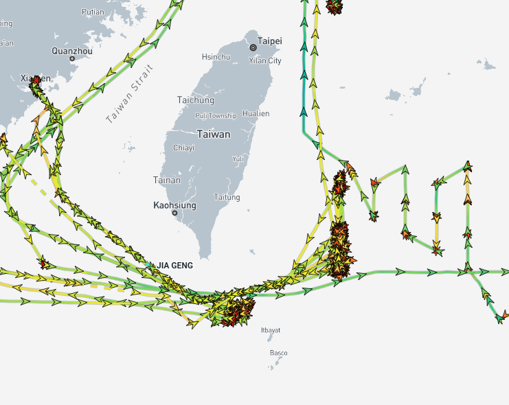
Select People’s Republic of China Survey Activities, May 28 – July 22, 2026 (Source: www.marinetraffic.com, used with permission)
While June and July saw a significant uptick in Chinese survey ship activity around Taiwan, Chinese survey operations were already underway in Taiwan’s exclusive economic zone and other nearby waters. In fact, on the same day the statement was issued, a People’s Republic of China acoustic research ship, the Shiyan 1, was operating about 90 nautical miles southeast of Taiwan’s Orchid Island, which sits only about 25 nautical miles off Taiwan’s southeastern coast. Days before that, from May 2-19, the People’s Republic of China research ship Tongji conducted a circumnavigation of Taiwan. While east of the island, it operated within just 30 nautical miles of Taiwan’s coast. The Taiwan Coast Guard responded by dispatching a cutter to “expel” it. During bridge-to-bridge communications, the captain of the Tongji repudiated Taiwan’s authority over his ship’s activities, declaring “there is no Republic of China, only the People’s Republic of China.” Tongji University, which owns the vessel, released photos of the embarked scientists and their students posing on deck with a People’s Republic of China flag and a Taiwan Coast Guard ship in the background.
Beijing’s Objectives
The People’s Republic of China’s marine scientific research vessels are likely operating in Taiwan’s exclusive economic zone for two reasons. First, these vessels and the civilian scientists aboard them collect information on the seabed and water column, contributing to the PLA’s overall “battlefield preparation” (zhanchang zhunbei). To be sure, China’s research vessels also engage globally and regionally in legitimate marine scientific research activities. For instance, the warm-water Kuroshio current passes through these same waters east of Taiwan and it has long been the subject of basic scientific inquiry by both Chinese and foreign scientists. However, knowledge of the Kuroshio is also vital for undersea warfare, since the current creates temperature gradients that directly affect sound propagation, enabling submarines to evade detection if they effectively exploit the complex acoustical conditions caused by the current. Thus, the military importance of these waters strongly suggests that a key purpose of the surveys is to conduct what the PLA refers to as “military oceanography” (junshi haiyangxue). If the People’s Liberation Army were tasked with attacking Taiwan, this data — and the resulting knowledge about the maritime environment in which the conflict would be fought — would help the Chinese military to “seize the initiative” (zhengduo haishang zhudongquan) on, above, and below the sea.
Aside from analyzing the water column, China’s civilian research ships are also collecting data on the seabed east of Taiwan. It is difficult to know for sure whether these maritime surveys are for military, as opposed to purely civilian, purposes. However, the operational patterns the ships employ, the history of Chinese military surveys throughout the region, the capabilities the research vessels possess, the close connection between China’s research institutions and the military, and the overall political context all point to military surveys in waters that will have a decisive impact in any future conflict over Taiwan’s status.
Accordingly, there is a strong inference to be drawn that in addition to collecting militarily relevant information about the water column, the currents, the seabed, and the acoustical characteristics of these waters, these ships are conducting surveys of any fixed infrastructure in these waters, such as undersea cables, that could be essential to the defense of Taiwan. In the period leading up to or during a conflict, the Chinese military may want to sever the data cables connecting Taiwan to the rest of the world. Knowledge of their precise location would be a necessary precondition for such operations. Civilian research vessels are also well equipped to locate any seabed sensor arrays employed by foreign forces to track Chinese submarines transiting the First Island Chain, a perceived asymmetric advantage enjoyed by China’s enemies and one that would surely be targeted in the event of a conflict. Lastly, exquisite knowledge of the bathymetry of the waters east of Taiwan would be needed if the Chinese navy decides to preposition sea mines in the area, as the writings of Chinese navy experts suggest it intends to do.
A second reason for China’s survey operations involves legal warfare. This is the main driver of Chinese maritime surveys around Taiwan since June, since Beijing believed its sovereign authority over Taiwan was being challenged by cooperation between the Philippines and Japan. Undertaking marine scientific research without requesting permission from or even consulting Taipei is a clear assertion of Beijing’s sovereignty since, according to Beijing, international and domestic law forbids foreign vessels from undertaking any form of research — scientific or military — without the coastal state’s permission. Beijing undertaking surveys in Taiwan’s exclusive economic zone without Taipei’s permission, therefore, is an assertion of Chinese sovereignty over Taiwan. Silence in the face of these operations by countries — including the United States — that have not explicitly accepted China’s sovereignty over Taiwan undermines their position. Since no public objections to Beijing’s actions have been forthcoming, it appears China’s challenge has gone unnoticed.
That does not mean China’s challenge is ineffective. Quite the opposite. Silence amounts to consent. Accordingly, Taiwan should at least publicly object to Beijing’s survey activities to retain any claim to a status separate from the mainland. Beijing has three possible responses, each of which is exploitable by Taipei in a different way. Beijing could claim the surveys are military in nature and exempt from Taipei’s approval — they could acknowledge the surveys are scientific in nature and request appropriate approval in the future — or they could claim the waters are part of the People’s Republic of China and Beijing needs no approval from Taipei. Most likely, Beijing will respond that these are Chinese waters in which the law allows Chinese vessels to conduct any survey activities as a legal right. But that response, tied to a public condemnation from Taipei, works to China’s detriment.
To an international audience, such statements are an explicit admission of Beijing’s legal and operational noose tightening around Taiwan. They put the rest of the world on notice that unless more stringent deterrence policies are put in place, Taiwan will fall into Beijing’s control like ripe fruit from a tree and challenge the policies of those states that have not acknowledged Taiwan as part of China. Furthermore, although Taipei’s objections will fall on deaf ears in Beijing, failure to object leaves the impression that the people of Taiwan either do not truly value their separate status or are unwilling to do even small things to preserve it. Objecting demonstrates that the Taiwanese people will not meekly succumb to mainland absorption, and it answers those tempted to ask why other states should defend Taiwan’s separate status if even the people on Taiwan will not.
A second aspect of China’s legal warfare may be to subtly put the United States in a bind through the issue of status under international law of marine surveys for military purposes. Beijing’s marine surveys appear to present the United States with a legal dilemma. The United States has long maintained the legal position that military surveys are distinct from the marine scientific research over which Article 56 of the United Nations Convention on the Law of the Sea gives the coastal state exclusive jurisdiction, even though they often gather the same data. The U.S. view is that coastal states have no right to limit or regulate marine surveys for military purposes. This position is based on the distinct purposes of the two surveys: Surveys in support of marine scientific research have economic and commercial value and are properly regulated by the coastal state in its exclusive economic zone, while military surveys, on the other hand, are undertaken for defense and security purposes and are beyond the coastal state’s authority to regulate. It might appear, therefore, that if Taipei were to publicly challenge the lawfulness of Chinese survey operations in Taiwan’s exclusive economic zone, its challenge would undermine the American position. We disagree. At present, the purpose of Beijing’s surveys is unclear. At a minimum, calling out Beijing will clarify the situation. If it ignores Taipei’s objection or claims it is acting in Chinese waters, those states that have not acknowledged Taiwan as part of China can put pressure back on Beijing. Still, if Beijing admits the military purposes of its actions, Taipei could accept Beijing’s right under international law to undertake them and simultaneously condemn its destabilizing and threatening behavior. This, as we have written concerning China’s surveys in the American exclusive economic zone, could dampen Beijing’s appetite for negative attention.
After recognizing that Beijing is playing legal warfare, silence from Taipei and Washington is the worst option. Each party needs to strengthen its capacity to battle on this ground. The actions we propose are just the first step. China is well ahead in this arena, since its leadership has long energized the capacity of its various ministries to pursue its maritime objectives using and misusing law as a tool. As People’s Republic of China scholar Jin Canrong once described Beijing’s maritime dispute strategy, China is “building a camp after each step” (步步为营). China is now almost certainly “encamped” in the waters around Taiwan. The marine surveys around Taiwan are a subtle but effective example of Beijing’s legal warfare strategy to bring the island under its control and to eliminate as much international resistance as possible. The perpetuation of a separate government on Taiwan remains a thorn in the side of China’s Communist Party, one that Xi Jinping has repeatedly warned cannot wait forever to be removed. The leaders of the People’s Republic of China have struggled since the Chinese Communist Party took control of the mainland in 1949 to extend their control to Taiwan. Beijing’s survey vessels are the latest lawfare salvo in that struggle.
Lessons for All
To respond more effectively to these provocations, only international pressure will move the needle of Beijing’s calculations. Together, Taiwan and its partners should engage in their own version of legal warfare. First, since People’s Republic of China sources describe Chinese operations as marine scientific research — the classification necessary to buttress the sovereignty narrative — Taiwan should publicly assert jurisdiction over them and state that in the future Beijing should seek Taipei’s prior approval. This should be accompanied by Taipei’s protest and publication of each instance of China’s unauthorized maritime surveys in Taiwan’s exclusive economic zone. Taipei should carefully monitor and record China’s survey operations and share intelligence about them with its security partners. This would give the people in Taiwan important information about the island’s security situation and the leaders of other states the necessary data to put pressure on Beijing. Allies and close partners should offer political support to Taipei when it objects. Words may not change Beijing’s behavior, but at a minimum, they raise global awareness that Beijing’s actions create regional instability in East Asia and threaten the interests of all states that rely on a stable trading system.
Second, although the chances of a return to the status quo ante are slim at best, countries that do not recognize Beijing’s sovereignty over Taiwan Island should reinforce their own policies by expressing concern about this violation of Taipei’s rights. As we have explained, failure to do so amounts to tacit acceptance of Chinese sovereignty. This will require sophisticated policy coordination within governments and between governments. If the chorus of objections to Beijing’s actions swells, Beijing’s path to controlling Taiwan may become more complicated. This is especially true if states begin to put in place a more substantial deterrence posture involving all dimensions of power, the details of which are beyond the scope of this article, but which others have thoughtfully described.
Finally, all states should come to terms with the fact that China’s survey operations east of Taiwan are either a prelude to war or to the slow strangulation of Taiwan’s separate status. China’s fleet of civilian vessels is, in essence, military assets at Beijing’s beck and call, and China increasingly uses its civilian fleet for military purposes, such as containerized missiles and amphibious lift. All states with an interest in peace and stability in East Asia have an interest in deterring China from using its research vessels to engage in military activities such as underwater sabotage, installing or employing fixed undersea sensors, or perhaps prepositioning sea mines. In fact, this applies globally. Beyond East Asia, China’s fleet of research vessels enables Beijing to conduct activities supporting military operations and political objectives anywhere in the world. Unless states recognize and respond to the political, legal, and military impact of their operations, Taiwan’s challenge today may be another country’s tomorrow.
Peter Alan Dutton, PhD, is a senior research scholar in law and senior fellow in the Paul Tsai China Center at Yale Law School.
Ryan D. Martinson is a member of the China Maritime Studies Institute at the U.S. Naval War College.
The views expressed in this article reflect the personal opinions of the authors alone and do not necessarily reflect the official views of the U.S. Department of the Navy, Department of Defense, or any other U.S. government entity.
**Please note, as a matter of house style, War on the Rocks will not use a different name for the U.S. Department of Defense until and unless the name is changed by statute by the U.S. Congress.
Image: Presidential Office Building via Wikimedia Commons















.png)






.jpg)



 English (US) ·
  French (CA) ·
 .jpg)