

.png) 9 months ago
142
9 months ago
142
PROTECT YOUR DNA WITH QUANTUM TECHNOLOGY
Orgo-Life the new way to the future Advertising by AdpathwayClimate talks set to stretch into weekend as countries clash over ending fossil fuel era
Fiona Harvey
It’s well into Friday afternoon in Belem and a contentious and sometimes incandescent Cop30 looks set to go into extra time (or overtime, for the Americans among us). Here are where things stand, according to the incomparable Fiona Harvey:
Climate crisis talks looked set to stretch well into the weekend in Brazil on Friday, with countries still far apart on the crucial issues of phasing out fossil fuels and cutting carbon.
Andre Correa do Lago, president of the talks, urged ministers and high-ranking officials from more than 190 countries to find common ground: “We need to preserve this regime [of the Paris climate agreement] with the spirit of cooperation, not in the spirit of who is going to win or is willing to lose. Because we know if we don’t strengthen this, everybody will lose.”
But on the core issue of a “transition away from fossil fuels”, no agreement looked likely and the conference has split into two large blocks. More than 80 developed and developing countries have called for the conference to begin a process of drawing up a roadmap for the transition, which would allow all governments to pursue their own self-chosen measures and timetable towards the eventual goal.
Even this – derided by some civil society groups as too weak – was unacceptable to a separate group of more than 80 countries, according to Corrêa do Lago. This bloc includes Saudi Arabia, Russia and some other petrostates, as well as some countries dependent on consuming fossil fuels. At their insistence, references to the roadmap were excised from a draft text published early on Friday morning.
Correa do Lago told the Guardian on Friday: “This issue [of a roadmap] has grown in importance. But more than 80 countries have said it is a non-starter. My president has said it is a priority. But we will see, as many countries have clearly said that they do not want this at the moment.”
A new draft text was expected late on Friday night or early on Saturday morning in Brazil, but several people involved in the talks warned it might have only minor “tweaks”. If so, this will bitterly disappoint those calling for stronger language on fossil fuels and the need to limit global temperatures. One developed country told the Guardian: “The Brazilians are only listening to the Arab Group.”
Key events Show key events only Please turn on JavaScript to use this feature
Fiona Harvey
Africa is still pushing for a tripling of the finance available from rich countries to help the poor world adapt to the impacts of the climate crisis. “We already compromised a lot,” said Richard Muyungi, Tanzania’s presidential envoy and current chair of the African Group of Nations. “But we cannot compromise on the means of implementation, the tripling of adaptation finance.”
He said developed countries demanded the group’s support for a roadmap to “transition away from fossil fuels” as the price of any support for an increase in adaptation finance.
Muyungi argued: “The phase-out of fossil fuels is not an African issue. We emit only 4% of total global emissions, and we have never discussed a phase-out. We have been discussing a phase down.”
He asked: “Why are we being held to ransom? It’s like you are trading our lives with something we never caused. So they were saying, ‘If you do not accept phase out, we cannot give you the triple of adaptation.’ We said, ‘We cannot accept that.’”
He said the group had been put under pressure to accept the removal of language calling for an increase in adaptation finance from the draft text of an outcome. But he replied: “Adaptation is a just request for the continent, and has nothing to do with the discussions on phasing out.”
This would require about $120bn a year in finance for adaptation. Developing countries can gain access to finance from the private sector for the technology they need to cut greenhouse gases and shift to a low-carbon economy, such as wind and solar power. But getting the private sector to invest in adaptation projects – such as defences against flooding, or changing the crops that farmers grow – is almost impossible.
Developing countries want more of the finance for adaptation to be delivered in the form of grants, not loans. However, developed countries have insisted on arduous “indicators” showing how the money is spent, which has been another bone of contention at these talks.
On the transition away from fossil fuels, Muyungi previously told the Guardian that Africa should be allowed to exploit its fossil fuel reserves, as rich countries had exploited theirs. Tanzania has large gas reserves, which it is planning to exploit in partnership with Saudi Arabia.

Damian Carrington
“Cop30 still has a choice – to protect people and life or the fossil fuel industry.” That was the message delivered directly to President Lula by eminent climate scientists here at Cop30 in Belém, led by Prof Johan Rockström, from the Potsdam Institute for Climate Impact Research in Germany. The scientists laid out the simple scientific reality.
“The global curve of greenhouse gas emissions needs to bend next year, 2026, not sometime in the future,” they told him. “We need to start, now, to reduce CO2 emissions from fossil-fuels, by at least 5% per year. This must happen in order to have a chance to avoid unmanageable and extremely costly climate impacts affecting all people in the world.”
To phase out fossil fuels quickly, the scientists said finance from rich countries to developing countries was imperative: “Without scaling and reforming climate finance, developing countries cannot plan, cannot invest and cannot deliver the transitions needed for a shared survival.”
“The global carbon budget, calculated by science, forms the backbone to guide the pace of emission reductions [needed],” the scientists said. “The remaining carbon budget [for 1.5C] is now essentially consumed, down to 130 billion tons of CO2, equivalent to 3-4 years of global emissions at current rate.
“This scientific budget provides the basis for all serious climate policy. It is our accounting tool away from danger. Removing the carbon budget from the text, means removing reality from the Cop.”
Damian Carrington
Our Kids’ Climate, a campaign group of parents, released a short film on Friday of the Global Climate March on the streets of Belém - it captures the colour and energy of the march.
Their message to the countries negotiating at Cop30 is simple: “Parents are watching. Our kids deserve a fighting chance of a safe, thriving future. Look at the energy and passion on the streets of Belém. We need a fair, fast shift from fossil fuels to clean, renewable energy to protect what we love: our kids and our planet.”
Arab countries reject fossil fuel phase out as EU warns of Cop deal collapse
Jonathan Watts
The Arab group of nations at COP30 has insisted its energy industry is off limits and any mention of the subject would lead to a collapse of the climate talks, according to NGO observers.
The European Union has meanwhile warned that Cop30 could finish without any deal because the countries are so far apart.
At a “multirao” meeting of delegates that aims to close the gulf in positions, the bloc of 22 middle-eastern oil-producing countries reportedly said it would not accept any language relating to roadmaps for a fossil fuels transition.
It gained the support of the African group (AGN), which said it represented 54 countries, the observers said. The Africa group opposed any attempt to put conditions (reducing fossil fuels) on implementation (adaptation funding).
The claims by the AGN to speak for all of Africa were disputed by other countries which pointed out that several African nations had expressed public support for a phaseout roadmap, and insiders claimed that several others were also on board but not yet saying so publicly.
The current chair of the AGN group is Tanzania, which has significant gas reserves that it is seeking to exploit with partners including Saudi Arabia. “It is clearly untrue to claim they speak for all of Africa,” said one person involved in the talks.
A contrary view was put forward by the European Union, which warned there was a clear risk that COP30 would not reach an agreement, according to NGO observers. The EU was also critical of the negotiating process, saying that it now doubted the Brazilian host’s promise that this would be “the Cop of truth.”
The European Union’s commissioner for climate, Wopke Hoekstra reportedly expressed dismay at the current text saying there was no science, no mention of a transition for fossil fuels, no global stocktake. Instead, he complained there was only weakness and a clear breach of last year’s agreement on climate finance goals. He told the session that there were no circumstances under which the EU would accept what was on the table.
He is said to have proposed new language to recognise the need for annual follow-ups of each government’s climate plans, known as NDCs (nationally determined contributions) and emphasised the need to keep the 1.5C warming target alive in practice and implementation.
The top priority, he reportedly said, was to transition away from fossil fuels - and if countries delivered on mitigation together then they could ask the EU to move out of its comfort zone on adaptation financing.
The Latin America group is said to have joined Europe in saying the current package of texts was unacceptable, criticising its lack of ambition, failure to respond to the UN’s top climate science body and lack of linkages between climate and nature.
The least developed countries and small island states, which are most threatened by the climate crisis, demanded language to keep the target of 1.5C alive.
The Coalition of Rainforest Nations said reducing deforestation had been relegated to a preamble in the text, even though it was essential for the 1.5C target, according to observers from the Rainforest Foundation Norway.
The UK said the package was not ambitious enough and re-iterated the EU stance that there could be more flexibility on finance if countries were more ambitious on limiting warming emissions.
The Brazilian presidency was then said to have indicated that a roadmap to transition away from fossil fuels was off the table. Although Colombia said more than 80 countries supported the idea, Saudi Arabia had said this issue was a red flag. The president therefore suggested it was impossible to have a debate on something that cannot get consensus.
The hosts then reportedly suggested countries formed huddles to debate contentious issues, to which Russia was opposed, while Saudi Arabia said it would not huddle on any roadmaps.
It looks set to be a long and bruising night.
Additional reporting by Fiona Harvey
Nina Lakhani
Finance needed to unlock climate adaptation is missing
Billions of people are already facing drought, food insecurity, floods, extreme heat and sea level rise, so adaptation is key to tackling global heating especially for developing countries facing the brunt of climate impacts but which have the least resources to adapt.
The global goal on adaptation (GGA) was first proposed by the African Group of Negotiators in 2013, and adopted under article 7 of the Paris agreement with the aim of “enhancing [the world’s] adaptive capacity, strengthening resilience and reducing vulnerability to climate change.”
GGA was meant to drive political action and finance for adaptation on the same scale as mitigation, but largely languished until Cop26 in Glasgow, when a working group was established. Finally, two years later at Cop28 in Dubai, a strong framework was agreed that includes broad themes such as water, health, agriculture, cultural heritage and public infrastructure, as well as more specific goals on impact based forecasting systems and hazard warning.
Since then, states have been focused on coming up with quantified, measurable adaptation targets as well as measures to mobilize finance, technology and capacity building - known collectively as the means of implementation - all of which are critical to driving adaptation and key to common but differentiated responsibility (CBDR) that oblige wealthy polluting nations to help developing nations who have contributed least to this mess.
The draft text on the GGA has a list of detailed indicators to measure progress on the adaptation targets, and which seem to include some, but not all, of the demands from developing and developed countries. For example it states:
-
Emphasizes that the Belém Adaptation Indicators are voluntary, non-prescriptive, non-punitive, facilitative, global in nature, respectful of national sovereignty and national circumstances and country-driven, and that the indicators should not create additional reporting burdens, particularly for developing country Parties, are not intended to serve as a basis for comparison among Parties, shall not become a barrier and shall not be used under any circumstances as a condition for developing country Parties to access funding under the Convention and the Paris Agreement
-
Also emphasizes that the Belém Adaptation Indicators do not create new financial obligations or commitments, nor liability and compensation
But, as Mohamed Adow from Powershift Africa likes to say, no matter how much you measure a cow, the cow won’t get bigger if you don’t feed it. “If you have a mechanism to weigh and scale the cow, you must also have a mechanism to fatten the cow through the provision of more finance.”
In addition to developing countries pushing for a separate adaptation fund (which is being negotiated as part of the main mutirao decision), they have been united on linking during each GGA indicator to means of implementation - in order to help track the finance gap that they simply cannot fill without the international cooperation required under international law, according to the Paris agreement and the ICJ ruling.
This is currently missing from the draft text, in a big win for developed countries.
Observers say that it’s this same roadblock around means of implementation that has paralysed progress on national adaptation plans, as developed countries steadfastly refuse to budge on providing fair finance, technology and capacity building needed for states to adapt their food, water, infrastructure and health systems.
“Finace is what unlocks progress. It’s the catalyst to adaptation - and all climate action, so if you don’t have the catalyst you won’t see progress,” Meena Raman from Third World Network said. “Without a clear link to means of implementation in the GGA, the developed countries must reciprocate this compromise with an ambitious, fair new adaptation finance goal.”
By 2035, developing countries will collectively need at least $310bn in adaptation finance per year in 2035. Yet international public adaptation finance to developing countries was $26 bn in 2023, down from $28 bn the previous year. The pact to double adaptation finance by 2025 made at Cop26 in Glasgow has not been met. The call from developing countries to triple that doubling is still under negotiation in Belem. And the draft text on the GGA, point 34, has been left empty for when this drops.
Damian Carrington
At Cops, both the countries and the campaign groups have their agendas which they are understandably fighting for. Finding neutral voices is more difficult, but some thinktanks come close to this, including E3G.
Alden Meyer, at E3G senior policy advisor says: “We’re in crisis in these talks. We can come out of here with something which is worthy of the call [by leaders at the start of Cop30] for multilateral collaboration and moving the Paris Agreement forward, something that meets the needs of people around the world, or we can come out of here with a very disappointing outcome.”
“The choice is now down to ministers,” he said. “I’d also say it is down to world leaders from the biggest countries meeting now [at a G20 summit] in Johannesburg, South Africa. President Lula is there and we believe he is talking to fellow leaders to try to get some signals back into this process from across the ocean, to try to strengthen the political will in the final hours.”
Alden said the European Union and other developed countries needed to improve their position on providing the promised $1.3tn of climate finance by 2035, and particularly for tripling adaptation funds, used to protect people from climate impacts: “I think that can unlock some trust and momentum from the vulnerable countries.”
In return, he said, “vulnerable countries and the Africa group need to be more willing to entertain reducing emissions and making the just transition to a sustainable energy future”.
Alden said there were multiple groups of countries on both sides threatening to walk away from a deal if they didn’t get what they needed.
Lily Harzmann, also at E3G, said the $1.3tn climate finance currently only has a “passing mention” in the draft text. “That is a disappointing outcome given the widespread recognition of the need for progress on channelling this level of financial resources into developing countries,” she said. “The formulation [on the tripling of adaptation finance] we have in the text at the moment is vague and it’s weak.”
The negotiations continue behind closed doors, with the Brazilian presidency having created “huddles” of nations to thrash out specific issues. A new text is expected later today.
Climate talks set to stretch into weekend as countries clash over ending fossil fuel era
Fiona Harvey
It’s well into Friday afternoon in Belem and a contentious and sometimes incandescent Cop30 looks set to go into extra time (or overtime, for the Americans among us). Here are where things stand, according to the incomparable Fiona Harvey:
Climate crisis talks looked set to stretch well into the weekend in Brazil on Friday, with countries still far apart on the crucial issues of phasing out fossil fuels and cutting carbon.
Andre Correa do Lago, president of the talks, urged ministers and high-ranking officials from more than 190 countries to find common ground: “We need to preserve this regime [of the Paris climate agreement] with the spirit of cooperation, not in the spirit of who is going to win or is willing to lose. Because we know if we don’t strengthen this, everybody will lose.”
But on the core issue of a “transition away from fossil fuels”, no agreement looked likely and the conference has split into two large blocks. More than 80 developed and developing countries have called for the conference to begin a process of drawing up a roadmap for the transition, which would allow all governments to pursue their own self-chosen measures and timetable towards the eventual goal.
Even this – derided by some civil society groups as too weak – was unacceptable to a separate group of more than 80 countries, according to Corrêa do Lago. This bloc includes Saudi Arabia, Russia and some other petrostates, as well as some countries dependent on consuming fossil fuels. At their insistence, references to the roadmap were excised from a draft text published early on Friday morning.
Correa do Lago told the Guardian on Friday: “This issue [of a roadmap] has grown in importance. But more than 80 countries have said it is a non-starter. My president has said it is a priority. But we will see, as many countries have clearly said that they do not want this at the moment.”
A new draft text was expected late on Friday night or early on Saturday morning in Brazil, but several people involved in the talks warned it might have only minor “tweaks”. If so, this will bitterly disappoint those calling for stronger language on fossil fuels and the need to limit global temperatures. One developed country told the Guardian: “The Brazilians are only listening to the Arab Group.”

Damien Gayle
People of African descent have been specifically mentioned in a UNFCCC Cop text for the first time, but critics have called the mentions “perfunctory and secondary” and called for greater recognition.
The Global Afrodescendant Climate Justice Collaborative (GACJC) said in a statement that afro-descendant people were referenced across multiple strands of negotiations.
This breakthrough reflects years of Afro-descendants organising across the world. It opens the door for meaningful participation, data inclusion, and climate justice for our communities.
The mention comes after a concerted campaign for the mention of Afro-descendant peoples as a group that faces specific challenges related to climate breakdown. There had been a push to get afro-descendants mentioned in at least four operational areas, including gender, finance, just transition and adaptation.
According to the UN Working Group of Experts on People of African Descent, Afro-descendant populations represent approximately 200 million people worldwide, including descendants of the victims of the transatlantic slave trade forcibly displaced into the diaspora across the Americas and the Caribbean.
Brazil, home to the biggest Afro-descendant population outside Africa, had backed the mention of Afro-descendants in the texts. But there had been pushback from the European Union, the UK, and Australia, which reportedly opposed the inclusion of references to Afro-descendant populations in summit’s Gender Action Plan.
The texts are not finalised, and campaigners say that unresolved issues could still “torpedo the whole thing”. “Nonetheless we are calling it a win to have people of African descent in the draft decisions,” said Mariama Williams of the GACJC.
But some campaigners said the outcome fell far short of what had been hoped for at Cop30. Anthony Karefa Rogers-Wright, with the US based Black Alliance for Peace, said:
We came down here with specific demands and goals, so it’s the equivalent of going to expect to eat a full meal and only being given appetisers. There is the word ‘Afro-descendant’ in a few sentences, keeping in mind that none of these documents are legally binding, whereas the demand was to be installed as a full standalone constituency in the UNFCCC framework.
This is an attempt to curtail and assuage concerns with some very perfunctory and secondary prizes instead of the grand prize – it’s a continuation of the myriad ways the UN and far too many governments continue to dehumanise specific Afro Descendant challenges while perambulating our material conditions altogether.
While I respect the decision of some Afro Descendant groups to claim a few tawdry mentions as a “win” I would also remind them what the great Amilcar Cabral once noted, “tell no lies and claim no easy victories.”
Until we demand our whole damn dollar, we’re going to keep leaving these COP conferences with chump change.
It’s the final (scheduled) day of Cop30 and like the final days of previous climate summits there is mix of hope, frustration and deep exhaustion among the thousands of delegates.
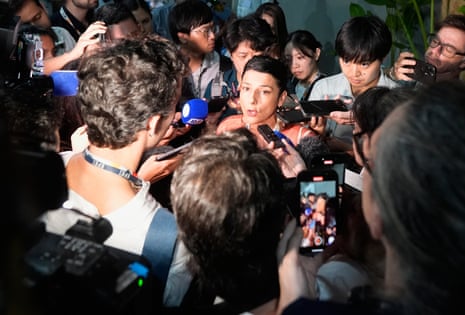
Climate activists have made their presence felt and leading figures such as Irene Velez Torres, Colombia’s environment minister who has led a charge for a fossil fuel phase out in Belem, are in high demand.
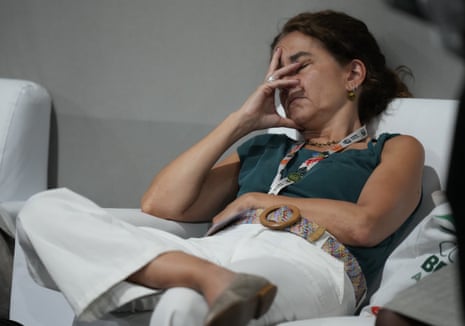
For others the overriding feeling is one of fatigue after a two-week gathering that is winding towards an as-yet indeterminate, and potentially unsatisfying, ending.
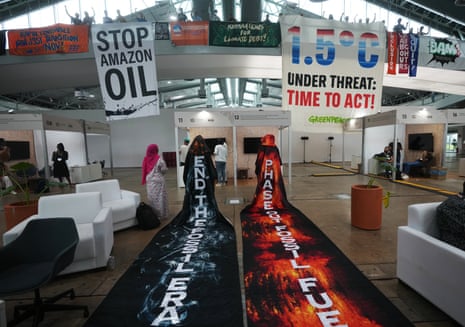
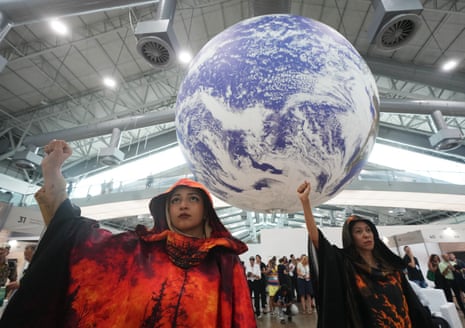
Activists hang banners while participating in a demonstration at the Cop30 UN Climate Summit, Friday, Nov. 21, 2025, in Belem, Brazil. (AP Photo/Andre Penner) Photograph: André Penner/AP
Fresh from his whirlwind visit to Cop30, António Guterres has arrived in South Africa for the G20 gathering.
In remarks to the media in Johannesburg, the UN secretary-general didn’t mention the contentious issue of a fossil fuel phase out, instead reiterating his call for wealthy countries to step up financially for those worst affected by the climate crisis. He said:
The ongoing COP30 meeting demonstrates how much work needs to be done.
Countries have failed to keep temperatures to the 1.5C temperature rise limit. Science tells us that a temporary overshoot above this limit is now inevitable.
We must make this overshoot as small, short and safe as possible. Avoiding more climate chaos means bridging the adaptation gap – urgently. That requires a massive scale up of financing.
While countries remain deadlocked in Belem on the crucial issue of phasing out fossil fuels, advocates from the UK have been cheered by other aspects of the draft text. ‘Fossil fuels’ may not be there but ‘just transition’ is, as my colleague Damien Gayle explains:
Asad Rehman, chief executive of Friends of the Earth, has described the inclusion of working in the Cop30 text of a “just transition mechanism” as “northing short of momentous”.
In a rare upbeat moment for civil society organisations at the UN climate talks, several have now come forward to praise the inclusion of reference to the just transition, which comes after years of campaigning.
Rehman said:
It’s nothing short of momentous that a mechanism for a fair and just transition has made it into the draft text. This injects some hope that this process can deliver concrete outcomes and that we can secure a transition to a greener future that is fair, just as well as clean.
This victory comes after tens of thousands of our supporters in the UK stood alongside a global movement representing workers, climate justice campaigners and youth organisations who not only got it on the table, but were instrumental in making sure it stayed in the text. This reaffirms what we’ve always known: people power is the answer. By harnessing our collective strength we have changed the conversation at these talks.
As Damien notes, ‘just transition’ does indeed feature in the draft text, although it appears within a list of noted advances, such as loss and damage, that have occurred in recent years. It doesn’t mention the mechanism that many have been pushing for in Belem, which means any jubilation on this could be slightly premature.
Thank you to my colleague Matthew Taylor for his sterling work helming the blog thus far.
I’m Oliver Milman in New York and I will be taking on the blog for the latter stages of what is scheduled to be the final day of a Cop30 summit that has brought floods, fire and now (metaphorically at least) quagmire. We will see how things unfold from here.
Damian Carrington
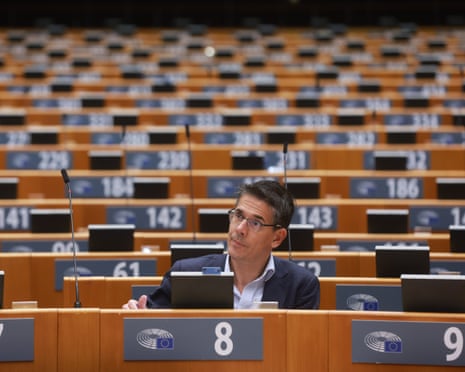
But Bas Eickhout MEP, member of the European Parliament’s delegation to COP30, has a less optimistic take.
With this text as it stands, no deal is better than a bad deal. Failure to reach an agreement on a roadmap to transition away from fossil fuels would not only be a big win for petrostates, but also for Trump and his hard right allies.
We will continue to push for a strong agreement that includes the phase out of fossil fuels and tripling ambition on climate adaptation. No one can seriously expect us to win the fight on the climate crisis if we don’t deal with the elephant in the room: phasing out fossil fuels.
Damian Carrington
The key draft text issued by the Brazilian presidency has infuriated many nations - Prof Michael Jacobs, a political economist, argues it is a tactic.
The text does not include either a roadmap to transitioning away from fossil fuels” wanted by a large group of developed and developing countries, nor a commitment to a tripling of adaptation finance - money from rich nations to protect poorer communities from climate impacts.
Writing on LinkedIn he says: “By issuing a text that leans so far to one side - in this case, towards the Arab Group and Like-Minded Group (China, India and some other developing countries) - the presidency is seeking to provoke a public row in the plenary session. This will tell the Arab Group and LMDCs that they have to compromise. Brazil will then be able to pressure them to accept a text more acceptable to the Least Developed Countries group, Latins, islands and developed countries.”





.png)




.jpg)


 English (US) ·
  French (CA) ·