

 4 months ago
36
4 months ago
36

Statins have been bedrock in lipid lowering therapy for decades but have come with adverse effects that are subject to exaggeration and discontinuation. Many have asked, is there a new class of drugs that will someday replace statins? This post signifies a breakthrough.
The CORALreef Lipids trial was a large, phase 3, multinational, randomized, double‑blind, placebo‑controlled study evaluating the efficacy and safety of enlicitide decanoate (Merck), a first‑in‑class oral proprotein convertase subtilisin–kexin type 9 (PCSK9) inhibitor, for lowering low‑density lipoprotein cholesterol (LDL‑C). The trial addressed an important unmet need: despite strong evidence that intensive LDL‑C lowering reduces cardiovascular risk, many high‑risk patients fail to achieve guideline‑recommended LDL‑C targets, in part because currently available PCSK9 inhibitors require injection every two weeks and are commonly rejected for insurance coverage. An effective oral PCSK9 inhibitor could substantially improve uptake and long‑term adherence.
CORALreef Lipids enrolled 2,909 adults across 168 sites in 14 countries. Participants either had a prior major atherosclerotic cardiovascular disease (ASCVD) event or were at intermediate to high risk for a first ASCVD event. Entry criteria required LDL‑C ≥55 mg/dL in those with established ASCVD or ≥70 mg/dL in those at elevated primary‑prevention risk.
Importantly, participants were required to be on stable background lipid‑lowering therapy before randomization. At baseline, 96.6% of participants were receiving a statin, and 95.4% were on moderate‑ or high‑intensity statin therapy, reflecting contemporary guideline‑directed care. Approximately 26% were also receiving ezetimibe or hybutimibe, highlighting that this was a population with residual hypercholesterolemia despite optimized standard therapy. Only a small minority were statin‑intolerant.
Participants were randomized in a 2:1 ratio to receive enlicitide 20 mg orally once daily or placebo for 52 weeks. Randomization was stratified by renal function, baseline statin use, and geographic region. The primary endpoint was the mean percent change in LDL‑C from baseline to week 24, with key secondary endpoints including LDL‑C change at week 52 and changes in non‑HDL cholesterol, apolipoprotein B (apoB), and lipoprotein(a).
.
.
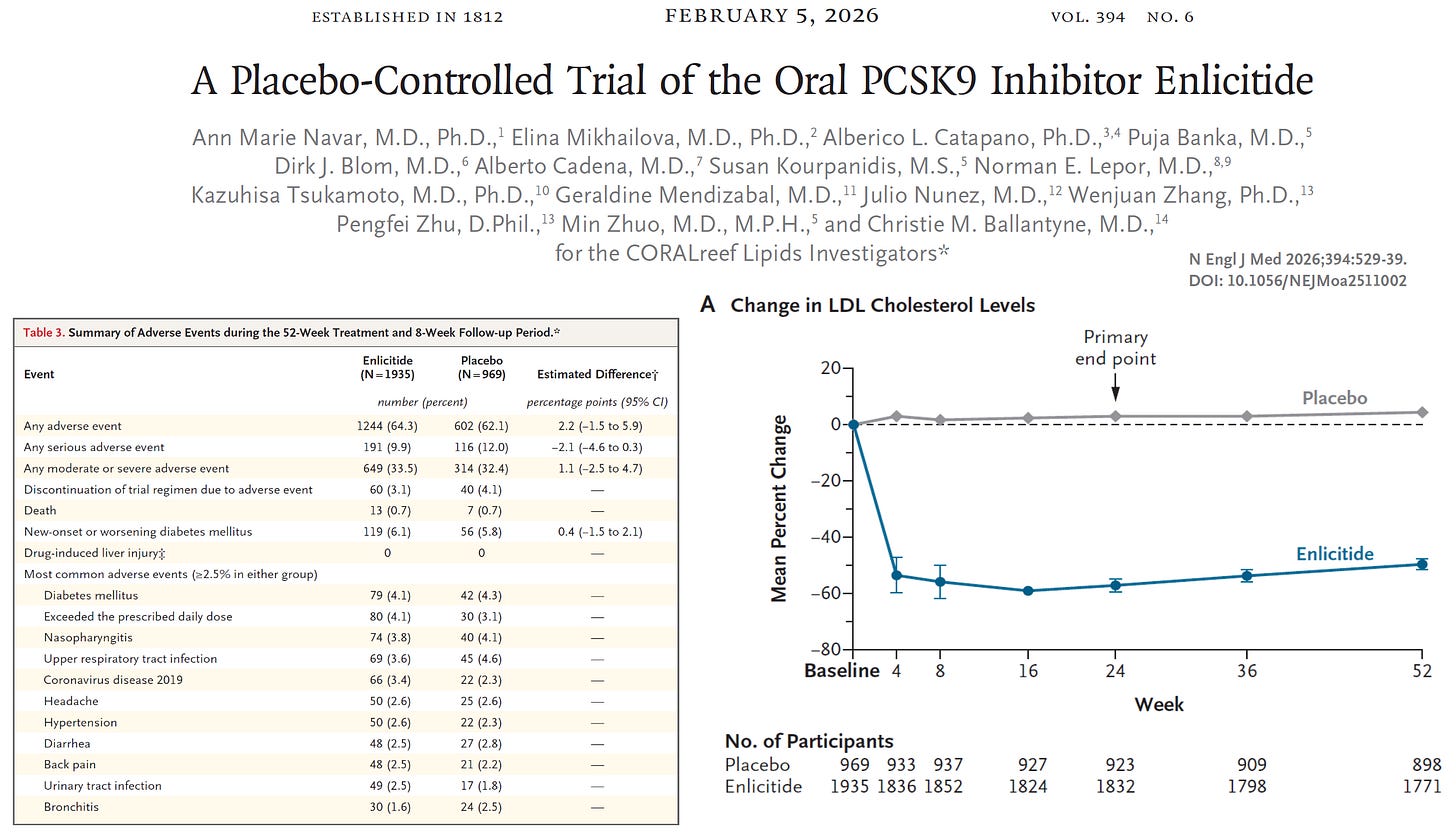
Enlicitide produced robust and clinically meaningful reductions in LDL‑C on top of background statin therapy. At baseline, mean LDL‑C was approximately 96 mg/dL. By week 24, LDL‑C fell to ~39 mg/dL in the enlicitide group, compared with ~99 mg/dL in the placebo group.
The mean percent reduction in LDL‑C at week 24 was −57.1% with enlicitide versus a 3.0% increase with placebo, yielding an adjusted between‑group difference of −55.8 percentage points (P < 0.001). LDL‑C lowering remained durable through 52 weeks, with a −47.6 percentage‑point placebo‑adjusted reduction at one year. A post‑hoc analysis using revised handling of beta‑quantification values showed even larger reductions, approaching −60 percentage points.
These effects are comparable to injectable monoclonal antibody PCSK9 inhibitorsand exceed those typically observed with other oral nonstatin therapies such as ezetimibe or bempedoic acid. Enlicitide also significantly reduced non‑HDL cholesterol (−53%), apoB (−50%), and lipoprotein(a) (−28%), supporting a broad favorable impact on atherogenic lipoproteins.
Clinically relevant LDL‑C targets were achieved by a large proportion of patients. At week 24, 70% of enlicitide‑treated participants achieved LDL‑C <70 mg/dL with ≥50% reduction, and 67.5% achieved LDL‑C <55 mg/dL with ≥50% reduction, compared with approximately 1–2% in the placebo group. These results are notable given that nearly all participants were already receiving statins, often at high intensity.
Enlicitide demonstrated a favorable safety profile over 52 weeks of treatment. The overall incidence of adverse events, serious adverse events, treatment discontinuation due to adverse events, and death did not differ meaningfully between enlicitide and placebo.
Prespecified safety concerns were carefully evaluated. There was no excess of new‑onset or worsening diabetes mellitus, and no cases of drug‑induced liver injurywere observed. Rates of common adverse events such as nasopharyngitis, headache, diarrhea, and upper respiratory tract infection were similar between groups and generally mild. Importantly, adherence to the oral regimen exceeded 97%, underscoring the practicality of once‑daily oral administration.
The CORALreef Lipids trial establishes enlicitide as a potent oral LDL‑C–lowering therapy that delivers PCSK9‑level efficacy when added to statins, without major safety concerns. Given that underuse of expensive, insurance-rejected injectable PCSK9 inhibitors remains a major barrier to optimal lipid control, enlicitide has the potential to transform lipid‑lowering practice by offering a highly effective oral alternative. Whether these substantial LDL‑C reductions translate into fewer cardiovascular events is being tested in the ongoing CORALreef Outcomes trial.
*
Click the share button below to email/forward this article. Follow us on Instagram and X and subscribe to our Telegram Channel. Feel free to repost Global Research articles with proper attribution.
Sources
Navar AM, et al. A Placebo‑Controlled Trial of the Oral PCSK9 Inhibitor Enlicitide. N Engl J Med. 2026;394:529‑539. DOI:10.1056/NEJMoa2511002.
Sabatine MS, Giugliano RP, Keech AC, et al. Evolocumab and clinical outcomes in patients with cardiovascular disease. N Engl J Med. 2017;376:1713‑1722.
Schwartz GG, Steg PG, Szarek M, et al. Alirocumab and cardiovascular outcomes after acute coronary syndrome. N Engl J Med. 2018;379:2097‑2107.
Featured image source
Global Research is a reader-funded media. We do not accept any funding from corporations or governments. Help us stay afloat. Click the image below to make a one-time or recurring donation.













.png)






.jpg)



 English (US) ·
  French (CA) ·