

PROTECT YOUR DNA WITH QUANTUM TECHNOLOGY
Orgo-Life the new way to the future Advertising by Adpathway
© J. David Ake/Getty ImagesPresident Donald Trump signed an executive order in March to "take all necessary steps to facilitate the closure of the Department of Education."
Today, the U.S. Department of Education announced that the agency's sunset is in view, releasing detailed plans to collaborate with other federal agencies. Instead of "throwing federal education programs into chaos," as critics of efforts to downsize the federal bureaucracy have claimed, federal officials spelled out a road map for offering services to children from low-income areas and on tribal lands while ultimately downsizing the department.
During the recent government shutdown, families using education savings accounts, public charter schools, and even traditional public schools did not need the U.S. Department of Education. Students attended class in assigned schools, and parents in states such as Arizona, Florida, North Carolina, and more than two dozen others still had access to a variety of public and private education options.
Now, the education agency is partnering with other departments to shrink the federal footprint, consistent with The Heritage Foundation's recommendations and a White House executive order.
Research has found time and again that the Education Department has created additional administrative work for state departments of education and local school districts, and no amount of additional federal taxpayer spending has helped students learn to read or reach proficiency in math. Rather, the federal education bureaucracy has pushed additional paperwork on state departments of education and even local districts, to the tune of hundreds of millions of taxpayer dollars in terms of manhours each year.
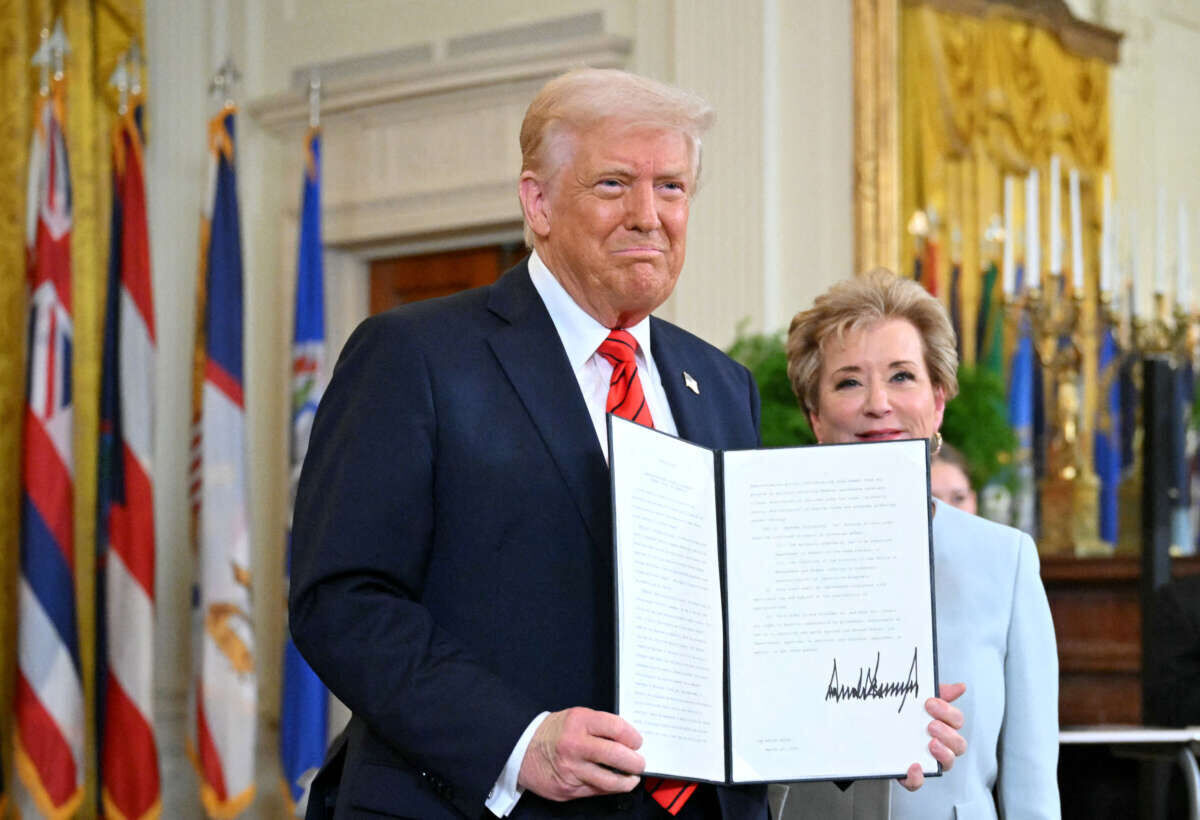
© Mandel Ngan / AFP via Getty ImagesPresident Donald Trump holds an executive order after signing it alongside Secretary of Education Linda McMahon (right) in the East Room of the White House in Washington, D.C., on March 20, 2025.
Earlier this year, Education Department officials entered into an inter-agency agreement with the U.S. Department of Labor to coordinate adult education programs and other workforce-related education initiatives. Now, the Education Department has launched additional agreements with the Labor Department, State Department, Department of Health and Human Services, and Interior Department to manage federal education responsibilities.
Crucially, the largest federal K-12 program, Title I of federal education law, will continue in partnership with the Labor Department. This agreement allows the agencies to align federal job training programs with federal programs for children in low-income areas. And the partnership is evidence that federal policymakers are paying attention to these students' needs even as the agency downsizes.
The Education Department also has plans for another persistently low-performing student group — children living on tribal lands. Native American students, including American Indian and Alaska Native students, score well below their peers on reliable comparisons of core subjects. The agency is partnering with the Department of the Interior for Office of Indian Education programs, as well as Career and Technical Education programs.
The Education Department's announcement noted that this inter-agency agreement will result in tribal authorities only having to talk with representatives from a department — Interior — for education services. Currently, the Interior Department manages Bureau of Indian Education programs, while Education manages the Office of Indian Education.
The new agreement between Education and Interior streamlines the activities. But federal lawmakers should take additional steps and create private learning options for these children as the agencies coordinate existing work.
Education officials are simplifying still more federal operations by moving certain college grant and fellowship programs to the U.S. Department of State. The State Department already maintains the Fulbright Scholarship program, and the new agreement will help manage the Fulbright-Hays grant for foreign education.
Considering the evidence that countries of concern, such as China and others, are using foreign exchange programs to conduct espionage through universities in the U.S., higher education policy has distinct national security elements. State Department officials should work with elected officials to protect Americans when foreign scholarship programs become a liability to national security. The White House has appropriately drawn attention to some of these grant programs already.
The Education Department announcement included still more agreements with Labor and the Department of Health and Human Services. Taken together, the news should encourage state policymakers and local educators who have watched federal services balloon over the department's 45-year history.
These agreements answer the claims from teacher unions and other special interest groups that the White House and Education Department are taking a "wrecking ball" to public schools. The only "system" in need of a shakeup is the federal bureaucracy, a bureaucracy that has resulted in more paperwork, not student success.
Comment: From the NY Post:
A majority of registered voters back closing the Department of Education when they learn key details of how it would work, a shocking poll found.When asked about shuttering the Department of Education and given no other details, 51% oppose that, compared to 38% who support it, according to a survey commissioned by the Yes Every Kid Foundation, a nonprofit that promotes school choice and is supported by the Koch network.
But when presented with key details of ending the department, such as preserving K-12 funding and merging important elements of the department with other agencies, the opposition inverts, with 56% in support and 30% opposed, per the poll.
[...]
"Returning education to the states means rightsizing the federal role in education by removing unnecessary red tape and micromanagement by DC while maintaining critical funding for students with disabilities and low-income schools and continuing to protect students' civil rights."
After being presented with even more details about how eliminating the department would unfold, including a gradual phase-out and protections for students with disabilities, support jumped to 59%, with 30% opposed.
The additional information included stats about how student reading and math scores have declined over recent decades under the Department of Education's watch.
Abolishing the Department of Education, which was first established in 1979, has been a top priority for President Trump during his second term.
However, it would take an act of Congress to fully dissolve the department. Republicans lack the votes in the Senate, where it would need to clear the 60-vote filibuster — something that would require Democratic support.
As a result, Trump, 79, has taken executive action directing McMahon to wind down the department to the "maximum extent appropriate and permitted by law."
Fox News reports on the whiners losing their cushy bureaucratic positions:
Democrats have railed against Trump's plan to dismantle the department, including House Minority Leader Hakeem Jeffries saying in March that Democrats will defeat the president's mission in the halls of Congress and in the courtroom."Shutting down the Department of Education will harm millions of children in our nation's public schools, their families and hardworking teachers. Class sizes will soar, educators will be fired, special education programs will be cut and college will get even more expensive," Jeffries said at the time.
"Congress created the Department of Education and only an act of Congress can eliminate it," he added in the media statement. "We will stop this malignant Republican scheme in the House of Representatives and in the Courts."
The federal government just emerged from the longest shutdown in U.S. history, at 43 days, with McMahon authoring an op-ed claiming the shutdown exposed how "little the Department of Education will be missed."
"The 43-day shutdown, which came smack in the middle of the fall semester, showed every family how unnecessary the federal education bureaucracy is to their children's education. Students kept going to class. Teachers continued to get paid. There were no disruptions in sports seasons or bus routes."
Jonathan Butcher is the Will Skillman fellow in education at The Heritage Foundation and the author of Splintered: Critical Race Theory and the Progressive War on Truth (Post Hill Press/Bombardier Books, 2022). Follow him on X













.png)






.jpg)



 English (US) ·
  French (CA) ·