

PROTECT YOUR DNA WITH QUANTUM TECHNOLOGY
Orgo-Life the new way to the future Advertising by AdpathwayWhat Mehanna’s “Christmas in Palestine” display does is transform a Christian celebration into land claims and grievances about the war between Hamas and Israel;
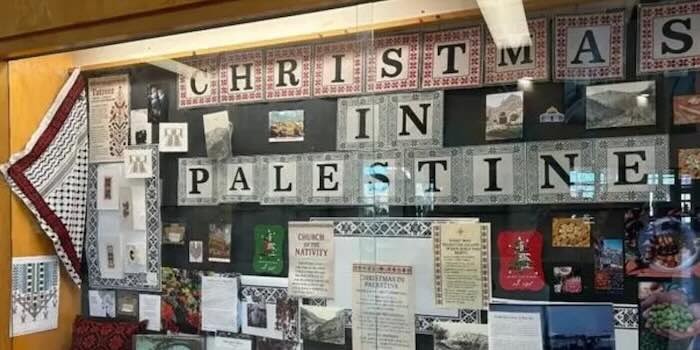
According to an exclusive story by True North’s Melanie Bennet, a teacher at Fletcher’s Meadow Secondary School in Brampton, Ontario, named Fadi Mehanna recently created and posted a hallway display named “Christmas in Palestine” that deliberately and provocatively transformed the birth of Jesus into a fallacious story about the origin of a people now called the Palestinians living in a mythical place called Palestine.
Photos shared with True North show a multi-panel project prepared by this teacher and department head.
What Mehanna’s “Christmas in Palestine” display does is transform a Christian celebration into land claims and grievances about the war between Hamas and Israel.
The panels describe Bethlehem as “a small Palestinian town” and repeatedly label Christmas as a Palestinian cultural event when it is not. Signs read “Christmas in Palestine” and “Bethlehem--Beit Lahm,” presenting the city almost exclusively via a fake modern national and political identity instead of through its well-known Jewish and Christian history.

From a historical perspective, Bethlehem’s origin traces back to ancient Canaanite times (around 14th century BCE), possibly meaning “House of Lahmu” (a deity) or “House of Bread,” due to fertile lands, serving as a strategic stop on trade routes near Jerusalem, and later becoming famous as Jewish King David’s hometown and, crucially, the birthplace of Jesus, solidifying its status as a major Christian pilgrimage site from the 4th century onwards.
- Old Testament: Bethlehem is identified as the home of King David (1 Samuel 16) and the setting for the Book of Ruth, where Ruth and Boaz met, linking to David’s lineage.
- New Testament: Bethlehem is called the birthplace of Jesus (Matthew 2:1, Luke 2:1-7).
In short, Bethlehem was an ancient, tactically located town with a deep history in both Jewish and Christian traditions, evolving from a Canaanite settlement to King David’s home, and ultimately, the world-renowned birthplace of Jesus.
Another section of the exhibit is titled “What was Palestine called when Jesus was born?” The answer given is that Jesus lived in Judea, Galilee, and Samaria, an area that “became known as Palestine.”
This is extremely misleading. Historians date the Roman name “Syria Palaestina”--a label deliberately chosen to extinguish its long Jewish heritage following the forced exile of most of its Hebrew residents--to the second century, long after the time of Jesus. More recently, the 19th and early to mid-20th centuries saw the use of the terms Palestine and Palestinians applied nearly exclusively to the Jewish residents of the region.
Another poster on the display, called “From the River to the Sea,” describes fishing customs and foods “along the coast of Palestine” in cities listing “Haifa, Jaffa, and Gaza” as examples.
In fact, both Haifa and Jaffa are cities in Israel.
According to Bennet, “The display appears to shift the focus away from Christmas as a Christian holiday toward a message about geopolitics. The boards do not explain the Jewish or multi-ethnic history of Bethlehem and the surrounding area, presenting an inaccurate, politically charged narrative instead.”
She also points out that “Mehanna is about to begin a tenure in a regulatory role within the Ontario College of Teachers. He has recently been appointed as a member of the college’s Investigation Committee for a two-year term starting in January.”
The College states that its Investigation Committee “reviews and screens complaints” about teachers, including allegations of professional misconduct, incompetence and incapacity, and decides which cases should proceed to disciplinary hearings.

Surely, this display shows that Mehanna should be charged with both “professional misconduct” and “incompetence,” perhaps rooted in psychological or other “incapacity.”
Jewish advocacy groups have been warning for some time that the College has chronically mishandled issues relating to Israel and Palestine in Ontario schools. A report by sociologist Robert Brym documented 781 antisemitic incidents in Ontario K–12 schools over a 16-month period, with about one in six incidents started by teachers or school-sanctioned activities.
In one widely cited case, a teacher accused of telling a six-year-old Jewish child she was “only half human” kept her job after discipline proceedings.
True North said it contacted the Ontario College of Teachers but did not receive a response.
Still, Fletchers Meadow Secondary School has since removed the display, presumably based on a combination of outcries by students and parents about its repugnant political messages and pressure on and from the overseeing Peel Region School Board.
Officials there told True North that the display “was created to share the Palestinian perspective on Christmas traditions and experiences in Palestine,” and that the intent was to “align with Christian Heritage Month and foster cultural understanding.”
Cultural appropriation of another group’s most important religious holiday only serves to destroy “cultural understanding,” not the least when the Moslem Palestinian perspective on Christmas is simple and straightforward: while Jesus was a Biblical prophet, He was certainly not the Son of God.
As for the Peel Region School Board, its statement argued, “they remain committed to creating learning environments that are inclusive and affirming of all identities,” and that the school’s administration is following a process that includes the use of the board’s guidelines to address the issues raised by community members.
Translation: We decided to surrender to community pressure by forcing the school to remove the display because we recognize that “all identities” don’t include fictitious ones trying to deny those that are authentic.
Recommended by Canada Free Press

View Comments
Support Canada Free Press











.png)




.jpg)



 English (US) ·
  French (CA) ·