

 3 months ago
94
3 months ago
94

The history of humanity is the history of the long and uninterrupted competition between the continental powers and the sea powers.
To read this article in the following languages, click the Translate Website button below the author’s name.
Türkçe, Deutsch, Farsi, Русский, Español, Portugues, عربي, Hebrew, 中文, Français, Italiano, 日本語, 한국어, Српски. And 40 more languages.
The book “Against the Grain: A Deep History of the Earliest States,” written by American anthropologist James C. Scott in 2017, re-evaluates the agricultural revolution and the emergence of the first settled states, one of the most important turning points in human history. In other words, it explains how the state and institutionalization emerged after hunter-gatherer people settled down.
Scott evaluates the role of grain production, which was the turning point of the transition from hunter-gatherer nomadism to settled society, in the development of the first civilizations, especially Mesopotamia, as primarily a tool for the strengthening of authority. Thus, it examines the role of states in the capacity to collect taxes, control the population and establish central authority. Scott claims that grain’s place in food security and trade benefits the state, not the peoples. Contrary to the traditional claim that humans have established a safer, wealthier, and more advanced civilization by switching to agriculture, Scott argues that hunter-gatherer life was healthier and more resilient in many ways.
According to him, grain farming especially facilitated the emergence of states. Because grains such as wheat, barley and rice were measurable, storable and taxable products. Early states relied heavily on grain production to collect taxes, control their workforce, and control the population. As a result, Scott’s thesis was replaced by the practice of a continental state that produces grain. However, the continental state, which draws its power from grain, has been confronted by the sea state, which draws its power from the sea and fish.
Continental and Maritime Struggle
The most important contradiction in history has emerged between the way of life that depends on the land and the way of life that opens to the sea. In other words, the history of humanity is the history of the long and uninterrupted competition between the continental powers and the sea powers. This competition is the history of the relationship between man and environment as well as military or economic. When we look at today’s geopolitical struggle, we see the reflections of the relationship between the continent and the sea or grain and fish. The geopolitical process of human history is often told through the agricultural revolution, the birth of states, and the rise of empires. Land offers a demarcated, measurable and controllable area. Reaching natural borders to facilitate defense on land is the goal. With access to the stream, mountains, hills and seashore, at least one side of the defense is secured. The continental state that reaches the sea faces a new challenge. The sea is the representative of a world that is constantly in motion, whose borders are variable and difficult to control. For this reason, land power produced order, hierarchy and centralism, while sea power produced mobility, trade and interaction with the outside.
The difference between the state order shaped around the granaries of the Sumerians and the trade networks established by the Phoenicians through ports and ships continues today. From global supply chains to seabed energy resources, the roots of current debates ranging from fisheries to maritime jurisdiction areas to the Blue Homeland go back 5,000 years. Therefore, to understand geopolitics, it is necessary to look not only at the borders of states, but also at the economic and geographical conditions that give birth to those states.
Sumerians and the Control of Grain
The first major state organizations in history emerged in Mesopotamia. The Sumerians, who lived their heyday between 3500-2000 BC, not only established city-states (Uruk, your, Lagash, Kish), but also laid the foundations of central administration, bureaucracy and registration systems. At the center of this development was grain. The Sumerians were the first civilization to control grain. According to the late Muazzez İlmiye Çığ, one of the most important Sumerologist raised by Türkiye, the Sumerians are one of the first great civilizations to develop writing, establish city-states and lay the foundations of human history in the fields of law, education, literature and state administration.
.
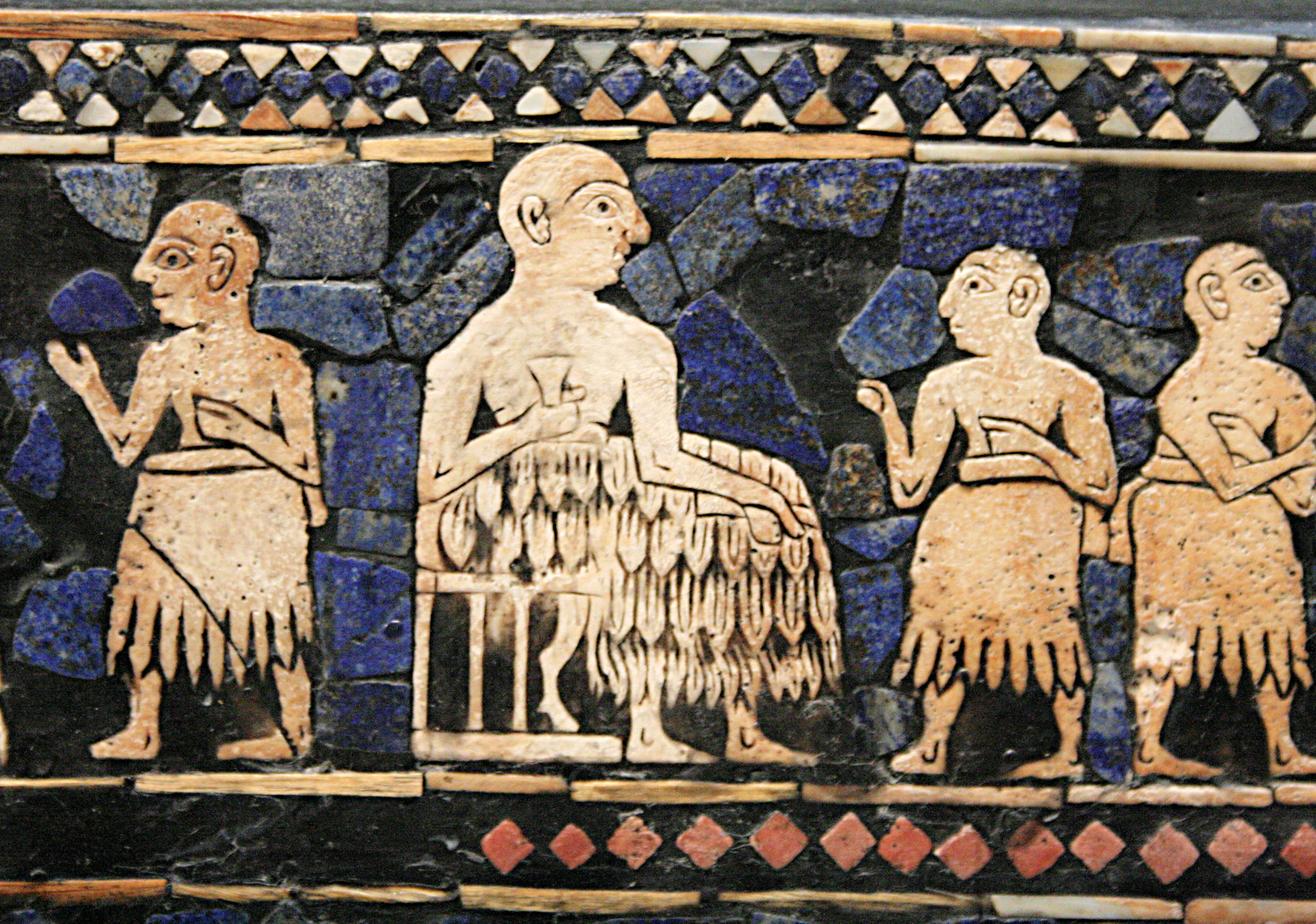
Enthroned Sumerian king of Ur, possibly Ur-Pabilsag, with attendants. Standard of Ur, c. 2600 BC. (CC BY-SA 3.0)
.
As James C. Scott points out in his book, grain is not an ordinary agricultural product. Grain is a measurable, storable, transportable and taxable product. These features are extremely critical for the emergence of states. Because the state can only establish permanent sovereignty over the population it can count and tax. According to him, the production of cereals forced human communities to live in certain regions. Thus, people ceased to be mobile hunter-gatherer groups and turned into settled populations that the state could control. This transformation was not only economic, but also political. For the first time, the state had the opportunity to regularly register people, collect taxes and provide compulsory labor, and establish an army when necessary.
According to Scott, the emergence of writing in the Sumerians was also related to this need. The first examples of cuneiform writing were not developed to write epics or produce philosophy, but to keep track of grain stocks, worker numbers and tax records. Thus, writing had become a bureaucratic tool before it was a cultural tool. Warehouses were the strategic centers of this system. Because grain does not only produce economic value, but also political power. The ruling class, which controls the warehouses, also controls the living resources of the society. Therefore, the Sumerian type state is a control and supervision mechanism that is mainly shaped around grain. In short, power is based on the soil and the resource produced by the soil. The population is fixed, registered, and under the supervision of the central authority.
Mobility of the Sea and the Phoenicians
In contrast to the land order represented by the Sumerians, the Phoenicians developed a different civilization model on the shores of the Levant in the Eastern Mediterranean. The Phoenicians, who came to the fore in maritime, shipbuilding and trade and lived their heyday between 1200-800 BC, established port cities in Tyre, Sidon and Byblos. They made the beginning of the Greek and Latin alphabets. Their strength was not due to the statics and size of the soil, but to the mobility offered by the sea. The Phoenicians did not have large agricultural basins. Food security was dependent on marine resources. In response, they established ports, trading posts, and colonies along the Mediterranean, creating one of the first major maritime trade networks in history.
.

Phoenicians build pontoon bridges for Xerxes I of Persia during the second Persian invasion of Greece in 480 BC (1915 drawing by A. C. Weatherstone). (Public Domain)
.
This network, which stretched from Carthage to the Spanish coast, from Sicily to the Eastern Mediterranean, created a different model of power than land-based states. The historian of antiquity, Herodotus of Bodrum (450 BC), wrote that the best ships in the Persian navy were provided by the Phoenicians, emphasizing their maritime superiority. The famous historian of the Roman Period, Strabo of Ionia (30 BC), who also lived in Amasya, states that the Phoenicians became the rulers of the seas thanks to their colonies that crossed the Mediterranean. The Phoenicians were not only merchants, but also one of the first great seafaring civilizations to transform the sea into a strategic powerhouse.
In the maritime world, power is measured by the density of connections. In this context, it was not important for the Phoenicians to occupy a region. It was essential to direct the trade of that region. On the other hand, although the biggest advantage of the state is mobility, this feature makes dynamic control of the state difficult. The continental state can count, tax and register people. However, it is not possible to control the merchants, sailors and commercial connections that constantly roam the sea to the same extent. Because registration is required for control. Sumerian cuneiform, which the Sumerians found around 3000 BC to control grain and tax, was a complex system for accounting and recording, while the Phoenician alphabet, which emerged 2000 years later, was an alphabet that facilitated rapid communication for trade. From this point of view, it can be said that the Phoenician model is one of the first globalization experiences in history.
Continental and Maritime Balance of Empires
Empires that have managed to become permanent powers throughout history have not relied solely on land or sea power. The secret to their success was that they were able to combine these two forces. Rome is one of the most successful examples of this. The Roman Empire was originally far from the sea. Rome, which created a strong continental (land) state by controlling large agricultural basins, embarked on a tremendous struggle with its neighbor, the seafarer Carthage, the descendants of the Phoenicians, for control of the Western Mediterranean in 264 BC. The Carthaginians sent the first navy of Rome, which they initially dragged into the storm, to the bottom of the sea with thousands of sailors. Rome responded by building a larger navy. This one sank to the bottom of the sea in another storm two years later. Thereupon, Rome sent its third armada, but its fate did not change. Finally, the fourth fleet won the war in 241 BC, because Carthage could not replace the great losses it had suffered. Rome later turned the Mediterranean into Mare Nostrum, “Our Sea”, and connected maritime trade to its own system. Therefore, Rome’s power came neither from the legions nor only from its navy. Its strength stemmed from the fact that it combined granaries and ports in the same strategic system.
A similar situation was valid for the Ottoman Empire in the 15th and 16th centuries. While the fertile agricultural areas of Anatolia, the Balkans and Mesopotamia fed the land power of the Ottomans, the dominance over the İstanbul and Çanakkale Straits, the Black, the Aegean and the Eastern Mediterranean Seas gave the empire sea control. During the rise of the Ottoman Empire, the naval power created by both the Istanbul and the Garp Ocakları (Western School) Navy balanced the enormous land power and made it a power that spread over three continents. After the defeat of Lepanto in 1571, the naval power rapidly shrank, triggering a period of stagnation and then collapse of the empire.
The British Empire represents another form of this synthesis. Despite its limited land resources, Britain established a global system by controlling sea routes. However, this system could only be sustained to the extent that it was connected to the production centers on land. When the First World War dragged on for 2 years longer than expected, all trade networks and flows of the island state were disrupted. This situation upset the financial balances and borrowing accelerated. In the end, the war was won geopolitically, but the economic collapse brought the end of the Pax Britannica.
Therefore, history shows us that unidirectional power models are not long-lasting. Lasting power arises from the ability to manage land and sea together.
Global Roaming Strategies
In today’s world, sovereignty is not just about protecting land borders. The security of maritime transportation lines, the control of energy corridors, the protection of maritime jurisdiction areas and access to global trade networks have also become integral parts of sovereignty. Today, approximately 90 percent of the world economy is transported through maritime trade. Crude oil and LNG, all kinds of bulk cargo, especially grain, container transportation and critical choke points form the backbone of the global system. For this reason, the geopolitics of the modern age is largely shaped around the control of the seas and logistics corridors. China’s Belt and Road Initiative, the United States’ global maritime dominance, Russia’s quest for access to warm seas, and its Indo-Pacific strategies are in fact current versions of the same historical struggle.
Today, the seas have also become the main arteries of data circulation. Most of the global internet traffic is carried over submarine fiber optic cables. For this reason, the seabed is now the domain of information sovereignty. Modern naval power will be measured by its capacity to protect these critical infrastructures as well as warships, merchant fleets and ports. The great powers of the future will be states that can dominate not only the sea surface but also the seabed.
Global Food Security Balance
Today, the importance of naval power is not only about the security of energy transmission lines or trade routes. It is also a key determinant of food security and protein security in particular. Today, when the world population has reached approximately 8.2 billion, according to the Food and Agriculture Organization of the United Nations (FAO), approximately 45 percent of global calorie consumption is provided directly from cereal products. Wheat, rice and corn constitute the basic nutritional backbone of humanity. However, a significant part of this grain is not consumed in the countries where it is produced, but is transported through the oceans and seas and reaches global markets. Approximately 90 percent of grain shipments in world trade are made by sea. Similarly, the fertilizer itself, which is an indispensable part of agriculture, and its raw material is also shipped through the seas. For example, one in three of the world’s fertilizer needs passes through the Strait of Hormuz. As a result of the closure of the Strait of Hormuz after the US and Israel’s attack on Iran, a serious fertilizer deficit and famine are expected in the coming period, especially in Africa.
.

Strait of Hormuz (Public Domain)
.
Similarly, the consumption of fish and aquaculture, which are an important element of global protein security, is increasing rapidly. Today, approximately 3 billion of the world’s population provides at least 20 percent of their daily animal protein needs from the seas.
The interruption of sea routes and denial of fishing areas are therefore not only an economic crisis, but also a direct food and protein crisis. The fluctuation created by the Black Sea Grain Corridor in world markets during the Russia-Ukraine War is the most recent example of this. The merchant marine fleet is therefore not only an economic tool, but also a strategic guarantee of national security, food supply and social stability. Just as the states that protected their granaries survived in the past, the states that can protect their merchant fleets, ports and transportation lines in the seas will be able to maintain their food security and economic independence. In other words, in the 21st century, the security of granaries now depends on the safety of maritime transportation lines rather than land walls.
Continental and Maritime Balance in the Geopolitics of the Future
In world history, continental powers (e.g. Germany, Russia) expanded the state, while maritime powers (Netherlands, England) connected the world. States such as Rome and the Ottomans, on the other hand, were able to stay on the stage of history for a long time by melting these two heritages in the same pot. The situation is no different today. States that rely only on land power are at risk of being excluded from global circulation. Structures that rely only on maritime trade, such as Greece, become fragile without a strong political and economic foundation.
For this reason, the geopolitics of the future will be shaped by states that can bring grain warehouses and ship holds together in the same strategic mind. The struggle that started five thousand years ago between Mesopotamia (Sumer) and the Eastern Mediterranean (Phoenicia) continues to live today in energy lines, maritime jurisdictions, global supply chains and doctrines such as the Blue Homeland. The rulers of the future will not only be those who rule the land or control the seas alone. The real determinant will be the states that can bring together the order of the land power and the mobility of the sea power within the same geopolitical vision. This synthesis will continue to be the basic condition of being a great power in the future, as it has been in the past.
Conclusion
Although Türkiye is surrounded by seas on three sides, it has developed its geopolitical thought largely land-centered for many years. However, most of Türkiye’s foreign trade is carried out by sea, its energy security depends on maritime transportation lines, and its economic welfare is directly affected by activities in the seas. For this reason, the vision for Türkiye in the 21st century is not only to protect maritime jurisdiction areas. It is imperative to develop a holistic strategy in the fields of a strong merchant fleet, advanced port infrastructure, seabed mining, marine technologies, marine sciences, fishing capacity, use of living resources and maritime security. The Blue Homeland is therefore not only a maritime jurisdiction or security doctrine, but also a vision of development and the future that supports Türkiye’s economic independence, food security and strategic sovereignty.
When the Blue Homeland approach is evaluated in this context, it is not just a maritime jurisdiction policy. It is also Türkiye’s attempt to complement its historically land-centered state reflexes with a sea-centered strategic vision. The Blue Homeland approach can also be read as an effort to combine the Sumerian-type continent-based power and the Phoenician-type circulation logic. The productive, regulatory and protective capacity of the state and the mobility offered by the sea are brought together in the same strategic framework.
*
Click the share button below to email/forward this article. Follow us on Instagram and X and subscribe to our Telegram Channel. Feel free to repost Global Research articles with proper attribution.
This article was originally published on Mavi Vatan.
Ret Admiral Cem Gürdeniz, Writer, Geopolitical Expert, Theorist and creator of the Turkish Bluehomeland (Mavi Vatan) doctrine. He served as the Chief of Strategy Department and then the head of Plans and Policy Division in Turkish Naval Forces Headquarters. As his combat duties, he has served as the commander of Amphibious Ships Group and Mine Fleet between 2007 and 2009. He retired in 2012. He established Hamit Naci Blue Homeland Foundation in 2021. He has published numerous books on geopolitics, maritime strategy, maritime history and maritime culture. He is also a honorary member of ATASAM.
He is a Research Associate of the Centre for Research on Globalization (CRG).
Featured image is from the author
Global Research is a reader-funded media. We do not accept any funding from corporations or governments. Help us stay afloat. Click the image below to make a one-time or recurring donation.















.png)






.jpg)



 English (US) ·
  French (CA) ·