

.png) 10 hours ago
7
10 hours ago
7
PROTECT YOUR DNA WITH QUANTUM TECHNOLOGY
Orgo-Life the new way to the future Advertising by AdpathwayHimalayas face severe glacial flood risks in years ahead, UN official warns
The Himalayan region faces severe risks from future glacial floods, an assistant secretary-general at the UN has warned.
The Nepal-Tibet floods have overrun hydropower facilities, knocking out about 10% of Nepal’s power capacity. There are now fears that entire riverbanks where millions of people live might become effectively uninhabitable.
“Technology cannot move fast enough to prevent loss along these massive river systems that catch the overflow of the glacier lakes,” Kanni Wignaraja told the Reuters news agency.
Researchers identified 47 potentially dangerous glacial lakes in Nepal, China and India in 2020 – but the real figure is now thought to be significantly higher.
The population at risk “goes into the millions”, Wignaraja said, citing updated data compiled by the United Nations Development Programme and partner organisations in June.
Last week’s catastrophic flooding was triggered when parts of a glacier near the Langtang Lirung mountain peak collapsed and fell to the valley floor, unleashing a landslide that sent a flood wave down the Trishuli River.
Glacier lake outbursts happen when melting glacier water accumulates behind a natural barrier, with pressure eventually resulting in a break or overflow that sends a flash flood downstream.
Both threats are on the rise, UN officials say, as the climate crisis accelerates glacier melt in the region, loosening rocks and putting more pressure on glacier lake barriers.
Key events 4h ago Closing summary 7h ago Nepal says flood death toll rises to 1,050, with total killed now 1,066 7h ago Himalayas face severe glacial flood risks in years ahead, UN official warns 10h ago Death toll from floods rises to 1,010, with thousands still missing, Nepal's foreign ministry says 11h ago 43,000 women and girls in Nepal need urgent humanitarian assistance, UN warns 12h ago Warning signs visible days before Nepal glacier collapse, report suggests 13h ago Nepal tourism department publishes list of names of missing people 13h ago Death toll from Nepal-China flood disaster exceeds 1,000, authorities say
Closing summary
-
Devastating floods on the China-Nepal border have killed at least 1,050 people in Nepal, the disaster authority said on Tuesday, with nearly 4,000 more missing. Chinese state media earlier confirmed 16 people were killed in Tibet, taking the total toll from Wednesday’s disaster to 1,066.
-
The Himalayan region faces severe risks from future glacial floods, an assistant secretary-general at the UN has warned. The Nepal-Tibet floods have overrun hydropower facilities, knocking out about 10% of Nepal’s power capacity. There are now fears that entire riverbanks where millions of people live might become effectively uninhabitable.
-
Researchers identified 47 potentially dangerous glacial lakes in Nepal, China and India in 2020 – but the real figure is now thought to be significantly higher. The population at risk “goes into the millions”, Wignaraja said, citing updated data compiled by the United Nations Development Programme and partner organisations in June.
-
The disaster has left at least 2.2m tonnes of debris, according to a preliminary estimate by the United Nations Development Programme (UNDP), including parts of buildings, rocks, and sediment. “The amount of debris shows the scale of the destruction and the challenge communities face as they clear homes, roads and public spaces and begin to rebuild,” it said.
-
Among Nepal’s list of the missing are 592 foreigners, including tourists who had come for mountain trekking and Hindu pilgrims seeking spiritual peace at Tibet’s sacred Mount Kailash, from countries such as India, the US, UK, Australia and Canada. Relatives abroad have been requested to undergo DNA profiling at an authorised laboratory and to “send a soft copy of the DNA profile to Nepal police’s official email address”.
-
Nepal last week turned down foreign involvement in general search and rescue but said it needed specialised services and advanced technological support in areas such as life-detecting machines, large refrigerators and prefabricated bridges. Aid worth more than $42m has poured into the country and Nepal is now working with experts from other countries to help with rescue operations.
-
In the capital Kathmandu, crowds lined up to search for their missing relatives, posting photographs on a long wall outside a hospital in the fading hope of finding them alive. Debu Sapkota, a 58-year-old driver, came to post photos of his 83-year-old mother-in-law and her granddaughter who went missing in the town of Trishuli Bazaar after being swept away by last week’s surge.
-
Nepal’s prime minister Balendra Shah said that the disaster highlighted the need for action to combat the climate crisis. “This incident has indicated that the risks we face in the Himalayan region are increasing with climate change,” Shah said in a social media post on Monday night.
-
China’s foreign ministry spokesperson Guo Jiakun said China’s second batch of relief supplies for Nepal was expected to ship today, including drones, DNA testing and water purification equipment. Chinese DNA testing experts will also help Nepal identity bodies, he said. Beijing has said it will continue to “strongly support” Nepal’s disaster relief efforts and safeguard the two countries’ common interests.
-
Three months before last week’s devastating floods, experts from China and Nepal met in Kathmandu, Nepal’s capital, on 27 May to discuss the risk of disasters in the border area and to coordinate on how best to monitor and respond to hazards such as floods, according to the Reuters news agency. The participants called for joint risk-reduction measures, including inventories of glacial lakes and hazard mapping, but two Nepali officials told Reuters they did not receive as much information as they wanted from China on glacier risks and water levels after the meeting.
-
The Red Cross estimates that more than 93,000 people have been affected by the disaster, heightening fears that the climate crisis is destabilising the geology of mountain and polar regions. The Nepali prime minister, Balendra Shah, said the flood was an “unprecedented and devastating natural disaster” and that it was difficult to compile a complete assessment of the damage.
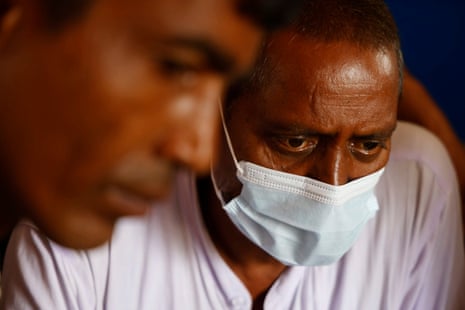
Families check a computer database to identify the bodies of their loved ones following a flash flood at a temporary shelter in Chitwan district, Nepal.
Nearly a week after a catastrophic glacier collapse struck the Nepal-China border, the death toll continues to rise as emergency teams search through heavy mud and submerged hydro tunnels.
With thousands still unaccounted for, including dozens of Australian travellers, international rescue operations are racing against time.
Guardian reporter Cait Kelly speaks to Rafqa Touma from Kathmandu about the devastation on the ground, the search for survivors and what happens next …
The disaster has left at least 2.2m tonnes of debris, according to a preliminary estimate by the United Nations Development Programme (UNDP), including parts of buildings, rocks, and sediment.
“The amount of debris shows the scale of the destruction and the challenge communities face as they clear homes, roads and public spaces and begin to rebuild,” it said.
UK prime minister Andy Burnham pledged to “meet the climate challenge”, as he said Britain was “doing everything” to support Nepal.
In his first appearance as prime minister in the House of Commons, he said: “I know I also speak for the whole House in expressing my profound shock and horror at the devastating scenes on the Nepal-China border.
“My sympathies are with all those affected, including the families and loved ones of those missing in this appalling tragedy. The foreign secretary is doing everything he can to support the Nepalese government and British nationals in the region.
“This is what the climate crisis looks like. We have just ourselves experienced what is likely to have been the hottest summer on record. This government will meet the climate challenge, and I can confirm to the House that I will attend Cop 31 in Turkey in November.”
Nepal says flood death toll rises to 1,050, with total killed now 1,066
Devastating floods on the China-Nepal border have killed at least 1,050 people in Nepal, the disaster authority said on Tuesday, with nearly 4,000 more missing.
Chinese state media earlier confirmed 16 people were killed in Tibet, taking the total toll from Wednesday’s disaster to 1,066.
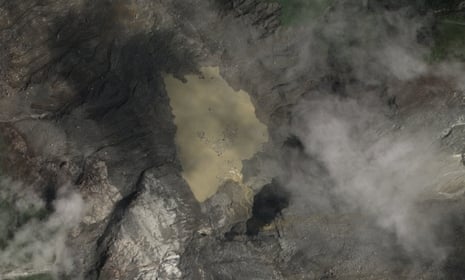
The first slider shows the stark difference in the landscape between 12 August and 27 August – the day after the disaster, caused by a glacial collapse, struck the Tibet-Nepal border.
A second set of images shows the glacier itself before and after the collapse.
Himalayas face severe glacial flood risks in years ahead, UN official warns
The Himalayan region faces severe risks from future glacial floods, an assistant secretary-general at the UN has warned.
The Nepal-Tibet floods have overrun hydropower facilities, knocking out about 10% of Nepal’s power capacity. There are now fears that entire riverbanks where millions of people live might become effectively uninhabitable.
“Technology cannot move fast enough to prevent loss along these massive river systems that catch the overflow of the glacier lakes,” Kanni Wignaraja told the Reuters news agency.
Researchers identified 47 potentially dangerous glacial lakes in Nepal, China and India in 2020 – but the real figure is now thought to be significantly higher.
The population at risk “goes into the millions”, Wignaraja said, citing updated data compiled by the United Nations Development Programme and partner organisations in June.
Last week’s catastrophic flooding was triggered when parts of a glacier near the Langtang Lirung mountain peak collapsed and fell to the valley floor, unleashing a landslide that sent a flood wave down the Trishuli River.
Glacier lake outbursts happen when melting glacier water accumulates behind a natural barrier, with pressure eventually resulting in a break or overflow that sends a flash flood downstream.
Both threats are on the rise, UN officials say, as the climate crisis accelerates glacier melt in the region, loosening rocks and putting more pressure on glacier lake barriers.
In a relief response situation report published today, Nepal’s disaster risk reduction and management authority (NDRRMA) said the majority of deaths – which include recovered human remains – occurred in Chitwan, about 100 miles downstream from the region worst hit by the flash floods and mudslides, followed by Nawalparasi East, Nawalparasi West, Nuwakot and Gorkha. The NDRRMA said 1.6 million people were affected from the floods across five districts.
“3,702 households, comprising a population of 14,461 remain isolated in the two most severely affected local levels (Gosaikunda and Amachhodingmo Rural Municipalities, Rasuwa), with road connectivity, electricity, and communication services disrupted for up to six days since the incident, severely limiting access to essential services, supplies, and emergency assistance,” the situation report read.
It said unidentified bodies are being kept at 21 hospitals across various districts, adding that 2,740 people received medical treatment from Nepal’s army following Wednesday’s massive flash food.
In terms of infrastructural impact, the NDRRMA said 41 bridges were washed away in the floods and four bridges damaged, while four health facilities and eight schools were “fully damaged”. In Nepal’s Nuwakot district, 1,267 houses have been reported as “fully damaged” and 1,253 as “partially damaged”.
As police in Kathmandu buried dozens of bodies in multiple trenches, Nepal’s disaster agency said that 1,003 deaths had been counted there, with 3,916 people missing, including 583 foreign nationals.
The 1,003 figure given here is seven lower than the death toll provided by Nepal’s foreign ministry spokesperson earlier today (see this post).
In its latest update, China reported 16 deaths and 546 missing, including 261 foreigners.
In the capital Kathmandu, crowds lined up to search for their missing relatives, posting photographs on a long wall outside a hospital in the fading hope of finding them alive.
Debu Sapkota, a 58-year-old driver, came to post photos of his 83-year-old mother-in-law and her granddaughter who went missing in the town of Trishuli Bazaar after being swept away by last week’s surge.
A warning alert sounded, but the elderly woman was “too old to run”, he told AP. “Her granddaughter was helping her escape, but both were swept away.”
Sapkota said he no longer has “any hope that they survived”, after witnesses saw them being carried away by the torrent.
“I am here hoping to find their bodies,” he said, holding up photos of the two missing women dressed in traditional clothes.
Here is footage filmed using a drone in the village of Devighat, Nepal, that shows damaged houses and shops, while roads remain covered in thick mud.
Local people have been using heavy machinery to clear the debris-covered streets and rescue efforts are continuing across the country.

Damian Carrington
“No siren can outrun a mountainside collapsing in seconds,” says Prof Anjal Prakash, from Flame University in India. He blames a lack of political will to fight the climate crisis and to plan infrastructure for the devastating flood in Nepal and Tibet.
Prof Prakash said:
Nepal’s mountains have been sending warnings for a decade: thinning glaciers, retreating snowlines, permafrost turning to slush under roads and hydropower plants we kept building anyway. We didn’t lack the science, as researchers have tracked this decline for 50 years. We lacked the political will to act on it.
Early warning systems are being sold as the fix, but no siren can outrun a mountainside collapsing in seconds. The real failure sits upstream, in land-use decisions that pushed settlements and infrastructure onto riverbanks our ancestors deliberately avoided, and in a global economy still burning the fossil fuels that are cooking these glaciers from the inside out.
Every villager who watched that valley disappear paid for emissions decisions made thousands of kilometres away. Until governments treat the Himalayas as a climate frontline rather than a postcard backdrop, Rasuwa won’t be the last name we’re forced to memorise.
Simon Stiell, the UN’s climate chief, said:
For years, scientists and local communities have been warning that the Hindu Kush Himalayas are at huge risk from climate change. We also know a warming climate, driven by humanity burning colossal amounts of coal, oil and gas, is making tragedies like this one, and so many others around the world, much more likely, frequent and severe, with vulnerable communities often hardest hit.
But the solutions to global heating are equally clear – especially a faster global shift from fossil fuels to renewables and more investment in climate resilience.

Cait Kelly
Among Nepal’s list of the missing are 592 foreigners, including tourists who had come for mountain trekking and Hindu pilgrims seeking spiritual peace at Tibet’s sacred Mount Kailash, from countries such as India, the US, UK, Australia and Canada.
Relatives abroad have been requested to undergo DNA profiling at an authorised laboratory and to “send a soft copy of the DNA profile to Nepal police’s official email address”.
In some of Nepal’s flood-affected areas, hundreds of unidentified bodies have already been buried because they are decomposing and there is no room left in hospitals or morgues.
At the police hospital in Kathmandu on Tuesday, more than 100 people were waiting to have their blood sampled.
Among them was Prakaiti Jurnj. Her mother was still missing, but the family had been able to identify her father’s body from a photograph on the wall outside the teaching hospital, where images of the deceased have been posted in an effort to identify the victims.
“Both my father and mother, they were in the village in Nukawot. They were both swept away by the flood,” she said. “We haven’t heard from them since Wednesday. We found my father’s body; my brother saw the photo on the wall.” You can read more here:











.png)





.jpg)



 English (US) ·
  French (CA) ·
