

 3 months ago
105
3 months ago
105
PROTECT YOUR DNA WITH QUANTUM TECHNOLOGY
Orgo-Life the new way to the future Advertising by AdpathwayCategories: Blog; Historic Events, People, and Milestones
Tags: crime history; true crime
By: Jojo Galvan
Jul 21 2026
Jojo Galvan Mora, CHM Digital Humanities Curator, writes about how John Dillinger’s early years influenced the outcome of his life and how his death changed federal investigation and surveillance in the United States.
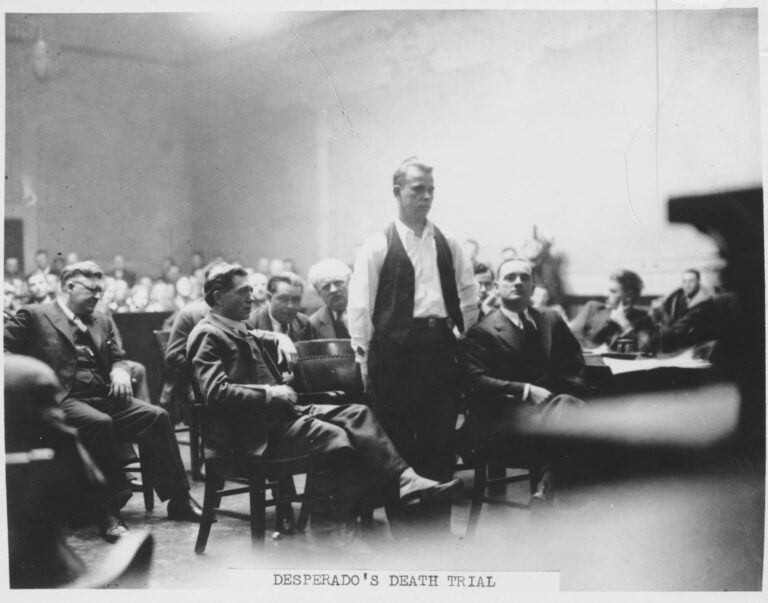
Undated photograph of John Dillinger in a court room titled “Desperado’s Death Trial.” CHM, ICHi-020930
John Herbert Dillinger didn’t get much of a chance to celebrate his 31st birthday on June 22, 1934, thanks to a gift from then FBI director J. Edgar Hoover: the inaugural title of “Public Enemy Number One,” marking Dillinger as the most wanted man by American law enforcement. The title probably brought little surprise. In 1933 alone, Dillinger and his gang carried out a confirmed seven individual bank robberies across the Midwest, looting more than $153,000 (approximately $3.97 million adjusted for inflation in May 2026). While the story of the nation’s first Public Enemy Number One is one that feels lifted from the pages of a fantasy western novel, a closer look into the legacy of John Dillinger, the man, leaves us with a lot to ponder over, not only when it comes to questions over public memory and commemoration, but also around the effectiveness of the criminal justice system.
Dillinger was born on June 22, 1903, in Indianapolis, the second child of John Wilson Dillinger and Mollie Lancaster. Dillinger had a turbulent upbringing. He lost his mother at age four and temporarily relocated to a new residence with his newly married older sister until his father remarried five years later. In school he was regularly disciplined for his poor performance in the classroom and for his streak of fights against his classmates. Despite his father moving the family to rural Mooresville, Indiana, in an effort to tamper his son’s wayward streak, Dillinger continued his trajectory deeper into the criminal underworld thanks in no small part to dropping out of school at 16 to work in a machine shop. His first major brush with the law came in 1922 after stealing a car. This would lead Dillinger to enlist in the US navy, briefly working aboard the USS Utah, before going AWOL, receiving a dishonorable discharge.
After deserting his station, Dillinger found his way back to Indiana and married his first wife, Beryl Hovious, in 1924, but the marriage didn’t last. Dillinger was apprehended after a botched grocery store robbery in September of that same year, which earned him the maximum sentence of 10 to 20 years behind bars. While by no means an outstanding member of society, Dillinger’s time behind bars in Indiana turned an otherwise petty criminal into the infamous outlaw the entire nation would come to know.
In 1929, Dillinger received the devastating news that his wife, Beryl, had filed for divorce. Driven by heartbreak and a growing dissent for what he believed to be a system uninterested in recapacitating inmates, Dillinger used his lengthy sentence to connect with other crime veterans who taught the young upstart everything one could ever know about the art of the of bank robbery. He was paroled in May 1933.
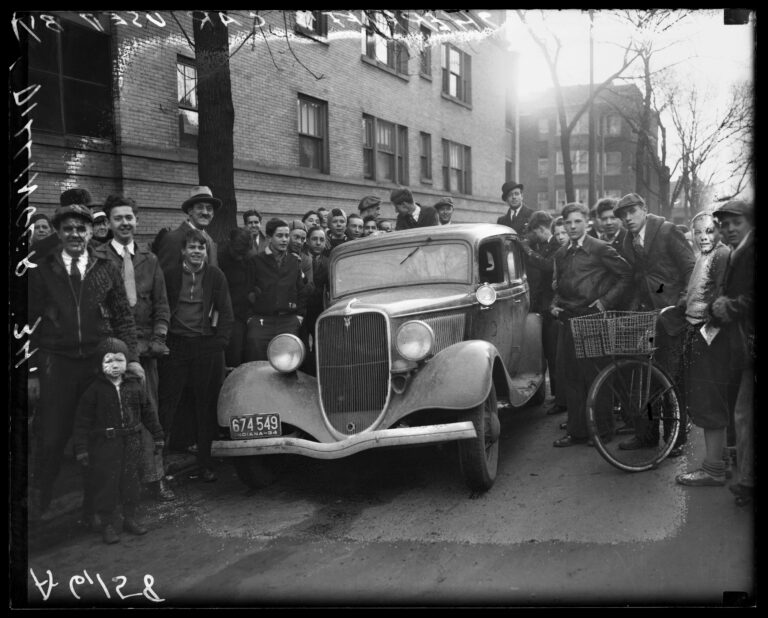
Crowd surrounds Indiana Sheriff’s car used by John Dillinger, Chicago, 1934. DN-A-6158, Chicago Daily News/Chicago Sun-Times collection, CHM
Dillinger quickly used the knowledge gained from his fellow inmates, committing his first two bank robberies in Ohio, first in June, and later in August 1933. The second robbery led to the capture of Dillinger in September, but his stint behind bars was much shorter this time. He ended up being freed by the members of what would come to be known as the Dillinger Gang thanks to an elaborate escape plan that had been facilitated by Dillinger and his other associates, who smuggled firearms into Indiana State Prison. In the roughly one-year period between June 1933 and July 1934, Dillinger and his gang committed about a dozen confirmed bank robberies, thanks to a careful planning and logistics system he had learned behind bars. Dillinger’s prowess as a bank robber turned him into a folk hero among many Americans disillusioned by the hardships of the Great Depression and the failures of the banking system.
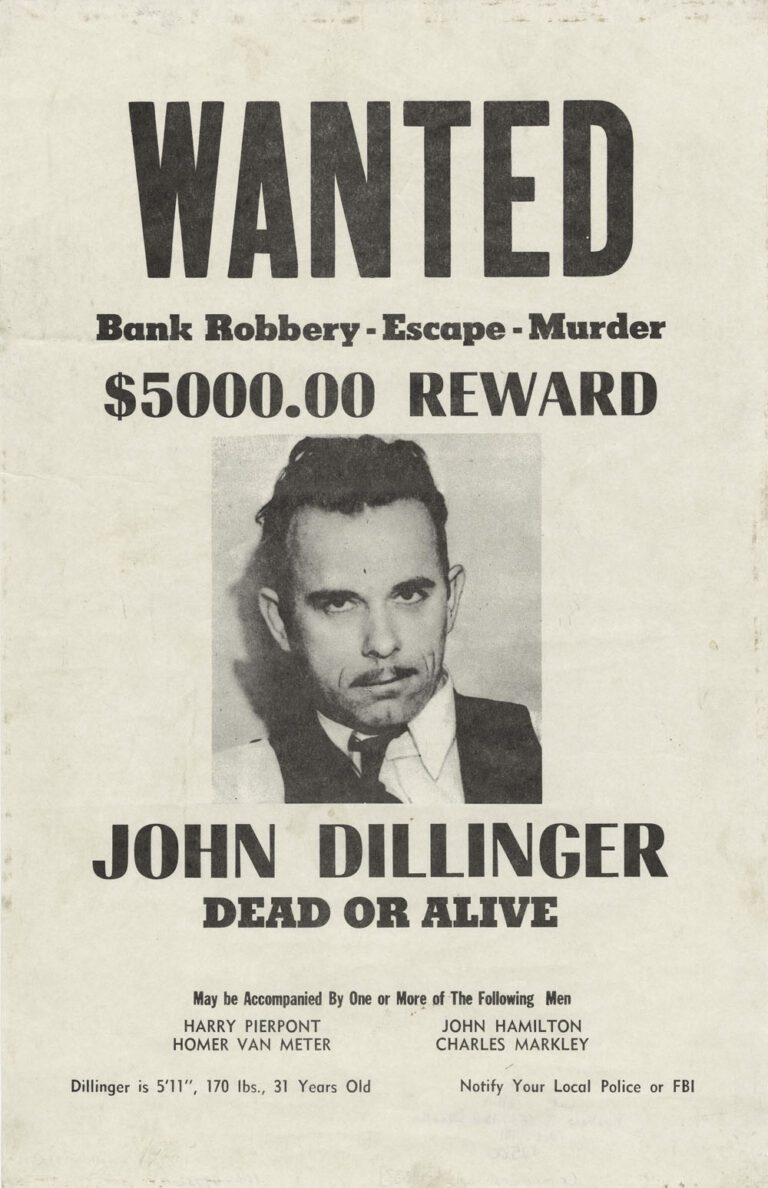
Wanted poster for John Dillinger, c. 1933. CHM, ICHi-059732
As their crimes continued and their notoriety increased, the Dillinger Gang moved westward, before he would ultimately be detained in January 1934 in Tucson, Arizona, and subsequently extradited to Lake County Jail in Crown Point, Indiana, to stand trial. Dillinger, of course would never make it to the trial, escaping as part of a coordinated effort in March 1934. As part of this escape, Dillinger stole a car belonging to an Indiana sheriff and drove it past state lines, a violation of the National Motor Vehicle Theft Act, a federal crime. It was this action that allowed an eager J. Edgar Hoover to make an example of Dillinger and pursue him with the full weight of the Department of Investigation, which would become the Federal Bureau of Investigation in 1935, an independent branch of the Department of Justice.
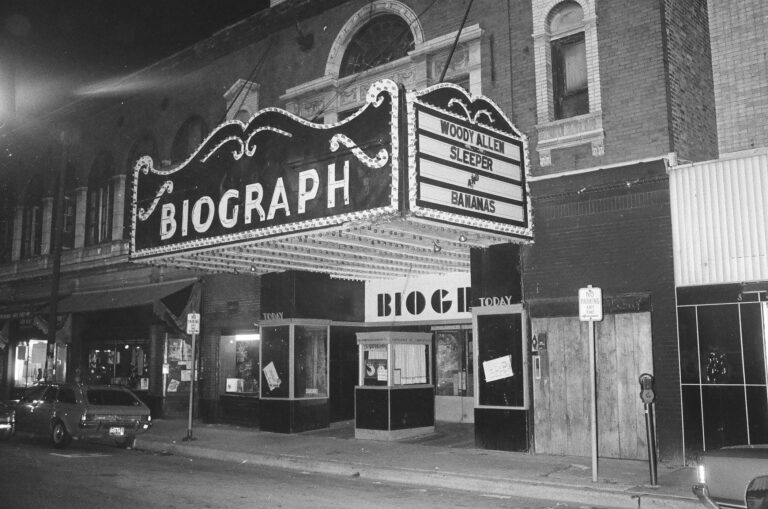
The Biograph Theater at 2433 North Lincoln Avenue, Chicago, July 10, 1974. The site of John Dillinger’s death in 1934, it was set to close in 1974 due to dwindling ticket sales. ST-10001418-0005, Chicago Sun-Times collection, CHM
Following his escape from Lake County Jail, Dillinger and his girlfriend, Evelyn Frechette, lived a life on the run across the Midwest, escaping several close calls with law enforcement across Minnesota, Indiana, and Wisconsin before ultimately being tracked down in Chicago, where they learned that Dillinger, tired of living as an outlaw, had undergone plastic surgery to alter his appearance. Conscious that Dillinger’s capture would mean an expansion in his agency’s profile and oversight, J. Edgar Hoover was unrelenting and assigned a special agent to gather intel and track down Public Enemy Number One by any means necessary.
Finally, thanks to a tip from Ana Cumpănaș, an associate of Dillinger, Hoover’s agents were able to close in on Dillinger, shooting him dead as he tried to flee from the Biograph Theater on July 22, 1934. Ironically, Dillinger and his associates had just watched a screening of Manhattan Melodrama, a film about crime and betrayal.
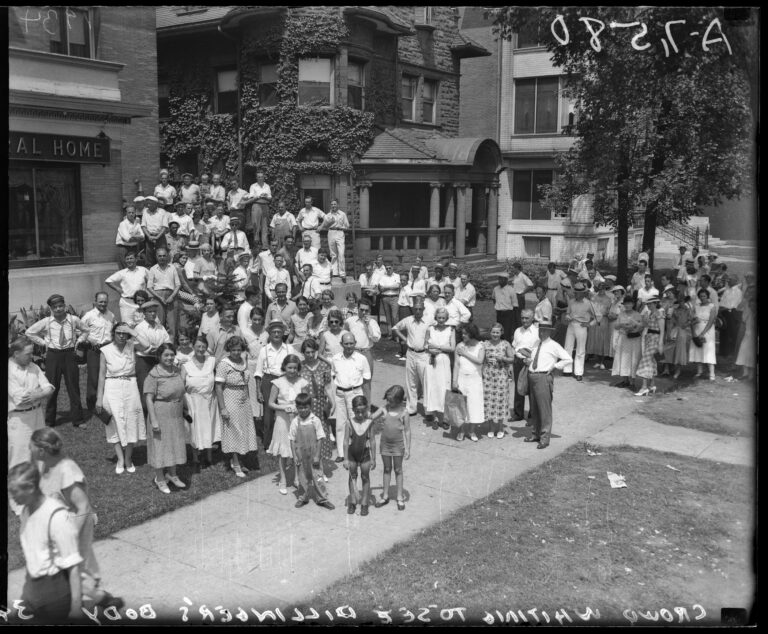
Crowds waiting to see the body of John Dillinger, Chicago, 1934. DN-A-7580, Daily News collection, CHM
The death of John Dillinger was anything but the end of his story. His demise at the hand of law enforcement was a national story, and his body was visited by thousands as part of a public display at the Cook County morgue. He was eventually buried at his family’s plot in Crown Hill Cemetery in Indianapolis, where his gravestone had to be replaced several times due to vandalism. Like his organized crime contemporary Al Capone, today it’s not uncommon to find offerings left at Dillinger’s final resting place, from small bottles of whiskey to handwritten notes and money.
The memory of Dillinger and his life go far beyond Crown Hill. Dillinger has become a mainstay of the American cultural landscape, with no less than a dozen films either focused on his story or an element of his public capture. Both the site of his death, the Biograph (now Victory Gardens) Theater, and the Lake County Jail and sheriff’s home in Indiana are listed on the National Register of Historic Places. At least a dozen other sites, from the numerous banks he robbed to his former places of residence, are all landmarked by several local and state agencies, often to promote tourism. Dillinger, after all, represents the mythological image of the “American outlaw” perhaps better than anyone else in US history. His notoriety in life laid a crucial part of the groundwork for the phenomenon of posthumous economy of “dark tourism” that has propped up around other figures who operated beyond the law like Al Capone, Charles “Pretty Boy” Floyd, and Bonnie and Clyde.
Embed from Getty Images
Gravesite of John Dillinger in Crown Hill Cemetery, Indianapolis, October 17, 2000. Photograph by Bill Tompkins/Getty Images
Thanks to numerous letters and the statements shared by those who knew him, we know that Dillinger held deep reservations about his life’s trajectory, more than once blaming his lengthy initial prison sentence where instead of rehabilitation, he found a bespoke set of mentors who offered him the camaraderie and belonging he needed in the outside world. His death at the hands of federal officials in 1934 ushered in a new era of policing in America, allowing agencies like the FBI to develop a national network of investigation and surveillance that has become one of the most sophisticated in the world. One can’t help but wonder how different things would have been had Dillinger’s story played out differently.
Additional Resources
- For more about Chicago’s notorious criminal outlets of the era in the Gangland Chicago section of Chicago: Crossroads of America.
- To learn more about other infamous crimes and criminal’s in the city’s history, see our True Crime LibGuide.








.png)



.jpg)


 English (US) ·
  French (CA) ·