

 5 months ago
84
5 months ago
84
PROTECT YOUR DNA WITH QUANTUM TECHNOLOGY
Orgo-Life the new way to the future Advertising by Adpathway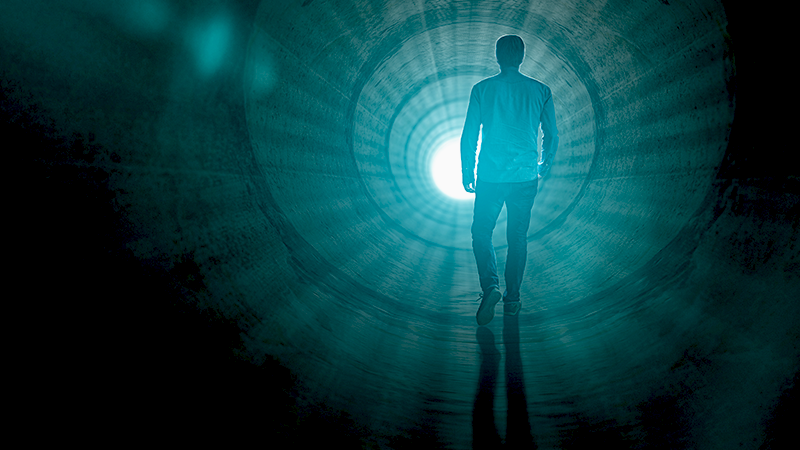
LIFE after death? The subject is ostensibly meaningless. If ‘death’ means, as we usually take it to mean, the end of life, then life ‘after’ death is a contradiction. For other amusing contradictions, see also ‘When time began’ and ‘God is outside space’.
The prevailing view in the secular Western world is that the human person is an animal who lives and dies like any other animal. (Or rather, as we suppose animals live and die.) This secular view is perfectly acceptable so long as we understand that it is just that: a view – a belief among other beliefs. In the secular view ‘life’ means biological existence which is without purpose. It is not created or caused by any supernatural agency. Mind or consciousness is a purposeless by-product of biological existence. As Bertrand Russell said, ‘I believe that when I die I shall rot.’ (Some think that with dear old Bertie the rot set in long before he kicked the bucket.)
There are countless alternatives. For the most intriguing, frequently entertaining and downright bizarre, take a look at some of the Pre-Socratic philosophers from Thales of Miletus to Plato.
Plato believed in the immortality of the soul which presents problems – chiefly that of saying just what the soul is. It is defined as non-corporeal. So where is it in relation to the individual? It does not make sense to say that the soul is in the body: for the only thing that can be in a physical thing is another physical thing. Rene Descartes declared confidently that the soul is located in the pineal gland. But then he also said, ‘I think, therefore I am’, which is rather a failure as a logical sequence – for it assumes what it promises to conclude. A distinguished visiting speaker turned up to address the Moral Sciences Club in Cambridge when Wittgenstein happened to be in the audience and began, ‘Cogito, ergo sum.’ Wittgenstein was overheard to say in a loud stage whisper, ‘That’s a bloody stupid place to start!’
Various strands of thought, mostly derived from oriental religions, teach reincarnation or the transmigration of souls. This is open to at least two objections: first, that which we have come across already in the difficulty of saying what the soul is; secondly what meaning can be attached to the idea that ‘I come back’? Who exactly is the ‘I’ here? There are obvious problems of discerning both identity and continuity.
Buddhism offers Nirvana, which is a sort of holy nothingness in which the individual is free from all pain, suffering and indeed sensation of any kind. Objection: what is the difference between an existence in which there are no sensations and no existence at all?
There is always Epicurus’s cheerful view: ‘Where I am, death is not; where death is, I am not.’ Cheerful because, according to Epicurus, you won’t be lying there thinking how awful it is to be dead; you just won’t be there at all. Peter Sellers had some fun with this in the film Being There. In other words, from my point of view, time is not something that goes on and on and into which I drop, as if into a river. From my point of view, time starts when I am born and ends when I die. I am, so to speak, embodied time. And when I die time stops. Schopenhauer expatiates on this theme – sometimes hilariously – in volume 1 of his The World as Will and Representation as indeed does Martin Heidegger in Being and Time where he coins the word Dasein which, funnily enough, may be translated as ‘being there’.










.png)




.jpg)



 English (US) ·
  French (CA) ·