

 3 hours ago
8
3 hours ago
8
PROTECT YOUR DNA WITH QUANTUM TECHNOLOGY
Orgo-Life the new way to the future Advertising by AdpathwayCongress needs to revisit this entire regime.
Josh Blackman | 6.12.2026 10:25 AM
Earlier, I offered some high-level thoughts on the latest episode of As the Couch Turns. Here, I want to drill down into the details.
First, the Eleventh Circuit's decision to make this reprimand private must be contrasted with the Ninth Circuit's decision to make Judge Nelson's investigation public. I agree with Arthur Hellman that the Ninth Circuit had the authority to make this proceeding public, but the Chief Judge was not obligated to. Judge Nelson has been charged with minor offenses. Given his lack of criminal history, the charges are likely to be dismissed. All of this may come to nothing. But now there is a permanent statement from the Ninth Circuit that Judge Nelson may have engaged in misconduct.
The Eleventh Circuit made the incomprehensible decision to make the reprimand private, but include so many facts that her identity could be readily determined. I am inclined to follow Hanlon's Razor here to explain the explanation. If it was intentional, then the members of the Judicial Council may have engaged in misconduct to bypass the confidentiality rules by subterfuge.
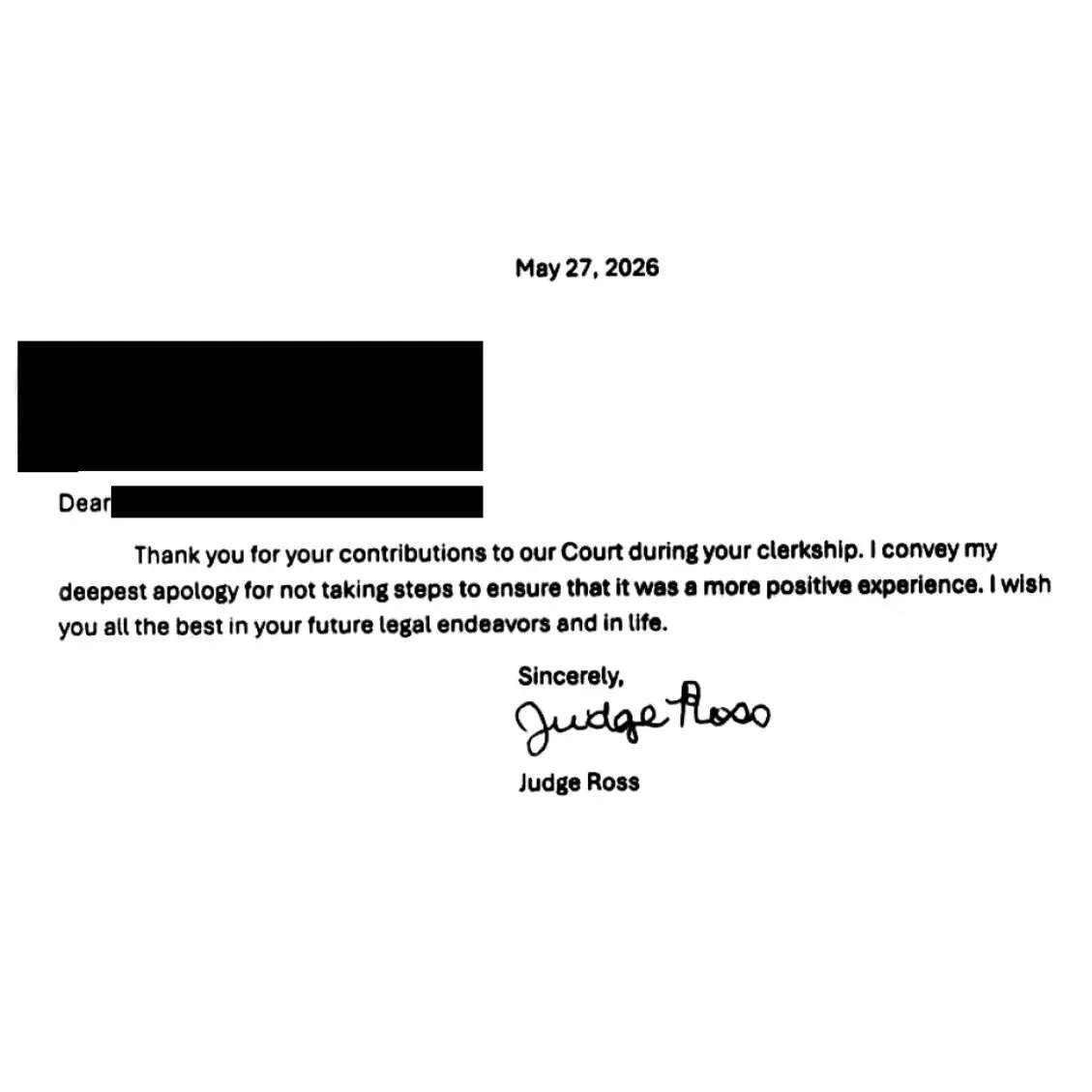
Second, Judge Ross sent her three-sentence apology letters on May 27, 2026. She did this after being given a sweetheart deal that not even Alex Acosta would have approved. And she spit in the face of her colleagues. She thought she could squeak by without offering any remorse, even though her identity was widely known.
Third, Judge Ross's brazenness forced her brave law clerks to once again reach out to the judicial process that had failed them before. They told the Judicial Council they "do not believe the letters of apology we received from Judge Ross comply with the remedial measures recommended by the Special Committee and adopted by the Council. Specifically, the apologies fail to 'make clear to the recipient the sexual misconduct for which the judge is apologizing.'"
On June 10, Chief Judge Pryor then gave Judge Ross a chance to "respond to the above allegations and state whether you failed to send adequate letters of apology to your former clerks." This offer to correct the record, yet again, is inexplicable. There is nothing to explain. She failed to do what she promised she would do. Of course the rules permit "appropriate corrective action," but Judge Ross is not a first-time offender. She has proven herself to be an inveterate liar who abuses process to save her skin. No law student or law clerk or law partner would ever be given this many chances.
Judge Ross (or ChatGPT) then wrote an apology letter to the three clerks.
"I am writing to you for a second time to convey my deepest apologies for my harmful, offensive, and unprofessional behavior that made your clerkship an unpleasant experience. My initial letter was entirely deficient, as I did not take full accountability for my actions, and I failed to give you the apology that you deserve."
Ross's chambers provided this letter to Bloomberg Law (and probably others).
The following day, Judge Pryor wrote back to say he would not identify a new complaint:
Based on my review of your new apology letters, my disclosure of the June 10 inquiry to The New York Times, and your consent to disclose the apology letters to the New York Times, I have determined not to identify a new complaint under Rule 5.
I am very confused by this chronology. First, the Eleventh Circuit Judicial Council and the JC&D Committee agreed to make the reprimand private. But the Chief Judge, acting by himself, decided to publicize the matter to the New York Times? How does Chief Judge Pryor have this authority? Did the other (unnamed) members of the Council agree to this plan? Moreover, it seems that Pryor decided not to investigate Ross further based on her making her private reprimand into a public reprimand. How does he have that authority? Judge Ross would have never consented to any reprimand if it was public. Judge Pryor nullified the cornerstone of the Judicial Council's agreement with Judge Ross. Finally, she already engaged in misconduct by not following the terms of the agreement. There was on need for further fact-finding.
This entire situation stinks, and continues to stink more by the day.
Judge Pryor's conduct here has not been exemplary. I say this with some pause, because I have long respected and worked with Judge Pryor on many matters. The problem speaks to a broader issue: Chief Judges have vast amounts of unstated powers. And absolute power can be wielded in improper fashions. Vindictive chief judges (like Kimberly Moore) can rule their circuits like petty tyrants. Magnanimous chief judges (like Bill Pryor) can provide too solicitous treatment of offending judges.
Congress needs to revisit this entire regime.










.png)






.jpg)



 English (US) ·
  French (CA) ·