

 13 hours ago
15
13 hours ago
15
PROTECT YOUR DNA WITH QUANTUM TECHNOLOGY
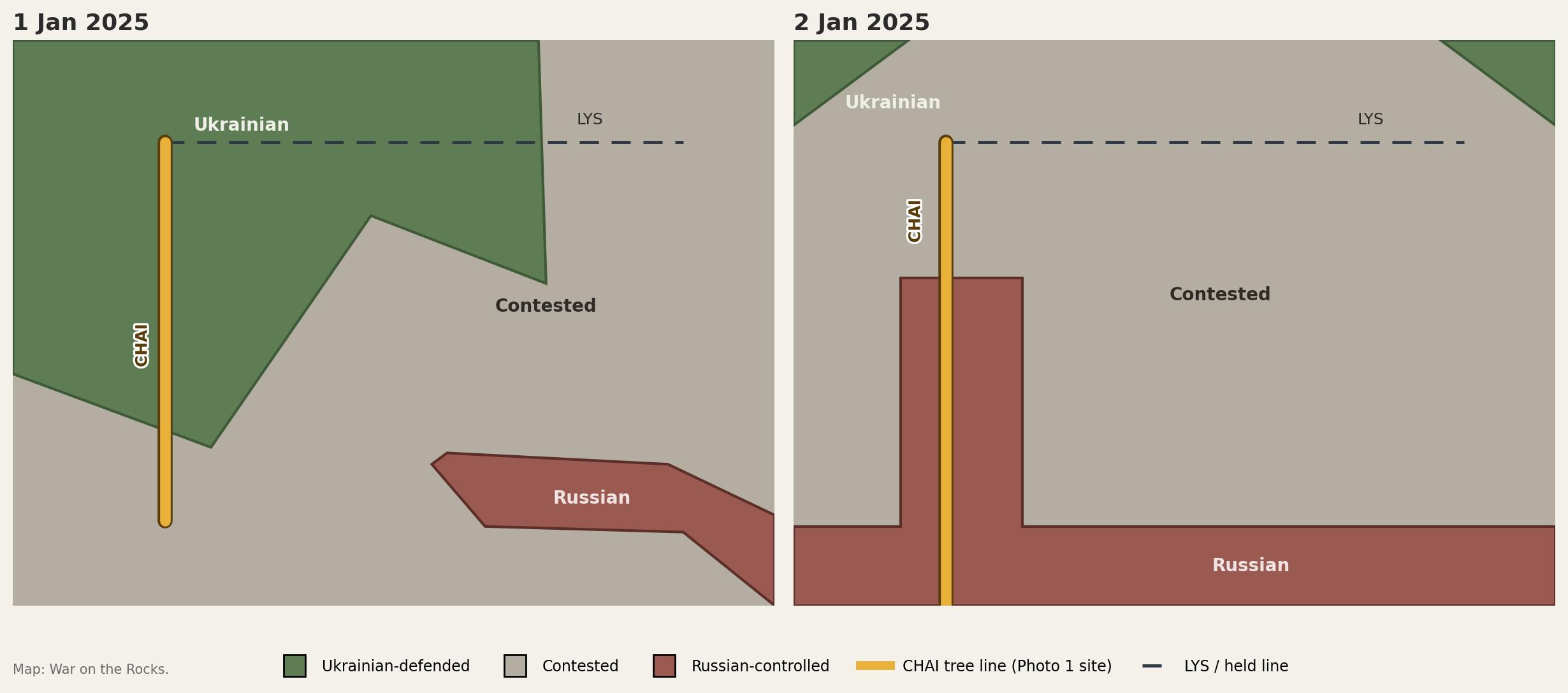
Orgo-Life the new way to the future Advertising by AdpathwayOn Jan. 5, 2025, my volunteer platoon attached to the 23rd Special Purpose Battalion of the Presidential Brigade entered a 1-kilometer-long tree line called CHAI, on the outskirts of Kotlyne, a few kilometers west of Pokrovsk, Ukraine. Our task was to occupy a position whose status on DeepState, an open-source map tracking military operations in the Russo-Ukrainian war, had been shifting out of gray for five days. On DeepState’s map, different colors illustrate the fighting situation: the red area is held by the aggressor, while green or blue areas show territory successfully defended or recaptured by the Ukrainian army. The gray area is an interstitial space of uncertainty where terrain is still disputed — let’s call it the contested zone. At that stage of the war, the contested zone remained quite thin, about 1 or 2 kilometers at most, but this was changing fast, because drones were adding a new dimension to the battlefield, creating operational depth, and generating battlefield legibility in equal measure to maneuvering uncertainty.
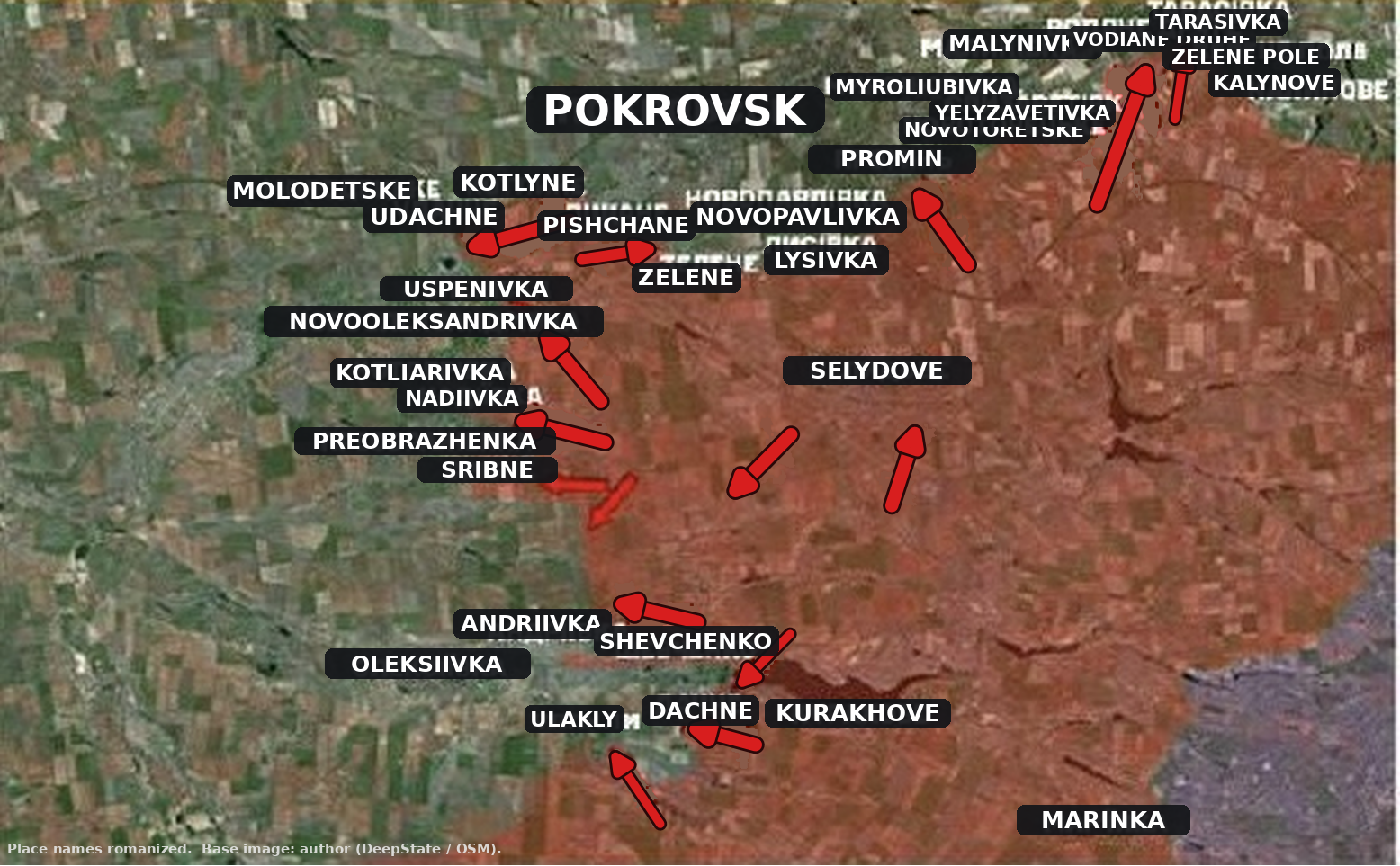
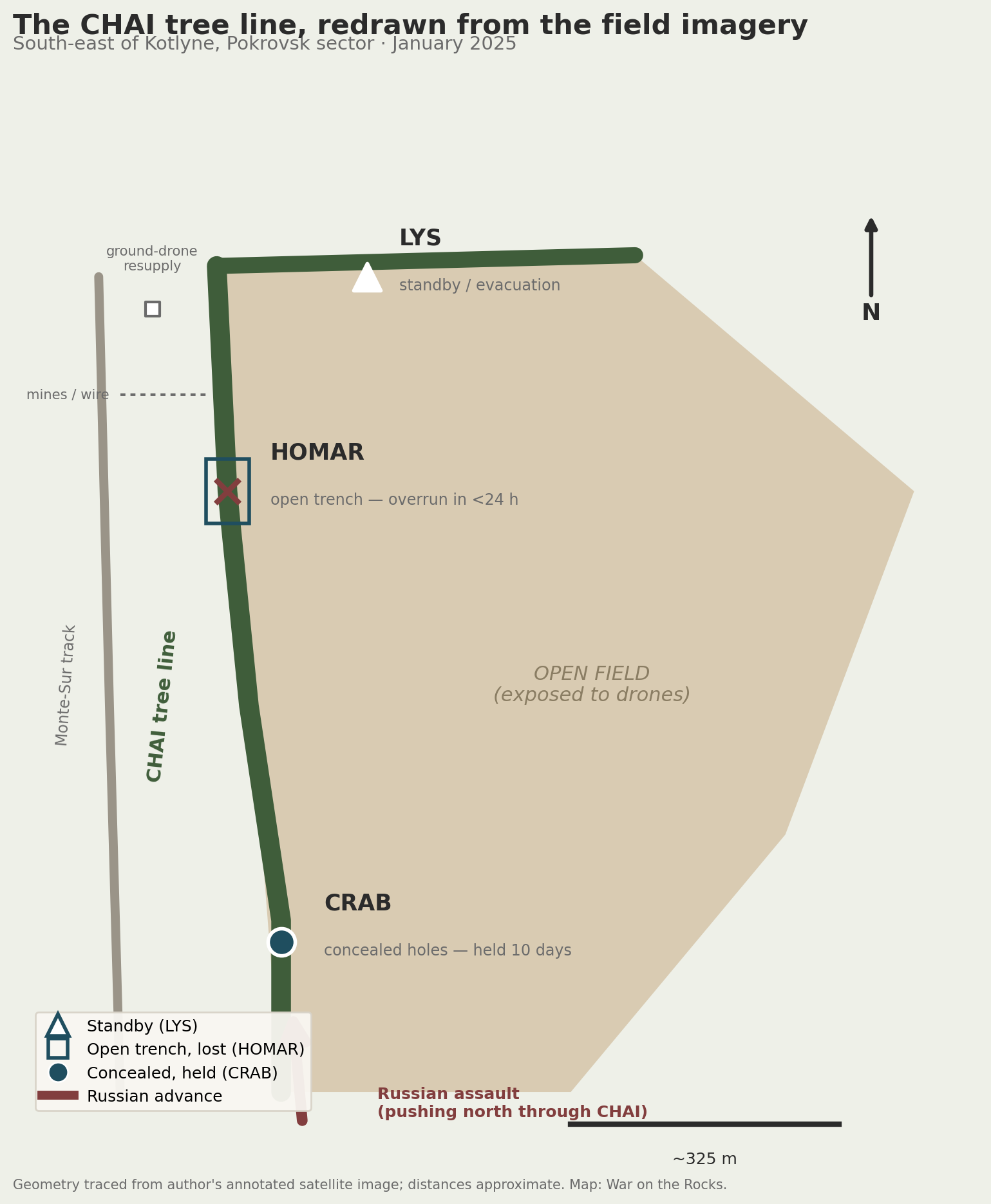
The Russians already occupied this tree line, contesting a large rectangular open-air trench that sat there as if bolted onto the tree cover without actually benefiting from it. Like the tree line CHAI, this trench was named “HOMAR” by the command; it was 80 meters long, 30 wide, stepped in two- or three-meter chevrons, fitted with a couple of bunkers and wooden firing slits. After the companies deployed their first batches of soldiers in this trench and suffered massive losses immediately, they called us in. Our first eight men entered the position and were out of combat in less than 24 hours. The next four men lasted less than 10 minutes.
A few hundred meters away, a second position, called “CRAB”, was hidden in the tree line. I was just two fighting holes dug into the undergrowth, with three riflemen in each. The men connected the positions by two radios and were supported by a stationary drone to deliver them ammunition or water. CRAB held for 10 days against that same Russian assault, inflicting dozens of casualties on the attackers and fixing them in place while drones and artillery harassed them as they tried to push back up through CHAI toward HOMAR. That contrast between HOMAR and CRAB fighting situation taught me something.
As many other observers have discussed here, like Rob Lee and Michael Kofman, cheap, ubiquitous surveillance and strike drones have created a context of augmented high-intensity warfare: fighting so saturated with sensors that being seen kills faster than being outgunned. At Kotlyne, our CRAB position held because we dug it in, camouflaged it, and covered it. The HOMAR trench failed because it exposed itself to a field it was never built to survive: the sky, compounded by the enemy knowing its location in advance.
The battlefield now has several “vertical” layers, and the trench is merely a relic of the layer above — the surface — unless it also serves as the entrance to the one below. This case does not explain everything, yield a doctrine, or offer every parameter of a tactical account immune to criticism. But I cannot help drawing lessons from an experience as binary, as almost caricatural, as this clash of two models.
Four Fields, Four Missions
In augmented high-intensity warfare, four layers of the battlefield are distinguished. Two belong to airpower: the super-aerial, where long-range drones, ballistic missiles, and aircraft operate, and the sub-aerial, the low, saturated layer of expendable first-person view drones, which stays in immediate contact with the surface, its air-to-ground objective. The surface logically follows, where ground combat is, in principle, fought. Ground combat, let’s be clear, no longer works at all according to the traditional rules. Take armor, for instance: what is striking is not the number of armored vehicles destroyed, but the systematic nature of their destruction and their short life expectancy, hence the impossibility of long-standoff positions for tanks.
Finally, the vital role of the subsoil can no longer be denied. Where the subaerial is defined by its proximity to the surface from above, the subsoil is defined by its depth below: tunnels, dugouts, covered galleries, and cellars turned into command posts. It has, in fact, become a real stake for drones to push ever deeper into the infantry’s “ratoneras” to penetrate cover and hunt for enemy pilots underneath.
The trench belongs to the surface — the thinnest and most exposed of the four layers — but it can also be a door downward. A trench that stops at itself is a target. A trench designed as an entry point into a gallery network is only the first meter of a much longer position. Even so, it still carries the disadvantage of marking an entry point, and a guided glide bomb can target it. In augmented high-intensity warfare, it seems that any position knowable to the enemy in advance is a major liability. This changes what engineers should design and what a small unit should know how to do.
The infantryman’s most valuable tools in the Donbas region remain the entrenching spade and the pick. Like the drone pilot, who is based in the subsoil between their own surface phases of rotation and take-off, the infantry soldier is bound to the underground between their own surface phases. For both, tactically, four verbs describe a combat mission: access, observe, communicate, and act. These allow Ukraine’s guerrilla resistance — facing the Russian steamroller — to maintain a residual presence in the contested zone and dispute it, if not retake it.
At a minimum, it means continuing to dispute territory by accessing it, observing it, communicating from it, and acting within it. These four verbs apply across every field: super-aerial, subaerial, surface, and subsoil, with different tools for each. For infantry, access means entering a position that is always high risk, and sometimes evacuating is impossible. Hence the major importance of tunnels, whether electromagnetic, surface-level — like the anti-drone netting strung over roads — or underground. What is needed is a cover — a buffer zone — between whatever is maneuvering or stationed and the subaerial field. Combat engineers can expand their role to include countermeasures tasks aimed at building up such a buffer zone between troops and the subaerial field.
That drone saturation has made concealment and dispersal decisive — and massed, fixed positions lethal — is not a new argument. It is easy to imagine that a dug-in position survived 10 days against the very assault that erased another one a few hundred meters away, simply because that other position exposed itself to drones. What the contrast between HOMAR and CRAB illustrates at the scale of a single tree line, analysts have already been tracking at the scale of the whole front — for both the Russian and Ukrainian sides — arguing for the necessity of sporadic personnel deployments and concealed, modular defensive positions.
The opposition between these two archetypes, CRAB and HOMAR, illustrates such a necessity for a shift in tactics due to subaerial field saturation by drones. Three factors explain CRAB’s efficiency further: protection, concealment, and surprise, which together allowed initiative to be conserved. The surviving position had rudimentary, improvised, covered defensive works: holes, thermal ponchos, suppressors on weapons, and was not known to the enemy in advance.
CRAB, hidden from the sky, harassed the rear of the Russian maneuver and contested territory from inside what the enemy already believed, or claimed, to be its own. DeepState had already awarded that territory to Russia. On Jan. 2, 2025, at coordinates Military Grid Reference System 37UCP5718644696, southeast of Kotlyne and west of Pishchane, a red arrow marked the Russian advance along the CHAI tree line containing the HOMAR and CRAB positions. HOMAR was in the northern part of the wood, and CRAB in the southern third. Just as a drone could operate within the subaerial field, CRAB enabled its six men to access the enemy’s deployment, observe it, report on it, and call in destructive fire, fixing its advance while artillery and drones processed the target.
Residual Presence
If static defense of surface structures known to the enemy fails, what replaces it is not retreat but a different measure of success. Call it residual presence: the capacity of a force, however small and dispersed, in the air, on the surface, and in the subsoil field alike, to conserve a foothold in contested or even enemy-held territory long enough to access it, observe it, communicate from within it, and act inside it. None of these four verbs require planting a flag over a piece of ground. They require a two- or three-man team able to move, hide, and fight without depending on mass, an armored vehicle used sparingly for insertion, evacuation, or a hit-and-run rather than static defense, and a command post able to see the same drone footage the front-line teams see, to coordinate fires, and to circulate information in real time.
That command post is the hinge of the whole system. In the fighting at Kotlyne, the units that survived had commanders who could see what the drones saw and communicate with them quickly, before enemy drones could destroy them. Centralized, rigid communication designed as a two-way line from a headquarters to its companies, with no channel between the companies themselves, leads to isolation, then destruction, or even friendly fire. A qualitative defense depends on collective situational awareness — awareness that is shared, acted upon, and converted into an effect on the enemy. Absent that conversion, what remains is not defense but endured resistance.
Residual presence is opportunistic by design, like the whole guerrilla resistance effort of the weak against the strong in augmented warfare. Command posts once dug for the old third line have resurfaced as forward drone-piloting posts, and much of the contested zone’s expansion rests on this inheritance of ad hoc structures, repurposed according to the enemy’s advance and to residual presence’s own objectives and field opportunities.

The Contested Zone is the Front-Line Thickness
An objection can be raised. First, that a conception of defense built on subtracting oneself from enemy fire amounts to a spirit of retreat, and that nothing proves a resisting force can actually maintain a defensive position when it concentrates on concealment rather than on holding ground. But is there another choice? Ukraine does not have Russia’s demographic resources for a frontal, symmetrical, and costly response. Commander-in-chief of the Ukrainian armed forces, Gen. Oleksandr Syrskyi’s “non-standard decisions” in Jan. 2025 — that is, defense at any cost, and at the highest cost at that — absorbed the shock for a resumption of strategic initiative to become possible later.
There was no clear doctrine behind those non-standard decisions, only urgency — whatever was on hand got mobilized, and improvised remedies came after the fact, not before. Commanders pushed noncombatants into defense, threw defenders into assault, and ordered untenable positions held regardless of cost. The positional reflex this exposed was not a relic of the past: it was live, in Jan. 2025, in the chain of command itself. Neither report specifies what the decisions were — that came only in retrospect, framed as expanded brigade/battalion commander autonomy, a push on drone capabilities, and a more proactive defense meeting enemy infiltration head-on. In practice, commanders committed whatever noncombatant personnel were available, even including aircraft mechanics or cooks, to hold positions.
These “decisions” led to a tremendous feeling of attrition within troops, and the will to defend better, at lower cost to oneself and at higher cost to the enemy, in a nezlamnist spirit (an unbreakable spirit), but without showing yourself where you are expected or exposing yourself to drones just to claim territory. Ukraine’s creation of numerous drone regiments illustrates that shift. In March 2025, the 23rd Special Purpose Battalion itself became the second battalion of the 427th Drone Regiment, known as “Rarog.” The short but promising Fedorov phase followed, with Mykhailo Fedorov, Ukraine’s minister of digital transformation and, from Jan. 2026, minister of defense, advocating drone warfare and technology-driven reform before his dismissal on July 15, 2026. More recently, Ukraine appointed Maj. Gen. Mykhailo Drapatyi to replace Gen. Oleksandr Syrskyi. Together with Ukraine’s many strikes deep into enemy territory, these developments confirm the trend.
At the time, as I read the Institute for the Study of War’s reports over those months, my impression was that, in their jargon, infantry “commitment” mostly meant pushing people into existing defensive positions.
That jargon was not unique to the Institute for the Study of War — it was one visible symptom of an entire strategic culture still thinking in unaugmented terms, a show-the-flag commitment that is not so much obsolete as useless, except for propaganda purposes, consenting to a sacrifice the battlefield itself had already made unnecessary. In the pre-existing defensive HOMAR trench in the CHAI woods, Russian firepower pushed us hard, but our men caught the enemy off guard and disrupted them from the CRAB hideouts. From CRAB, they then helped fix and contain the enemy, contributing to the February retaking of Kotlyne by paratroopers from the 25th Sicheslav Separate Airborne Brigade.
Perhaps that was the only available answer, given Ukraine’s manpower asymmetry: not a demonstrated formula for stopping the advance, just the muscle to dispute that portion of terrain and push the shock back onto the enemy as it maneuvered, inflicting the highest toll for every square meter taken. The collapse of HOMAR didn’t give more to the aggressor than a deeper drone kill-zone radius for the enemy’s advance. When the enemy finally invested in and occupied the trench, its infantry was systematically destroyed.
Overall, for the past 20 months, the front has moved from a stretched line of shock to an extension of the drones’ kill zone. Today, Kotlyne marks the limit between enemy-held territory and the start of the contested zone width. Around this specific salient, on Jan. 1, 2025, the contested zone had roughly 1-kilometer depth. It’s now five to eight times wider.
Friction along the front line seems to have given way to residual presence in the contested zone, which replaces the frontal holding of ground. The front line can no longer be the real stake of the fight once it has become porous or has thickened into a depth of 12 kilometers. Both sides actually contest the width and depth of the contested zone — territory claimed by one side and denied, at real cost, by the other — and that contested zone expands or contracts according to operational capacity (access, observe, communicate, act) as much as according to the belligerents’ will to keep fighting.
At Kotlyne, at the CRAB position, in the early winter of 2024 to 2025, that nezlamnist spirit — unbreakable and indestructible, as European Commission President Ursula von der Leyen puts it in a recent social media post — held two exhausted three-man teams in their fighting holes in place against a manpower ratio of one to eight. That same spirit has since allowed the contested zone to keep expanding, even as the “front” itself has barely moved. No one can claim to occupy what remains disputed. Though DeepState marked CHAI wood as red on Jan. 2, we knew it was foggy gray. We had to cultivate this fog and deceive the drones as well as the listening posts, so CRAB fighters could remain hidden in the terrain, observe, report, and disrupt the enemy advance. This unexposed defensive tactic, and the following extension of the contested zone, manifests residual presence and is worth more than any occupier’s “show the flag” or commitment to untenable positions at any cost.
Two Archetypes, Not a Doctrine
The fight for CHAI wood, where the HOMAR trench couldn’t be held while CRAB’s two fighting holes stood, is only a dialectical case — and a narrow one, consisting of two positions, a 12-day engagement, one failure, and one success. What the case offers cleanly is a choice between two paradigms: mass-on-mass attrition on the surface, where only numbers decide and mutual destruction by drones is all but assured, as at HOMAR, or an asymmetric response that evades the enemy’s intelligence, where a handful of concealed fighters survive an assault built for a far larger target and kill many times more of the enemy than they lose. CRAB sat squarely in the second paradigm, and, as far as I could judge from what I saw, the dividing line between the two was thermal signature: “delta T,” the gap between an object’s heat and that of its surroundings.
“Delta T” has become as decisive a variable in augmented high-intensity warfare as range or caliber once were in the wars before it: a low “delta-T” signature improves its odds of survival, and a high “delta-T” signature is destroyed very quickly. But this was just the actual criteria for identification then, and this is also subject to changes or augmentation. You Only Look Once-class object detection algorithms and AI embedded in drone flight controllers, are now critically completing thermal target acquisition: machine learning data sets become paramount for the last-mile flight and strike, and this is another game changer in high-intensity warfare augmentation.
What This Means
No army preparing for its next war can assume it will fight one slower and less transparently than the one Ukraine is fighting today. Autonomous systems are proliferating faster than doctrine is adapting to them, and the temptation to respond with more firepower, more armor, and more surface fortification will keep producing the result the open trench at HOMAR produced: an easy target, with a clean “delta T” and patterns that any available intelligence system can identify and recognize.
Guerrilla resistance is not an insurgent’s fantasy of heroic hit-and-run raids. It is a disciplined, unglamorous practice of concealment, depth, dispersal, technological and tactical repositioning and maneuver, built around a simple test for every team and every device: can it access, observe, communicate, and act? So, it’s all about creating informational fog and a buffer zone to shield against the pervasive subaerial field while, as drones from all sides fill the air, continuing to dig for access and activity in the contested territory.
Édouard R. Maurin, callsign FIDES, is a French writer and veteran who served with an international volunteer section attached to a Ukrainian special-purpose battalion near Pokrovsk in 2024 and 2025. His war journal, “La Chair à Drone,” recounts that deployment.
Image: ArmyInform via Wikimedia Commons












.png)





.jpg)



 English (US) ·
  French (CA) ·