

.png) 1 day ago
16
PROTECT YOUR DNA WITH QUANTUM TECHNOLOGY
Orgo-Life the new way to the future Advertising by AdpathwayWASHINGTON — As members of Congress, wannabe members of Congress, voters and political junkies settle in for the results of Tuesday’s long-awaited midterm elections, one major question is largely going unasked: What happens if Donald Trump refuses to accept the results and abuses his power to overturn them?
While many legal experts offer the assurance that the Constitution does not grant a president any role in the administration of elections taking place across the 50 states, others point out that the Constitution also does not permit a president to incite a violent attack on the Capitol as part of a coup attempt — yet Trump did that anyway the last time an election ended badly for him.
“The depths of his authoritarianism cannot be overestimated,” said Ty Cobb, a lawyer in the White House Counsel’s office during Trump’s first term. “He was willing to tolerate the hanging of his vice president in 2020. Power is even dearer to him now. Real violence is a possibility.”
Since returning to office, Trump has already proven that he is ready to stretch or break the law to do as he pleases, with deadly results.
He has ordered massive deployments of masked, unidentified federal agents into cities over the objections of local officials in his goal to hunt down undocumented immigrants, leading to repeated shootings, including the deaths of U.S. citizens in Minnesota early this year. He began a now eight-month-old war against Iran without seeking authorization from Congress. He has ordered the extrajudicial killings of people aboard small boats in the Caribbean and Eastern Pacific — people who were never charged with any crime, let alone convicted.
Regarding the midterms specifically, he has done little to tamp down fears that he may resort to openly illegal tactics to prevent Democrats from taking control of one or both chambers of Congress. He has reportedly been advised by allies who want him to declare martial law, if needed. He has said he regrets not illegally seizing ballots following the 2020 election he lost.
Asked on Oct. 10 if he would accept the results of Tuesday’s election regardless of the outcome, Trump responded: “Of course I will, but we don’t want cheating.”
When pressed if that meant he would honor the result if Republicans were to lose, Trump answered: “We don’t want cheating. Do you understand me?”
His White House did not respond to HuffPost’s queries about who would make the determination that such “cheating” had occurred.
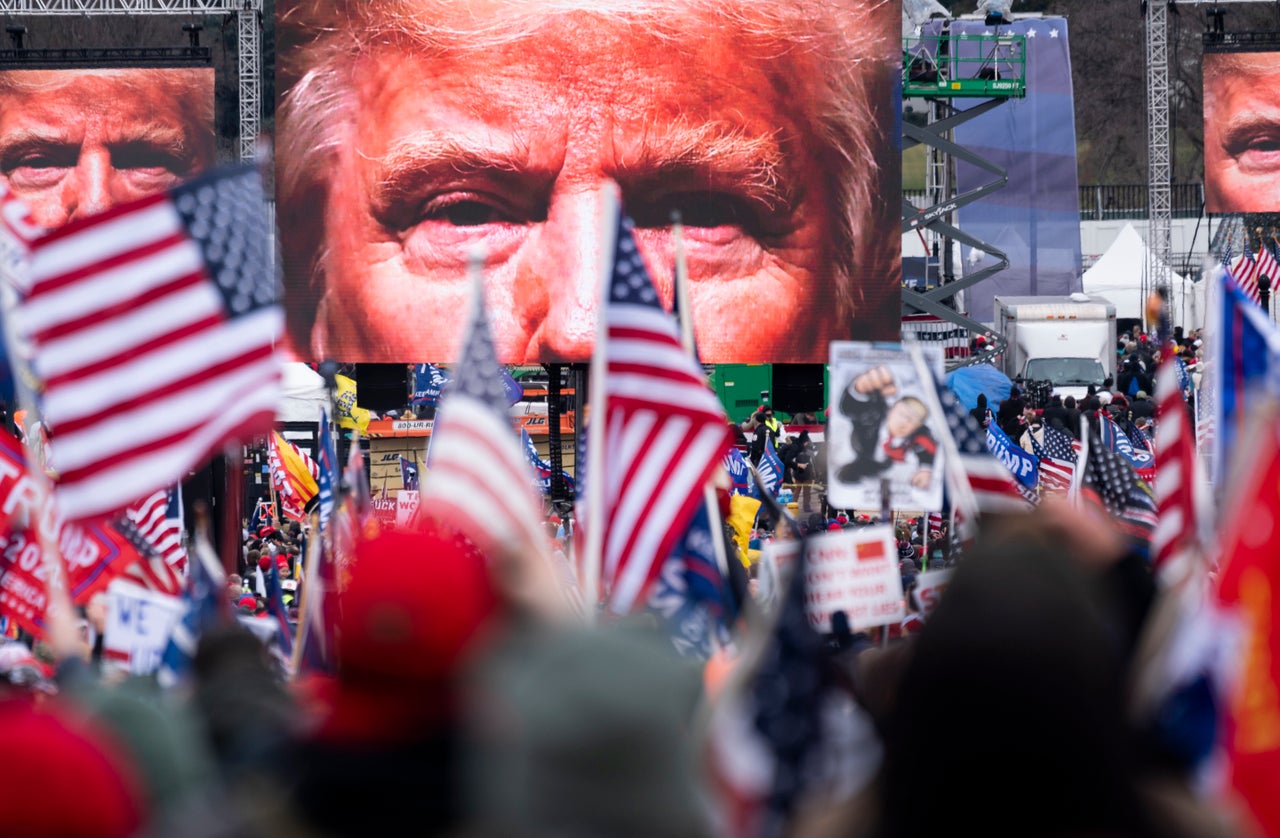
Bill Clark via Getty Images
Democracy advocates, hoping to make clear what the law does and does not allow, point to loss after loss suffered by Trump’s Department of Justice as it tried to carry out his efforts to hurt Democratic turnout in the months ahead of the 2026 midterms. They argue that the courts will continue to uphold the law if Trump tries to break it.
“Any desperate attempts by Trump to cast doubt on midterm election results will be seen for what they are: empty threats. We have seen this failed playbook before, and we stand fully prepared to defeat it again,” said Norm Eisen, a top lawyer in President Barack Obama’s White House who is now a key player in the pro-democracy legal battles. “We have absolute confidence that our democracy and the rule of law will prevail against any attempt to sabotage our elections.”
Others, though, acknowledge the dangers the nation faces. Stephen Richer, a lawyer who in 2020 was the top election official in Maricopa County, Arizona, said he learned firsthand about the limits of rules and laws when mobs of Trump’s followers, some carrying AR-15s and other weapons, converged on government offices in Phoenix in the days following Trump’s election loss in that state.
“That was an eye-opener to me. This was turning into something that was really meant to disrupt the tabulation process,” Richer said, adding that he never imagined he would see those sorts of tactics in his own country. “My imagination is bounded by a belief in American exceptionalism, that there are simply some things we don’t do in America.”
Trump’s attempt to overturn the 2020 election he had lost failed because his attorney general, his FBI director, his homeland security secretary, his White House counsel, his defense secretary and, ultimately, his vice president refused to go along with his demand to put his wishes ahead of the Constitution.
One top Republican close to the White House, who spoke on condition of anonymity, said it was beyond worrisome that all those jobs are now held by Trump-first loyalists who have, for years, gone along with his election lies.
“There’s no one left. The serious people are all gone,” he said.
“He was willing to tolerate the hanging of his vice president in 2020. Power is even dearer to him now. Real violence is a possibility.”
- Ty Cobb, lawyer in the White House Counsel’s office during Trump’s first term
‘The Elections Are Rigged’
Lying about the integrity of U.S. elections has been a core Trump feature over his entire time in politics.
The first election he claimed was fraudulent was the very first one in which his name appeared on the ballot: the 2016 Iowa Republican caucuses. After leading in the polls for much of the previous autumn, his support collapsed late, and he lost to Texas Sen. Ted Cruz. Almost immediately, Trump began claiming, without evidence, that Cruz had somehow cheated and demanded that the election be re-run.
That fall, having won the GOP nomination and facing Democrat Hillary Clinton, he refused to say he would accept the result if he lost — an answer few saw as worrisome because of the widespread belief that Clinton would handily beat him.
When he managed to win that election and become president, the fact that Clinton had received nearly 3 million more votes than he had irked him to the point that he bought into a conspiracy theory relayed by a golfing friend of his who claimed that undocumented immigrants had voted for Clinton many times each by changing into new shirts and hats and returning to polling locations. A task force he ordered up to look into it quietly disbanded months later without finding anything.
Trump’s disparagement of elections dramatically ramped up as he sought reelection in 2020. That spring, he began attacking mail-in ballots — which he himself has used multiple times — as a form of cheating and concocted a story about people sitting at home on their couch filling out thousands of fake ballots coming in from China or North Korea.
As it became clear that Trump had lost, the lies that the 2020 election had been stolen from him began almost immediately and continued, nonstop, through recounts in the closest states, through dozens of failed court challenges, through the Electoral College vote that formalized his loss to Democrat Joe Biden, right up through the speech on Jan. 6, 2021, in which he incited an insurrection to prevent lawmakers from certifying the election.
“There was no question he was stoking violence and inciting his followers to take action to overthrow the election results,” said Amanda Carpenter, once a Republican in Cruz’s Senate office and now with the group Protect Democracy. “Everyone could see that.”
The violence on Jan. 6 left 140 police officers injured and led to the deaths of five. Yet through it all, Trump sat in the White House watching it unfold on television, and only told his mob of followers ― whom he himself had called to Washington ― to disperse three hours later, after police had retaken control of the Capitol and his coup had failed.
Most worrisome to democracy proponents is that Trump did not repudiate the words and deeds that led to the greatest assault against the republic since the Civil War. Rather, within months, he began repeating them, and continues to do so to this day.
No Adult Supervision
Nearly two years after his return to the White House, barely a day goes by when Trump, either in public remarks or in online posts, does not continue to lie about the 2020 election or denigrate U.S. elections more broadly.
“Right now the elections are rigged like nobody’s ever seen,” he said during a June 25 “tele-rally” for his preferred U.S. Senate candidate in Louisiana.
“The elections are rigged in this country,” he told the Capitol Hill outlet Punchbowl News on Aug. 6.
What’s more, Trump’s lying about past elections has grown even more absurdly over the top. In recent months, he has repeatedly claimed to have won in California and Minnesota in all three of his elections. In reality, he lost Minnesota all three times and never even came within 20 points of winning California.
Richer, who is now with the Cato Institute, said that history makes him suspect Trump could very well try to abuse his presidential authority in the coming weeks if, as appears likely, Republicans lose control of at least the House.
“I think the president lives a little bit by the mantra of Johnny Depp in ‘Pirates of the Caribbean,’ that the only rules are what a man can do and what a man can’t do,” he said.
He added that he can imagine a scenario where U.S. law enforcement or military, under orders from Trump, tries to illegally seize voting equipment under the control of local authorities. “We would be in a standoff with county and local law enforcement on the inside of the gates and federal law enforcement on the outside of the gates,” he said. “And that’s really dark.”
Fellow Cato scholar and lawyer Walter Olson acknowledged that his and other legal experts’ optimism about American democracy is rooted in the idea that the rule of law is inviolable. “We can’t do something about the total breakdown of the rule of law. Others have to mobilize society in some way about that,” he said.
The Republican close to the White House said that preventing Trump from inflicting chaos, and potentially violence, on American democracy yet again in the weeks until the new Congress is seated may well be in the hands of GOP figures like Senate Majority Leader John Thune and House Speaker Mike Johnson, who would need to stop pandering to Trump and step up on behalf of the country.
Six years ago, while Thune voted to certify the election results, Johnson was a key player in the legal challenges to boost Trump’s election theft.
“If Mike Johnson loses the House, maybe he goes out as a statesman,” he said.




.png)



.jpg)


 English (US) ·
 French (CA) ·