

 4 days ago
32
4 days ago
32
PROTECT YOUR DNA WITH QUANTUM TECHNOLOGY
Orgo-Life the new way to the future Advertising by AdpathwayPreviously: The Hexham Heads.
Do you know about Langville, Montana? You’d be forgiven if you didn’t; it’s not on any maps, and you won’t find any trace of it in the history books. You won’t, in fact, find any trace of it anywhere at all — because the town of Langville, Montana disappeared some time ago. Just vanished. It doesn’t exist anymore, and all record of it has been erased.
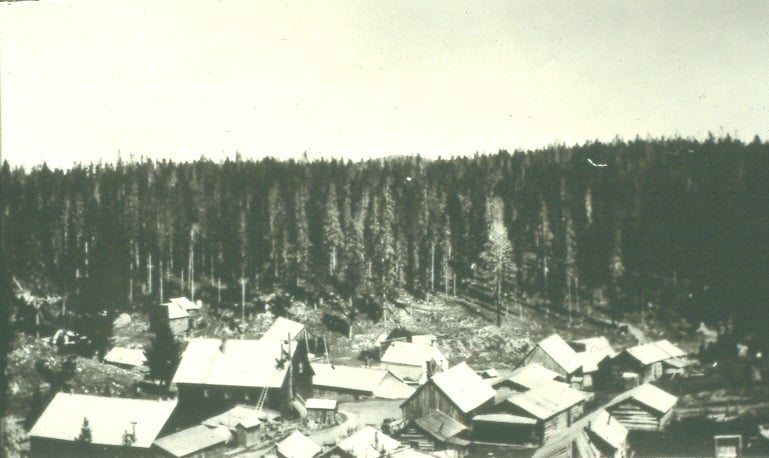 This is not Langville. This is Garnet, Montana as it appeared in the late 19th-early 20th century. It is now a ghost town.
Why?
Because something terrible happened there.
Something no one wants you to know about.
[Like what you read? Check out Dangerous Games To Play In The Dark, available from Chronicle Books now!]
The reason Langville, Montana vanished is because one day, its entire population — every single person living in the town — was turned… inside out.
And I don’t mean metaphorically. I mean literally. Skin on the inside. Organs on the outside. The works.
We don’t know how. We don’t know why. It just… happened.
Naturally, the town couldn’t survive after that — not with all of its residents in a state that was… no longer compatible with life.
So every trace of the town was wiped from history. If you go looking, you won’t find anything about it — not about its history, nothing from its local papers, and certainly no pictures of it.
Or at least, that’s what the stories say. The reality, though, is a bit… different. A lot different, actually. Because here’s the thing: There’s no real information about Langville, Montana to be found not because it was erased from the public record, but because Langville, Montana never existed in the first place.
But the plot thickens — because that’s actually not the weirdest part of the Langville, Montana legend. The weirdest part is this: Although it’s quite clear that this particular tale falls into the same category of story that Doveland, Wisconsin, Urkhammer, Iowa, and Ashley, Kansas do, what’s less clear is how, when, or where the legend of Langville, Montana started.
Questions abound regarding its origins. Is it a longstanding piece of internet lore? An even older piece of folklore? Or, is it the invention of a pair of screenwriters, who dropped the story of Langville into what’s almost a throwaway line in big budget Hollywood picture?

We know popular interest in the legend kicked up following the release of that movie in 2016.
What we don’t know — not totally — is whether the legend was around before then.
The picture becomes a little clearer the closer you look at things, though, so let’s do that, shall we?
Let’s take a look at Langville, Montana, its odd and unsettling legend, and what we do and don’t know about them both.
Who Ya Gonna Call? Langville And The Ghostbusters Connection
When most people talk about Langville, Montana, they cover all the basic talking points — that the town disappeared; that its residents were, somehow, turned inside out; that all evidence of the town was subsequently erased; and that the story was even referenced in the 2016 Ghostbusters reboot.
That last point, it turns out, is really the best place to start when it comes to looking at the Langville, Montana mystery; in fact, most coverage of the legend hinges directly on that Ghostbusters reference.
So let’s do that. Let’s start there.
Directed by Paul Feig with a screenplay by Feig and Katie Dippold, the 2016 version of Ghostbusters starred Kristen Wiig, Melissa McCarthy, Kate McKinnon, and Leslie Jones as our erstwhile team of paranormal investigators. Just as their 1984 counterparts did, these Ghostbusters experience a number of hits to their credibility throughout the course of the film — even from highly-placed individuals who admit they know they’re telling the truth.
About an hour in, there’s a scene that takes place in the mayor of New York’s office in which the groundwork is laid for a classic government cover-up. The mayor (Andy Garcia) explains to the Ghostbusters that, although he and his office are aware of everything that’s happened — they know ghosts are real, and they know that the strange phenomena the Ghostbusters say they’ve observed did, in fact, happen exactly as they said — they’ll still have to “put the cat back in the bag,” so to speak. Y’know. For the general good. Can’t go around letting the populace have a mass panic over ghosts and all.
When the Ghostbusters protest, questioning what good it will really do to cover up things people have already seen for themselves with their own eyeballs, federal agent Henry Rourke (Matt Walsh) explains that “the cat has been out of the bag before — and yet, people lose interest and put it back in.” Then he cites three incidents — Langville among them — as evidence of the public’s willingness to memory-hole anything they can’t fully explain or comprehend.
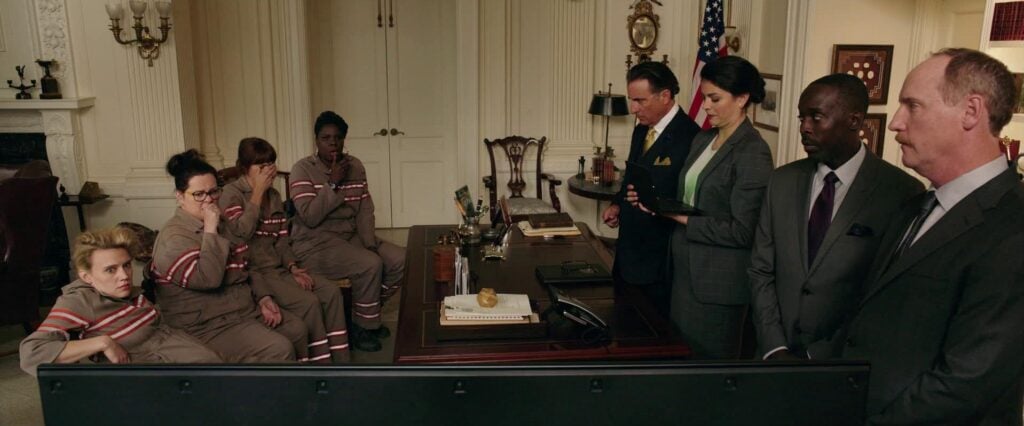 The Ghostbusters in the mayor’s office. The meeting is… not going well.
The exchange itself goes like this:
Agent Rourke: Sheriff in New Mexico reports a UFO encounter. The crew of the S.S. Ourang Medan dies mysteriously. The entire town of Langville, Montana goes missing.
Jillian Holtzmann: It does?
Abby Yates: Okay, but we’re talking about relocating. No one’s being killed here. Right?
Mayor Bradley: They were turned inside out.
Erin Gilbert: Their skin is on the inside of their body?
Mayor Bradley: Their skin is on the inside of their body because their organs are on the outside.
Abby Yates: But, they’re okay, right?
Mayor Bradley: Sure.
Jillian Holtzmann: I think they’re dead…
And there it is: All of the elements of the Langville legend, contained within just a few short lines. The only thing that isn’t overtly present is the whole thing about all evidence of Langville having been wiped from the record — but then again, I’d argue that the context of the conversation in which Langville appears provides that element. I mean, not only is the story brought up within a conversation focused on performing a coverup, it’s also presented as an example of a successful coverup that’s already been carried out.
This appearance of the Langville, Montana mystery in Ghostbusters can definitely be pointed to as the thing that popularized it, or at least the thing that brought it into the public eye. That’s evident in the amount of coverage of it that kicked up both around the time of the movie’s release, and in the years following it. (We’ll talk about that in a bit — I promise.)
But the fixation on the Ghostbusters connection in all that coverage is still somewhat puzzling. The exchange itself is so short that I’d almost consider it a throwaway; it also has no bearing at all on the rest of the film’s plot. So what — among all of the other weird things in Ghostbusters, including other, quite well-known incidents referenced in the same line that introduces the Langville story! — was it about Langville in particular that stood out? What made it resonate, and why did viewers grab onto it so tightly?
If we break down the different elements of the tale, we can start to get at that a little — and I’d argue that the first element to examine is the fact that it’s all at least somewhat believable. If you’re willing to set aside the whole “turning people inside out” thing for a moment, all we need to do is look at the history of the state of Montana to see why.
Setting The Scene: Montana And Its Many Ghost Towns
Montana, of course, has a long, long history — one that stretches back thousands of years before it became occupied land following the arrangement known as the Louisiana Purchase in 1803. Its post-Louisiana Purchase history, however, is the bit that’s relevant for the Langville story, so that’s what we’re going to look at here. Because what that part of the area’s history tells us is that the idea of a town in Montana disappearing isn’t that far-fetched; indeed, the state itself is home to a vast array of ghost towns even now.
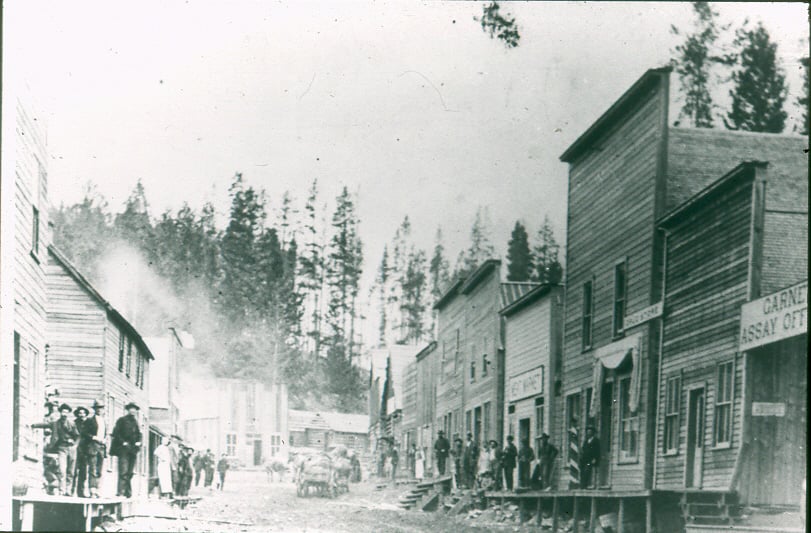 Not Langville. This is Garnet, again.
Many of these ghost towns are former mining towns. A variety of them were hotspots during the 1862 Montana gold rush; others were rich in copper, or iron, or coal; and still others were tapped for silver. But the towns were partially or totally abandoned after their mines closed — regardless as to whether those closures occurred because the mines themselves dried up, or because they were mismanaged into financial ruin.
Some of them are preserved in some capacity these days, and visitable — for instance, Bannack, which is now a state park, and Garnet, which is considered Montana’s best preserved ghost town. Others, however, like Coloma, remain largely tantalizing mysteries, with only the barest of archaeological evidence left to find, and even less in the way of documentation available.
But not all of the ghost towns in Montana are remnants of a flagging mining industry. Many of them, like Comertown, were established as intended agricultural centers — only for it to become apparent early on that the soil and the climate made the areas unsuitable for that Or they were trading posts or transportation hubs, like Bearmouth, which served either the agricultural towns or the mining towns — and which, naturally, couldn’t survive when those agricultural and mining towns shut down. These towns, too were gradually abandoned, the death knell mostly tolled by the closing of their post offices.
As each of these towns became ghosts of their former selves, many of them disappeared in a more literal sense, as well: Once they ceased to exist, they also stopped appearing on new maps. And, of course, people stopped talking about them — no one lived there, so no one was sharing stories about what it was like there anymore.
The difference, of course, between these ghost towns and Langville is that there’s record, however scant, of the real vanished towns. They may disappear from maps as time goes on, but they’re present on older ones — and, of course, we have letters and photographs and bills of sale and all other manner of physical material attesting to the fact that these towns did once exist.
So: That’s what made the idea of Langville believable. But what made it popular?
Remember how we set aside the “people got turned inside out” bit? It’s time to look at that piece of it again — because that’s the second element that’s at play in Langville, Montana mystery.
The Creepypasta Connection: From Ashley, Kansas To Langville, Montana
Disappearing town mysteries and legends have existed for ages (see also: The actual, real-life mystery of the Roanoke colony, which — surprise! — has also mostly been solved by this point), and they’ve been popular among armchair detectives for all that time, too. During the 2010s, however, they had something of a resurgence, which gives the Langville story some valuable context — and for more reasons than one.
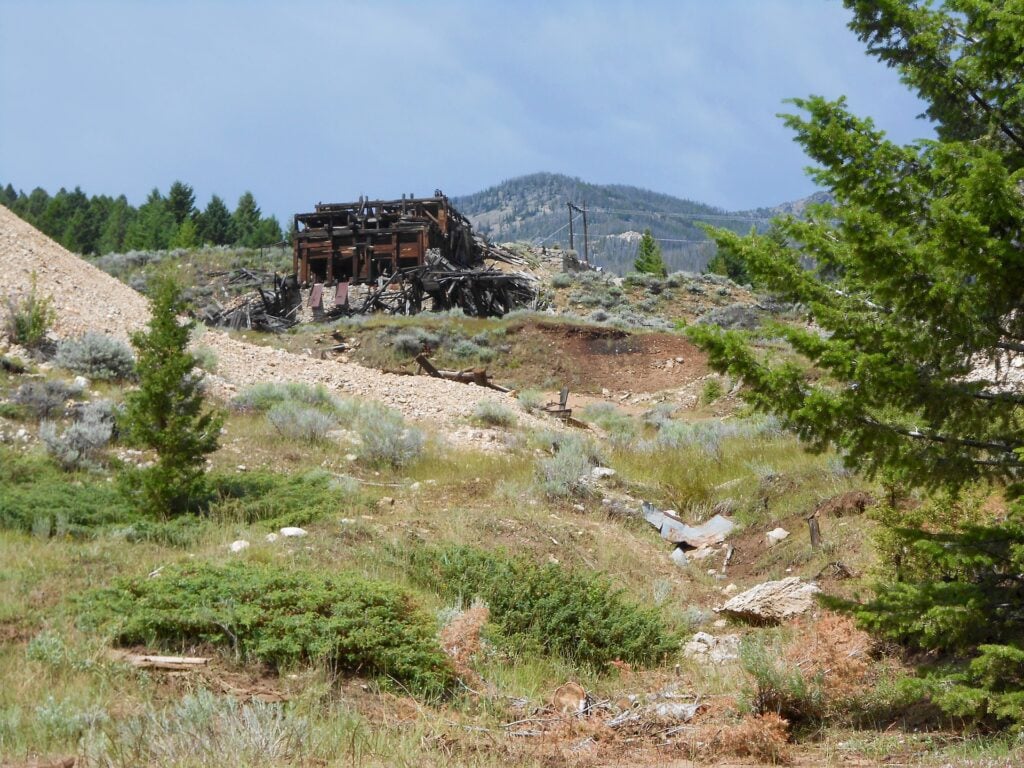 Still not Langville. These are the remains of Elkhorn, Montana.
You’re familiar with the tale of Ashley, Kansas, for example, right? The town that allegedly disappeared one hot summer’s night in 1952? According to reports that emerged — or re-emerged, maybe — in the early 2010s, a massive earthquake allegedly occurred right where the town used to be ,swallowing both it and its entire population in one fell swoop. Nothing but a gigantic, smoking fissure was left behind, and the population was deemed lost. But even odder was this: Not two weeks later, a second earthquake occurred at exact same spot — and when law enforcement went to investigate, they found that the fissure left by the first earthquake had entirely closed up after the second. After that, nothing remained of Ashley, Kansas — neither town, not people.
“The Disappearance Of Ashley, Kansas,” however, isn’t a documentation of something factual or historical; it’s a creepypasta. Not only that, but it’s an extremely popular and well-loved creepypasta, and has been ever since it was first published in 2012.
It had something of a ripple effect, as well: In the years following the publication of “The Disappearance Of Ashley, Kansas,” more and more stories joined it, filling out the pantheon of Tales About Towns That Mysteriously Disappeared — all of them pieces of internet-based horror writing.
The tale of Urhammer, Iowa, for instance? That hit the internet in 2015. Doveland, Wisconsin? Most of those stories date to around 2017. The legend of Hoer Verde, Brazil is older — it’s been circulating the internet since the early 2000s, and an even earlier version can be found in the 1983 Dean Koontz novel Phantoms — but it, too, would have been floating around in the online horror and paranormal spaces in the 2010s — and most of the discussion of it I’ve seen online dates to after the publication of “The Disappearance Of Ashley, Kansas,” rather than before it.
All of this gives us a pretty good idea of why the Langville story caught so many people’s attention: It had the disappearing community elements that have long made the real-life stories of places like Roanoke popular, plus the supernatural bent and realistic tone and style that characterized the creepypastafication of this kind of story. Add to that the timing of it all — Ghostbusters’ 2016 release meant that we were just a few years after the appearance of the Ashley, Kansas story and right in the heyday of the subgenre it spawned — and, well… it’s a recipe for success, as they say.
 Not Langville. This is Flathead Lake.
But wait! There’s more!
There’s a third bit of context to consider here — one that addresses the final piece of the Langville legend: The question of whether it existed prior to Ghostbusters or whether it was an invention of Ghostbusters.
For that bit of context, we have to return to the movie scene itself.
Two Truths And A Lie: The Lonnie Zamora Incident, The Ourang Medan, And The Legend Of Langville
The line in Ghostbusters which directly references Langville is interesting for more than just Langville itself. Take another look at it. Roarke says, pointing out three separate incidents in which the cat has successfully been put back in the proverbial bag: “Sheriff in New Mexico reports a UFO encounter. The crew of the S.S. Ourang Medan dies mysteriously. The entire town of Langville, Montana goes missing.”
Langville, which may or may not be an extant legend, is one of those incidents — but the other two? Those are extant legends. And in surrounding Langville with legends that had existed before the movie came along, the Ghostbusters script subtly presents the idea that the Langville legend, too, existed before.
“Sheriff in New Mexico reports a UFO encounter?” That’s the alleged Socorro UFO encounter, also referred to as the Lonnie Zamora incident. In 1964, Zamora, a sergeant in the police department of Socorro, New Mexico, went to investigate what he had told radio dispatchers he suspected as being a vehicular collision; he later claimed that instead of a car or other standard motor vehicle, he had seen some sort of O-shaped vessel made out of something aluminum-like in appearance lift up on a burst of blue and orange flames and then speed away into the sky. Project Blue Book — the U.S. Air Force program that investigated alleged UFO claims between 1952 and 1969 — even looked into it.
“The crew of the S.S. Ourang Medan dies mysteriously?” That’s, of course, the mystery of the S.S. Ourang Medan — a naval vessel whose entire crew was found inexplicably dead somewhere in the Pacific Ocean sometime during the Second World War. Precisely what happened to them has never been determined; all we have to go on is the strange SOS message the crew left before they expired.
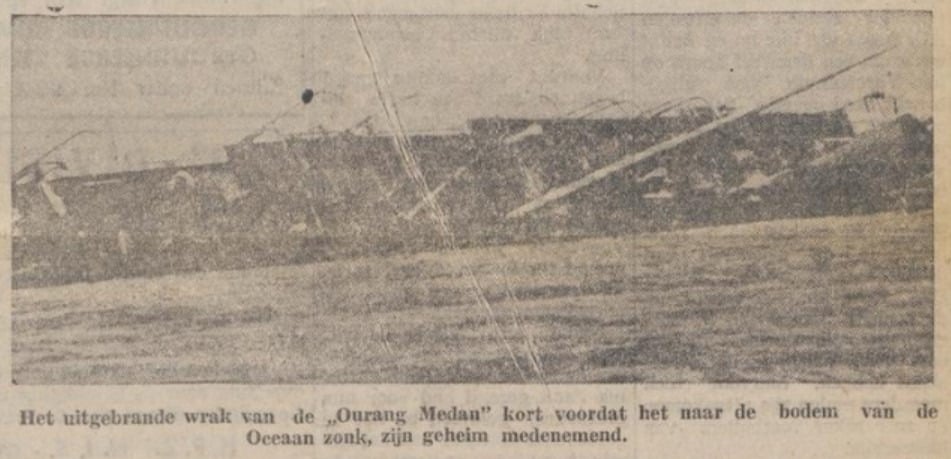 An alleged photograph of the S.S. Ourang Medan as seen in the newspaper De Locomotief on Feb. 2, 1948.
Both of these incidents have been pretty much debunked by now — but what they do have going for them is not that the stories themselves are true, but that the stories have longevity. Whatever the truth might be of the Lonnie Zamora incident, something did happen then; it’s well-documented, we have those records, and it’s been part of the larger discussion around UFOs ever since the whole thing occurred more than 60 years ago. The S.S. Ourang Medan may or may not have existed in reality, but the story about it has been passed around since at least 1940; again, it’s well-documented. We have those records. It was literally in the papers.
So: Given that Ghostbusters groups the Langville story together with these two definitely-extant legends, it lends credibility to the idea that the Langville story, too, could be a longstanding, well-documented legend, whether or not the town itself was ever real.
But from where I’m sitting, that’s actually a careful piece of misdirection — a sort of cinematic version of two truths and a lie: The truths are there to make the lie look believable. It does its job well — but, friends?
I’ve got a case to make for what I think the origin of the Langville, Montana legend was.
Stay with me, now.
We’re in the homestretch.
The Chicken Or The Egg: The Case For An Origin Point
Let’s return once more to Ghostbusters.
Let’s talk about why I’m fairly certain — not 100 percent certain (hence this piece’s categorization here as an unresolved mystery), but pretty dang close to it — that Ghostbusters is responsible not just for popularizing the Langville, Montana legend, but for inventing it in the first place.
For that, we’ll need to begin with tracking the coverage of it — looking at who was talking about it, when they were talking about it, and how they were talking about it. (Told you we’d get to this, didn’t I?)
 Montana. Not Langville.
We’ll start, again, during the summer of 2016.
Immediately following Ghostbusters’ release on June 8, 2016, a handful of short posts — often on the blogs of local or regional radio stations, like the one corresponding to the Missoula-based rock station 96.3 The Blaze — popped up across the internet pointing out the inclusion of the Langville legend. These posts, as short as they were, mostly addressed the legend as a piece of what we in the content biz used to call identity content: It zeroed in on the Montana-based nature of it — that is, it talked about the legend in a “Hey, look, fellow Montana folks! We’re in Ghostbusters!” sort of way.
By the early 2020s, slightly longer reads about Langville began appearing elsewhere — often on websites or in publications geared either towards travel more broadly or hyperlocal, Montana-based content specifically, though occasionally also on sites that focused on the paranormal. In these pieces, the Ghostbusters reference was usually still made; however, unlike in the earlier coverage, the story was typically discussed in a way that divorces it from the movie. These pieces also tended to blur the line even further when it comes to questions about the legends origins and age. For instance, as road trip planning website Hwy.co put it in 2022:
“Doubters would tell you that the missing town in Montana is a hoax, first mentioned in the 2016 Ghostbusters remake. Many doubters claim that the directors of Ghostbusters created the Langville Legend to build buzz for their upcoming movie. …
…Nonetheless, many Montanans swear by the fact that [Langville] did indeed exist. They also claim that the legend existed long before the new Ghostbusters movie came along.”
Or, per the Montana sub-site of Only In Your State, also circa 2022: “Some say that the online search for evidence of the whole town that disappeared began after the Ghostbusters movie was released. Others swear that the rumors have been around much longer.”
Or, at Paranormal Catalog in a piece that was published in October of 2022, according to the page’s source code: “Langville had all but disappeared from memory until 2016 when it was mentioned in the Ghostbusters remake.”
All of this, you’ll note, deals with Langville as if it may have been a real town, and as if it may have been an extant legend.
Something interesting happens if you try to track coverage of the legend before the release of Ghostbusters, though — because there basically isn’t any. And that’s quite a large clue, indeed.
Here’s what I found when I went digging.
 Glacier National Park. Montana is a pretty state, isn’t it?
Google Trends data, although certainly not infallible, can provide rather a lot of valuable information. For the unfamiliar, it’s a tool that lets you track the relative popularity of search over time. The caveat, of course, is that Google Trends data only goes back to 2004, so the tool can’t tell you anything about any given search term before that year; I’d also add that I’m a little skeptical of the current version of Google Trends, because it relies on Google’s Gemini AI, which I neither like nor trust.
As of this writing, however, we can still access the legacy, non-Gemini version of Google Trends — and if we look at the search data there for “Langville Montana” here, we can see something quite telling: It’s a completely flat line… until the summer of 2016. It spikes a little bit in July of that year, just after Ghostbusters’ June release date; then it hits its peak in October; and after that, it tapers off, but never disappears completely. Simply put, there’s a clear division in the search data for “Langville Montana” indicating a distinct Before Ghostbusters era and an equally distinct After Ghostbusters era.
I went a step further, too, and did some searching for Langville, Montana using a number of different search engines — Google, Bing, DuckDuckGo, etc. — with some time-related parameters in place. And guess what? There are basically no relevant results for “Langville Montana,” “Langville”+ “Montana,” and other similar queries prior to 2016. The few results I did dig up for “Langville”+“Montana” are all about people named Langville who have some connection to the state of Montana; I found nothing at all about the legend of the disappearing town specifically.
Of course, that doesn’t necessarily mean that the Langville, Montana legend wasn’t on the internet at all prior to 2016; just that if it was, then those sources are no longer accessible — which, it’s true, does play into the whole idea of the town being wiped from record (e.g., if there were sources, the lack of results could indicate that those sources were subsequently taken offline). But honestly, we’re much more likely to be looking at an Occam’s Razor situation here than, say, an argument from ignorance or other logical fallacy: If we’re finding nothing, it’s simply because there is, in fact, nothing to find, and never has been.
In other words, Paranormal Catalog’s assumption that Langville “had all but disappeared from memory until 2016 when it was mentioned in the Ghostbusters remake” may have been erroneous. It’s not that it had disappeared from memory until Ghostbusters; more likely, it just didn’t exist at all until Ghostbusters.
Loose Ends: Fakelore, Folklore, And The Evolution Of A Legend
The further away we’ve gotten from 2016, the fuzzier the lines around Langville have become — which makes it serve as a pretty good case study for how a manufactured legend can become a real one. How fakelore becomes folkore, if you will.
These days, for instance, the details of the legend are sometimes separated out from each other and spoken about as if they all came from different sources, rather than from one single source. The bit about people having been “turned inside out” is frequently positioned this way; it’s often surrounded by phrasing like “some stories even claim the townspeople were ‘turned inside out’” and “some claim the residents were mysteriously ‘turned inside out.’”
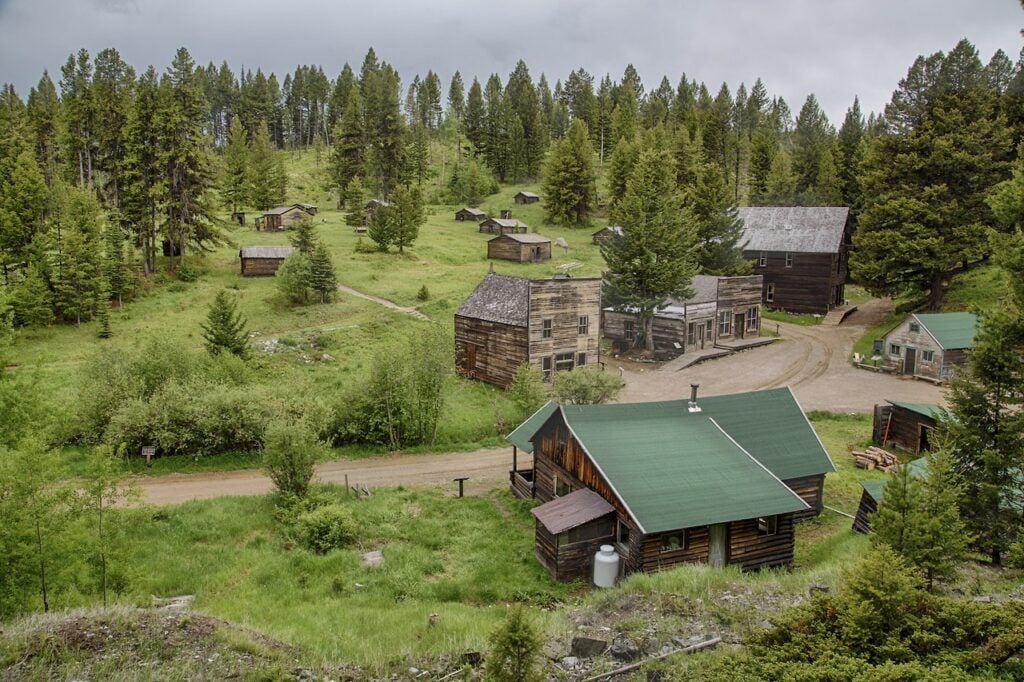 Still not Langville. This is what the preserved remains of Garnet, Montana look like today.
Even when pieces about Langville correctly identify both that it was never a real town and that the legend likely originated in Ghostbusters, the “inside out” bit is still sometimes presented as if it were a later addition to the story. For instance, a piece published at Distinctly Montana in August of 2025 about towns in the state that never existed gets both the first two bits right, but then goes on to say that “in the manner of web lore, [the Langville story] has since acquired new layers, such as the idea that town didn’t just disappear, but that its residents were ‘turned inside out’” — despite the fact that we can see in the Ghostbusters scene that likely serves as the origin point for the legend that the “turning people inside out” detail was always part of the story.
That pieces isn’t wrong about the fact that the legend has evolved, though. Other sources elsewhere that repeat the legend do include some “new layers” — particularly dates. Although the legend as it appears in Ghostbusters doesn’t say exactly when Langville is meant to have disappeared, some pieces, like the Paranormal Catalog one, state that it happened sometime in the 1900s; meanwhile, Paranormal Catalog, Discovering Montana, and Only In Your State all identify the 2000s as the era in which evidence of Langville was wiped from the record. Discovering Montana further states that Langville “even showed up on Google Maps but no one could find it in person” before going on to say that “Google Maps apparently has saved images from street views but no map of the town” — another detail that’s absent in the Ghostbusters exchange.
You may have noticed that these dates and details are somewhat nonsensical if taken together. I did, too, which, to me, further points to them being embellishments added by others later on. The 1900s could conceivably fit an appropriate timeline for the town’s destruction, as it lines up roughly with the timeline on which Montana’s actual ghost towns began appearing; however, the record of Langville not being wiped until the 2000s — a full century later — makes zero sense. But, well… the internet’s gonna internet, and that is, in fact, how legends grow: Each storyteller puts their own spin on the tale, and over time, the details begin to add up to something greater than the sum of their parts.
Occasionally, the Mandela effect is also sometimes brought up alongside Langville — and in two different ways, at that. According to some reports, there are folks who swear they’d heard of the town of Langville, Montana itself long before 2016; meanwhile, according to others, there are folks who swear they’d heard of the legend of the town of Langville, Montana long before 2016. In both cases, the implication is that folks who have memories of Langville or its legend are remembering falsely — although if your beliefs about the Mandela effect hinge less on the imperfection of human memory and more on the possibility of alternate universes, then I suppose the implication is that folks who have memories of Langville or its legend aren’t remembering falsely, but remembering a different universe or timeline.
For what it’s worth, though, I’ve only found one instance of folks from Montana actually talking about Langville as if it existed prior to Ghostbusters. In a Reddit thread at the r/Montana subreddit asking readers about strange creatures or weird local legends they’ve heard in their communities, one person brought up Langville and stated it had been “mentioned in several shows,” including possibly The X-Files; then, below that, a second person reported that they used to hear their father, who was a manager at a hardware store, “talk about doing business in Langville all the time.”
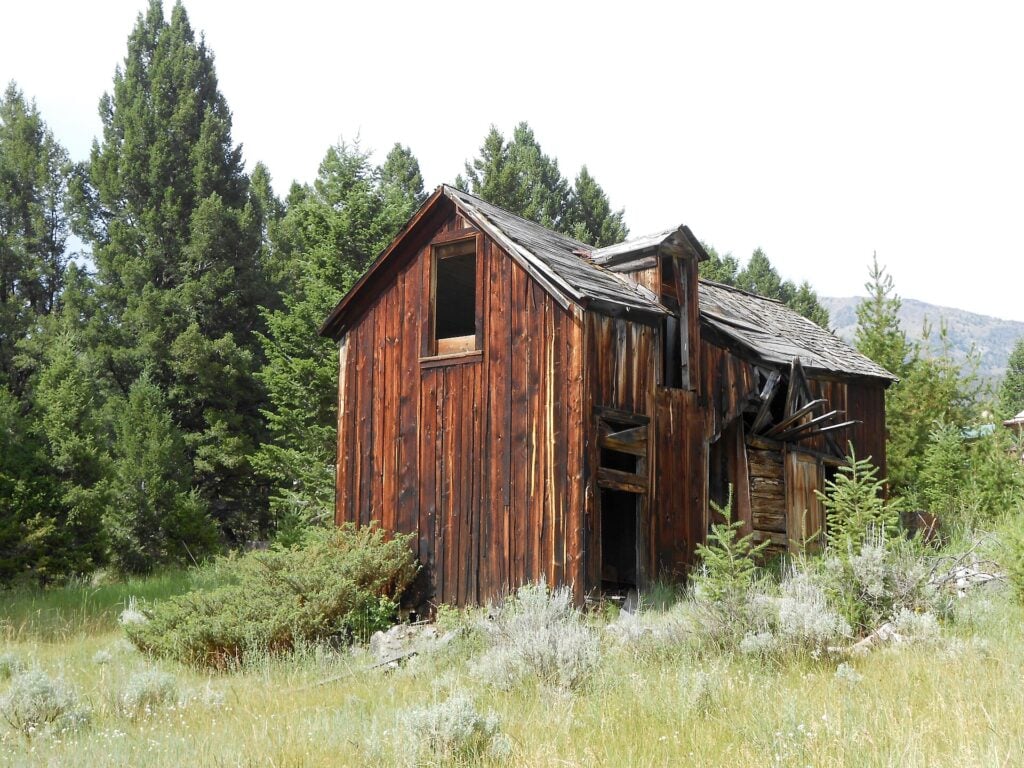 Not! Langville! This is more of the remains of Elkhorn, Montana.
 I’m not entirely sure what to do with these two comments, to be honest; I did some digging about the possible X-Files or other TV show connection and came up empty, and the hardware store manager story doesn’t really check out if Langville is supposed to have disappeared in the 1900s. (Though, again, the Ghostbusters scene notably does NOT include a year — which, in turn, means that it could have hypothetically happened much more recently.)
It’s possible that those citing the Mandela effect could have dug up these two comments and subsequently drawn the line from there to the generalization that lots of people from Montana supposedly swear they remember either the town or the legend. That’s… not something I’d choose to do with such a small sample size, but, again, the internet’s gonna internet.
Here’s the thing, though: At the end of the day… I still don’t know with absolute certainty whether the legend of the disappearing town of Langville, Montana originated with Ghostbusters or whether it really was lost to time prior to the movie’s release.
Not totally.
I suppose at least we can be reasonably sure that no one from a town in Montana called Langville turned inside out.
…Probably.
You never know, I guess.
Maybe the cat really was put back in the bag.
Who knows how long we’ve got until it gets back out again?
***
Follow The Ghost In My Machine on Bluesky @GhostMachine13.bsky.social, Twitter @GhostMachine13, and Facebook @TheGhostInMyMachine. And for more games, don’t forget to check out Dangerous Games To Play In The Dark, available now from Chronicle Books!
[Photos via the Bureau Of Land Management (1, 2, 3), PJ Johnson/Flickr, available under CC BY 2.0 and CC BY-ND 2.0 Creative Commons licenses; igorovsyannykov, jdblack/Pixabay; Sony Pictures; Montanabw (1, 2), Balon Greyjoy/Wikimedia Commons, available under CC BY-SA 4.0 and CC BY-SA 3.0 Creative Commons licenses.]









.png)






.jpg)



 English (US) ·
  French (CA) ·

