

.png) 6 days ago
9
6 days ago
9
PROTECT YOUR DNA WITH QUANTUM TECHNOLOGY
Orgo-Life the new way to the future Advertising by AdpathwaySen. Lindsey Graham (R-S.C.), a close Republican ally of President Donald Trump, died at the age of 71 on Saturday evening.
Trump led tributes Sunday to someone he called “one of the greatest people and Senators I have ever known,” describing Graham as a “true American Patriot” in a Truth Social post.
But it didn’t take long for the focus to shift back to Trump.
There was this wild Truth Social post, featuring a photo of Graham holding up Trump’s Wikipedia page where Trump’s photo is captioned, “Acting President of Venezuela.” “So sad!!!” wrote Trump (or “President DJT,” as he self-referred.)
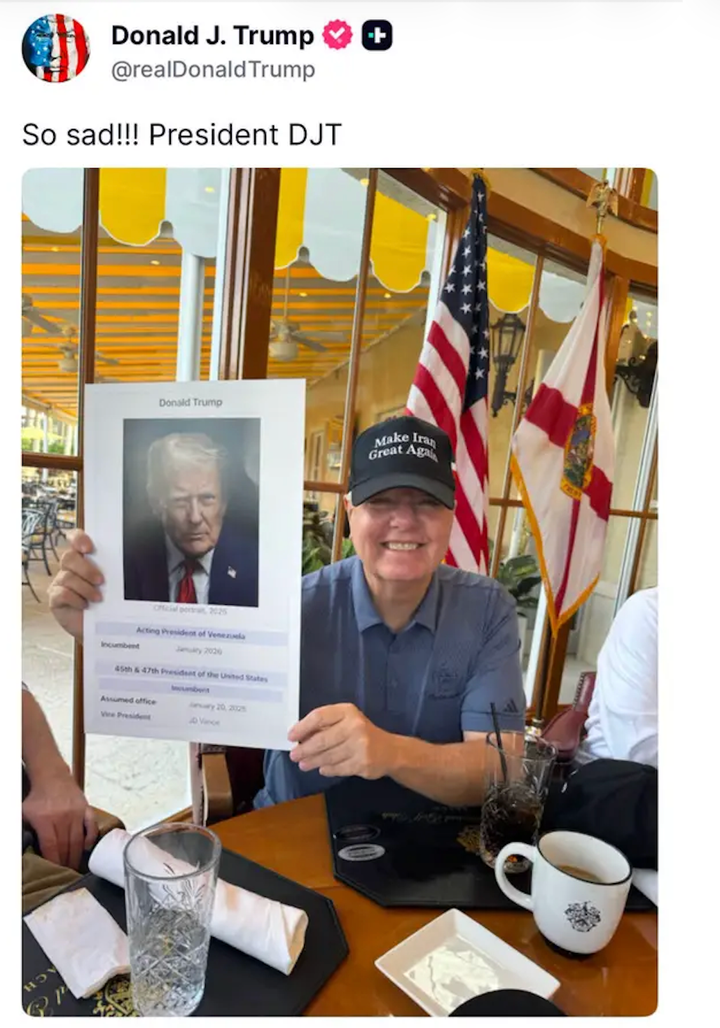
WhiteHouse/Truth Social
On “Meet the Press,” Trump reflected on Graham’s death from the perspective of what it would mean for his pet policy issue: “This is a big blow to the SAVE America Act, let me tell you,” he said. And when the hosts of “Fox & Friends” tried to coax a tribute out of Trump, the president went on a tangent about the SAVE America Act and the purportedly rigged elections in California.
His musings weren’t all about the SAVE America Act, though. In the days since Graham’s death, Trump has also reminisced about all the ways he beat the late senator in life.
“He was totally against me. I mean, he was fighting me,” he told Fox News of Graham’s opposition and campaign threats during the 2016 Republican presidential primaries.
“I was leading in the polls by a lot,” Trump said. “He said, ‘I’ll get you in South Carolina!’ That didn’t work out too well, I joke about it. It was amazing.”
Running for president wasn’t the only thing Graham was bad at, according to Trump. Though the senator was a “nice man,” his golf game left a lot to be desired. “He loved playing golf,” he told Fox News. “It wasn’t that he was a great striker of the ball ... He wasn’t Jack Nicklaus… he was not Tiger. But he loved it and he had fun.”
Psychologists say behavior like this is called ‘egocentric framing.’
Trump’s comments about Graham reflect a specific pattern, said Craig Malkin, a clinical psychologist and author of “Rethinking Narcissism.”
“His comments suggest empathy impairments and the tendency to organize relationships around status, loyalty, competition and usefulness to the self — all signs of a preoccupation with the need to feel special or exceptional compared with everyone else,” Malkin told HuffPost.
“In these clips, Trump repeatedly seems to convert Graham’s death into evidence of Trump’s own political importance: his victory over Graham, Graham’s loyalty to him, and the impact of Graham’s death on Trump’s legislative agenda,” he continued.
Psychologically, this type of behavior is what experts call egocentric framing or self-referential processing: using someone else’s tragedy to redirect attention to oneself.
Trump also “instrumentalizes grief,” Malkin said, making the loss a vehicle for advancing his political message.
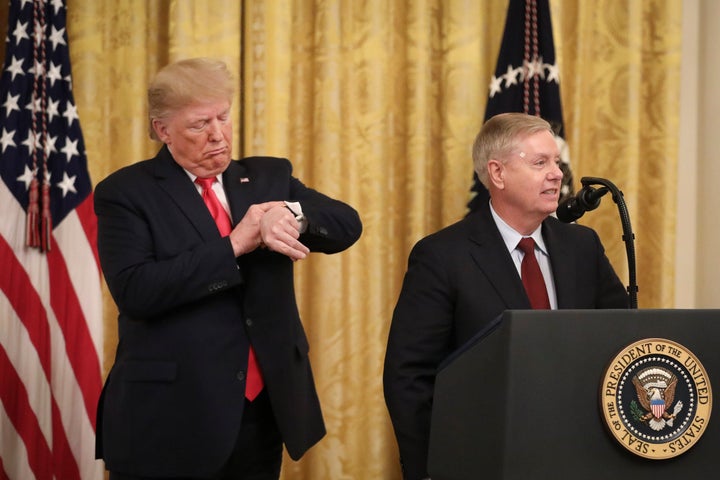
Drew Angerer via Getty Images
At the core of it, people who engage in egocentric framing ― often those who meet the clinical criteria for narcissism ― see others as an extension of themselves rather than as separate individuals, explained Avigail Lev, a psychologist in San Francisco.
“In psychological terms, other people function as ‘self objects,’” she told HuffPost. “They exist to mirror the narcissist, to prop up their self-esteem, to serve a function for the self.”
The narcissist doesn’t experience others as whole, separate people with their own inner world. Instead, the narcissist relates to another person as a means to an end, rather than as an end in and of themselves.
“That’s why, when someone close to them dies, a narcissist can only process it through one lens, which is how does this impact me,” Lev told HuffPost. “Is this good for me or bad for me? Is this because of me? Does this make me more powerful or less powerful? Does this work better for me or worse for me?”
There’s an “empathy deficit” at play, Lev explained. “The person who died almost disappears as a person and becomes a backdrop for the narcissist’s own experience.”
Why someone with this behavior pattern may struggle extra with death or grief.
There’s another layer: A death like this also forces someone with this behavior to confront their own mortality. They thrive on grandiosity and see themselves as omnipotent, omniscient ― almost immortal, Lev said.
“Omnipotence is the fantasy of total power and control, the feeling that they can control outcomes, control other people, and bend reality to fit what they want,” she said. “A death cuts straight through that, because death is the one thing no one can control and no one can outsmart. It’s a direct assault on both the omnipotence and the omniscience.”
That reaction has a name, Lev said: a “narcissistic injury,” which occurs when a minor criticism, boundary or perceived slight threatens a person’s fragile, grandiose self-image, triggering a disproportionate emotional reaction.
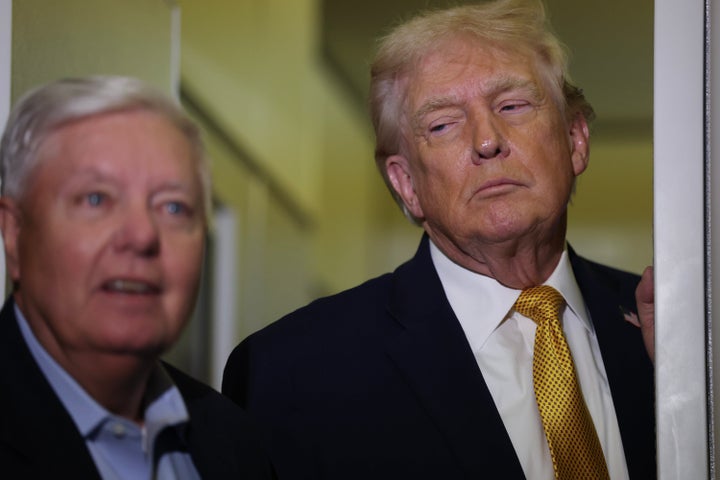
Joe Raedle via Getty Images
Ami B. Kaplan, a psychotherapist in New York and Florida specializing in adult children of narcissists, said attention being shifted away can be another trigger for people with this behavior pattern. They’re “notorious for having a difficult time when there is a positive focus on another person in their sphere,” she said. “It’s taken, unconsciously, as a kind of slight against them.”
Kaplan compared it to a young child dealing with another sibling’s birthday, and being upset and angry that the attention is not on them, or a narcissistic parent acting out at their child’s weddings, graduation ceremonies or birthday.
“I have heard of a narcissistic parent showing up at their child’s college graduation in a cap and gown,” Kaplan said.
Makin said there’s a simple way to tell whether a public tribute — whether it’s from the president or an Instagram post from someone you follow — is truly honoring the person who died or is instead centered on the person posting it.
“After hearing it, do we understand more about the person who died — or mainly more about the speaker?” he said. “Healthy mourning makes room for both the relationship and the separate humanity of the person who’s gone. “
People commonly process shocking news by first calculating what it means for their own lives. That initial self-focus is human, Malkin said.
“For most of us, though, empathy helps us move beyond that first reaction and bring our attention back to the person who died and their loved ones,” the psychologist said.
Narcissistic mourning, meanwhile, “tends to collapse that distinction: the person’s value becomes primarily what they provided, represented or reflected back to the survivor,” Malkin said.







.png)




.jpg)



 English (US) ·
  French (CA) ·