

 2 hours ago
6
2 hours ago
6

The US Naval Academy (Annapolis) now prepares the future naval officers not only for artificial intelligence, hypersonic weapons and unmanned systems, but also for Stoic philosophy.
*
The United States Naval Academy at Annapolis, which has trained officers for the U.S. Navy since 1845, reports directly to the Chief of Naval Operations (CNO). There is no separate Naval Education and Training Command within its chain of command. Today, Annapolis is not the Navy’s only source of commissioned officers. The U.S. Navy also commissions officers through the Officer Candidate School (OCS) and the Naval Reserve Officers Training Corps (NROTC) programs conducted at universities across the country.
Each year, the U.S. Navy commissions approximately 2,500–3,000 new officers, of whom roughly 1,000–1,100 graduate from Annapolis. Although the Academy provides only about one-third of the Navy’s annual officer intake, it produces a disproportionate share of its future strategic leaders, fleet commanders, and candidates for the position of Chief of Naval Operations (CNO).
In American naval culture, Annapolis graduates are known as “Ring Knockers.” Their distinctive class rings symbolize far more than a shared educational background. They represent the strategic tradition, institutional memory, and elite leadership culture of American sea power. It is therefore no coincidence that Annapolis graduates have historically occupied a dominant position within the U.S. Navy’s admiralty and its most critical command appointments.
The Foundation of Imperial Power Is Naval Power
Throughout its history, the backbone of American global and imperial power has been its navy. During the Second World War in particular, aircraft carriers, battleships, cruisers, destroyers, submarines, and millions of tons of ammunition produced by American industry on an unprecedented scale were employed by commanders educated at Annapolis in pursuit of U.S. political objectives. The naval supremacy achieved at the end of the war elevated the United States to global leadership not only in military terms but also economically and geopolitically.
Yet the strength of a navy cannot be measured solely by its ships, weapons, or technology. The decisive factor is the strategic culture, value system, and intellectual tradition that shape the officers entrusted with commanding that force. To understand American naval power, one must therefore examine the historical, philosophical, moral, and spiritual environment in which its officers are educated. This is precisely what makes Annapolis unique and significant.
Annapolis is more than a military academy; it reflects the American state, society, and strategic culture. For that reason, understanding the education provided there and the intellectual outlook of its graduates requires an examination of the political and social environment in which the Academy operates. In particular, the place of religion in American public life and its influence on politics constitute an important element of this broader cultural context.
Religion and Its Place in American Politics
Religion continues to play a significant role in American public life and politics and has become increasingly visible in recent years, particularly through conservative Christian circles and the evangelical movement. Unlike the stricter model of secularism found in much of Europe, the United States has traditionally adopted an approach that does not exclude religion from the public sphere. As a result, religious influence remains evident across many aspects of American society, from education to politics.
Following the strengthening of U.S.–Israel relations after 1967—and especially during the period that gained momentum after the September 11 attacks—the influence of Christian Zionist circles, particularly evangelical Christians, on American policy toward Israel became increasingly pronounced. Especially within the Republican Party, support for Israel is viewed not only as a strategic necessity but also as a religious obligation rooted in biblical interpretation. During the recent Israel-Iran confrontation, religious services, sermons, and spiritual guidance provided by military chaplains in some U.S. military units reflected this broader trend.
The influence of religion is also visible at the U.S. Naval Academy in Annapolis. The campus contains nine chapels and spiritual support centers serving different faith communities. These institutions function not only as places of worship but also as centers for character development, ethical leadership, spiritual resilience, and the cultivation of the will to fight. Their presence demonstrates that religion has not been excluded from institutional life within the U.S. Armed Forces, rather, it continues to be regarded as one of the elements that strengthen morale, cohesion, and resilience. To fully understand the cultural environment in which Annapolis educates America’s future military and political leaders, the continuing prominence of religion in American society must therefore be considered.
Stoic Training for American Naval Officer Candidates
In recent years, the U.S. Naval Academy has undergone a remarkable evolution in its educational philosophy. Alongside traditional military instruction, Stoic philosophy has been incorporated into officer education, introducing cadets to the works of Marcus Aurelius, Seneca, and Epictetus. The objective is not to promote a new belief system, but to develop leaders capable of making sound decisions under uncertainty, enduring hardship, mastering fear, exercising self-discipline, and demonstrating strength of character in combat.
This approach has moved well beyond theory. During the 2024 and 2025 Plebe Summer programs, the Academy introduced a six-week voluntary Stoicism course for incoming midshipmen. Participants learned to distinguish between what lies within their control and what does not; to regard adversity as an opportunity for character development; to confront the possibility of death and failure with composure; to value inner discipline over external recognition; and to judge events rationally rather than emotionally. In this context, Stoicism is taught not as an ancient philosophical tradition, but as practical preparation for the psychological demands of war.
This educational shift also reflects a broader transformation in the U.S. Navy’s concept of leadership. At a time when artificial intelligence and autonomous systems are becoming increasingly central to warfare, the Navy seeks to produce officers who are not only technologically proficient but also capable of preserving sound judgment, emotional stability, and psychological superiority under the extreme pressures of combat. In the wars of the future, victory will depend not only on superior technology, but also on the character, resilience, and moral strength of those entrusted to employ it.
Why Stoicism?
Originating more than 2,300 years ago, Stoicism is a philosophy of life that teaches individuals to master their own minds in the face of events beyond their control. No commander can know with certainty what an enemy will do, how a war will unfold, or when death may come. In the face of such uncertainty, Stoic philosophy seeks to replace fear with reason, anger with composure, and despair with a steadfast sense of duty. Stoicism is therefore not a doctrine of passive fatalism but a philosophy for cultivating warriors capable of preserving their will and judgment under the harshest conditions.
This is precisely why Annapolis has reintroduced Stoicism into its curriculum. The objective is not to teach ancient philosophy for its own sake, but to equip future naval officers with the mental discipline required to make sound decisions under pressure, demonstrate psychological resilience, and remain focused on their mission regardless of circumstances.
This educational choice also reflects the U.S. Navy’s evolving understanding of “spiritual readiness.” The Navy seeks to unite personnel from different religious traditions—as well as those with no religious affiliation—around a common ethic of character, duty, and leadership. In this context, Stoicism provides a secular, non-sectarian framework for moral and character development that can serve as common ground for all. States may adapt to changing patterns of religious belief within society, but military institutions cannot rely on a shared faith alone. To prevail in war, they require officers who share a common character rather than a common creed.
The broader message Annapolis seeks to convey is that the wars of the twenty-first century will not be decided solely by artificial intelligence, hypersonic weapons, or autonomous systems. They will also be contests of the human mind, resilience, and the will to fight. Technology remains only an instrument of war; victory ultimately belongs to those who can employ it wisely under pressure, hardship, and uncertainty.
Perhaps no quotation captures this philosophy better than the words traditionally attributed to the Stoic Roman Emperor Marcus Aurelius: “Be like the rock against which the waves continually break; it stands firm while the raging waters are stilled around it.” In war, what ultimately proves decisive is neither enemy fire nor violent storms, but the commander’s ability to preserve clarity of mind and firmness of will. At Annapolis, young officer candidates are therefore taught a simple but enduring principle: first master your mind, then fight.
Change in American Society
The U.S. Naval Academy’s renewed emphasis on Stoic philosophy represents more than an educational reform; it reflects the impact of profound sociological changes in American society over the past two decades on the nation’s military institutions. As affiliation with organized religion has steadily declined—particularly among Generation Z—the number of Americans who identify with no religious tradition, commonly referred to as the “Nones,” has grown rapidly. The leadership at Annapolis recognizes that a significant proportion of incoming midshipmen are no longer motivated by traditional religious references to the same extent as previous generations.
This trend is equally evident within the U.S. Navy itself. Approximately 40 percent of enlisted sailors do not identify with any religious tradition, while roughly 15 percent of newly admitted midshipmen at Annapolis report no religious affiliation. This demographic transformation has been one of the principal reasons for incorporating Stoicism into the Academy’s broader concept of “spiritual readiness.”
According to the U.S. Naval Academy, spiritual readiness is the inner resilience and moral strength that enable a warrior to perform his or her duty with honor under the most demanding circumstances. Rather than reinforcing a particular religious tradition, the Navy seeks to cultivate a shared ethic of character, duty, and commitment among personnel from diverse faiths—or from no faith at all. Consequently, Stoicism has become an integral component of the Academy’s spiritual readiness program rather than simply another subject within ethics education. Combat readiness is thus understood in holistic terms, encompassing not only physical endurance, technical competence, and tactical proficiency, but also psychological resilience, moral character, and spiritual strength.
.
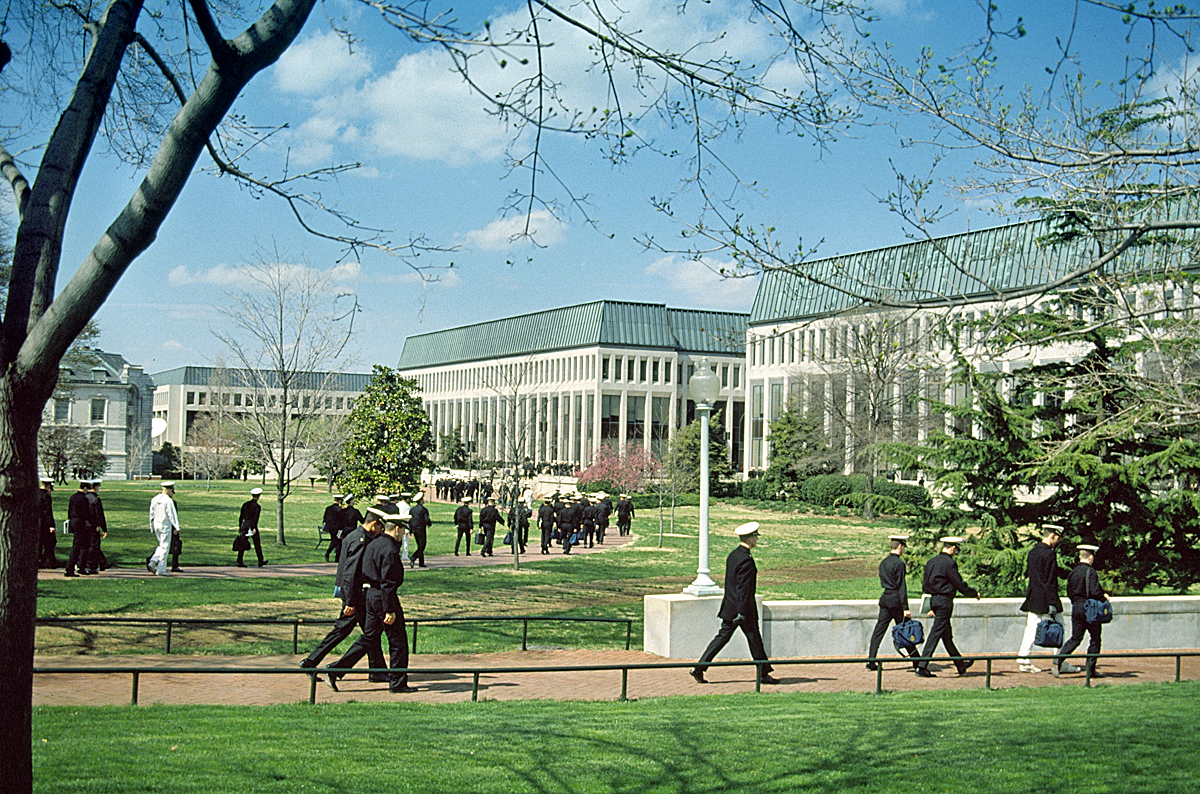
Midshipmen walking to class at the US Naval Academy in Annapolis (Free Use)
.
One of the most influential symbols of this philosophy is Admiral James Stockdale. After being shot down during the Vietnam War, Stockdale endured seven and a half years of imprisonment, torture, and solitary confinement in Hanoi. He later explained that his ability to preserve his mental resilience owed much to the teachings of the Stoic philosopher Epictetus. For this reason, Stockdale’s experience continues to serve as one of the most powerful sources of inspiration for Stoic education at Annapolis.
This educational choice also reflects a broader feature of American strategic culture. As Samuel P. Huntington argued, military institutions cannot remain completely insulated from social change, yet they must preserve a distinct professional ethic if they are to retain their combat effectiveness. Annapolis’ rediscovery of Stoicism is one of the clearest contemporary expressions of this principle. The objective is not to replace or diminish religion, but to place a universal, non-sectarian philosophy of character at the center of officer development, thereby preserving the timeless military virtues required for war in an increasingly diverse and changing society.
Fighting in the Mud
One of the enduring truths of war is that a nation can bomb a country for months, destroy its infrastructure, and exploit overwhelming technological superiority. Yet if it truly intends to impose its political objectives, occupy territory, or establish a lasting order, it must eventually send its young soldiers into the mud. This memorable observation by the American military historian T. R. Fehrenbach, written about the Korean War, captures the timeless essence of warfare. The ultimate measure of military success is not technological superiority alone, but a society’s willingness to bear the human cost of war.
It is here that the fundamental distinction between a war for the homeland and an overseas geopolitical war becomes apparent. People are prepared to fight—and, if necessary, die—for their own land, their families, their nation, and their future. It is far more difficult to inspire the same level of sacrifice thousands of miles from home in pursuit of political objectives, energy routes, or geopolitical ambitions that are remote from their daily lives.
The great power competition of the twenty-first century will therefore not be determined solely by artificial intelligence, hypersonic missiles, or autonomous systems. It will also be a contest over how societies understand death, suffering, sacrifice, and the burden of prolonged war. The defining strategic question of the future is not simply who develops the most advanced technology, but which society remains willing to bear the costs of employing it over time. As throughout history, victory will ultimately belong not to those who possess the most sophisticated weapons, but to those whose people retain the determination to endure hardship, accept sacrifice, and, when necessary, continue fighting in the mud until the mission is accomplished.
Conclusion
The transformation taking place at Annapolis, US Naval Academy is far more than an educational reform. It reflects a profound shift in strategic thinking—one that recognizes technological superiority alone cannot guarantee victory in twenty-first-century warfare. The U.S. Navy is seeking to prepare the future warrior not merely as a master of artificial intelligence, hypersonic weapons, and autonomous systems, but as a leader capable of making sound decisions under uncertainty, maintaining psychological resilience, and remaining steadfast in the ethics of duty.
This transformation is driven not only by military necessity but also by the sociological evolution of American society. As affiliation with organized religion declines and individuals from diverse faiths—or from no faith at all—serve under the same uniform, the Navy seeks to cultivate a common will to fight based not on shared religious doctrine but on shared character and enduring values. In this context, Stoicism has regained relevance not as an ancient philosophical school, but as a secular framework for character formation suited to the demands of modern military leadership.
Ultimately, this reflects one of the timeless realities of war. Artificial intelligence may identify targets, autonomous systems may deliver firepower, and algorithms may accelerate decision-making. Yet none of them can overcome fear, embrace sacrifice, or choose to risk death in the fulfillment of duty. The decisive factor in future warfare will therefore remain not technology itself, but the mind, character, and fighting spirit of the human being who employs it.
Perhaps this is the true reason Annapolis has rediscovered Stoicism. The U.S. Navy is not simply developing new weapons; it is shaping the mindset of the future warrior. History has repeatedly demonstrated that victory belongs not to those who possess the most advanced technology, but to those who preserve their discipline, resilience, and will to fight under the harshest conditions.
*
Click the share button below to email/forward this article. Follow us on Instagram and X and subscribe to our Telegram Channel. Feel free to repost Global Research articles with proper attribution.
This article was originally published on Mavi Vatan.
Ret Admiral Cem Gürdeniz, Writer, Geopolitical Expert, Theorist and creator of the Turkish Bluehomeland (Mavi Vatan) doctrine. He served as the Chief of Strategy Department and then the head of Plans and Policy Division in Turkish Naval Forces Headquarters. As his combat duties, he has served as the commander of Amphibious Ships Group and Mine Fleet between 2007 and 2009. He retired in 2012. He established Hamit Naci Blue Homeland Foundation in 2021. He has published numerous books on geopolitics, maritime strategy, maritime history and maritime culture. He is also a honorary member of ATASAM.
He is a Research Associate of the Centre for Research on Globalization (CRG).
Sources
The Stoic Anchor: Expanding Spiritual Readiness at the U.S. Naval Academy, By Commander Matthew Krauz, U.S. Navy, and Marcus Hedahl, June 2026,USNI Proceedings
Improving Spiritual Readiness in the Navy, By Commander Matthew B. Krauz, U.S. Navy, December 2025, USNI Proceedings
Featured image is from the author
Global Research is a reader-funded media. We do not accept any funding from corporations or governments. Help us stay afloat. Click the image below to make a one-time or recurring donation.














.png)






.jpg)



 English (US) ·
  French (CA) ·