

 9 months ago
116
9 months ago
116

The global systemic transition to multipolarity is increasingly characterized by the “19th-century Great Power chessboard” paradigm in which such states prioritize their interests at the (perceived or actual) expense of comparatively medium- and smaller-sized ones and non-state actors.
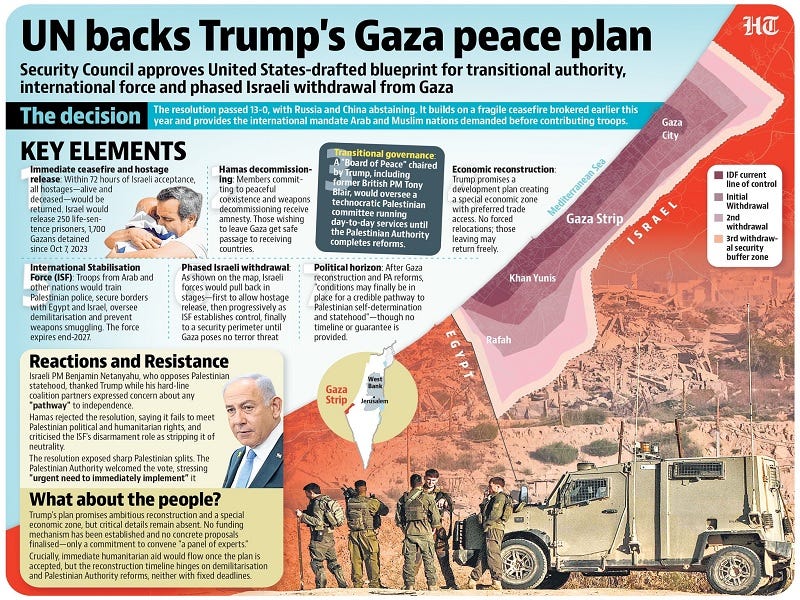
Quite a few folks on social media are disappointed, enraged, and/or disgusted that Russia abstained from the latest UNSC Resolution on Gaza after it authorized an “International Stabilization Force” (ISF) there in alignment with the so-called Trump “peace plan” that the US mediated between Israel and Hamas.
They believe that Russia should have vetoed the resolution in spite of the Palestinian Authority’s support for it, thus essentially suggesting that Russia should be “more pro-Palestinian than the Palestinians themselves”.
These expectations aren’t surprising since they align with the general sentiment espoused by many members of the Alt-Media Community, especially top influencers, quite a few of whom have peddled false claims about Russian policy towards the conflict or at least reinforced false perceptions of it. The foundational lie upon which all the others are built is that Putin is an anti-Zionist secretly allied with Iran against Israel and that all facts to the contrary are just him “playing 5D chess to psyche out the Zionists”.
The reality though is that he’s actually a proud lifelong philo-Semite, even going as far as to describe Russians and Israelis as “a true common family” and Israel as “a Russian-speaking country”, but false perceptions about his views and Russian policy continue to proliferate for the reasons explained here. Russia’s abstention might finally shatter this false paradigm since it’s extremely difficult to spin this as anti-Zionist, however, especially since it’s widely seen as having been imposed upon Hamas by the US.
About that group, Russia officially considers October 7th to have been a terrorist attack, but it doesn’t consider Hamas’ political wing to be a terrorist organization even though Israel wishes that it did. At the same time, Russia doesn’t consider Hamas to be the legitimate representative of the Palestinian people, the role of which it considers to be played by the Palestinian Authority. This further contextualizes why Russia abstained from the resolution instead of vetoed it even though Hamas was fiercely against it.
Be that as it may, Russia’s Permanent Representative to the UN still harshly criticized the resolution in his detailed comments that are worth reading in full here, thus dispelling speculation that Russia “sold out” Gaza to Israel after Putin’s call with Bibi ahead of the vote. Russia was therefore clearly displeased with this resolution, but it can’t realistically present itself as “more pro-Palestinian than the Palestinians themselves” after the Palestinian Authority supported it, ergo why it lambasted the draft then abstained.
.
.
Vetoing the resolution under these circumstances, especially without China doing so as well (it too abstained), would have therefore been blatant obstruction. It would also have offended those of Russia’s partners that are ready to participate in the ISF by withholding UNSC legitimacy from their mission. Since Russia has no desire to prevent them from deploying to Gaza, they’d thus likely do so anyhow, which would expose its grandstanding, embarrass it, and harm its ties with them without any benefit at all.
The global systemic transition to multipolarity is increasingly characterized by the “19th-century Great Power chessboard” paradigm in which such states prioritize their interests at the (perceived or actual) expense of comparatively medium- and smaller-sized ones and non-state actors. Accordingly, there was never any realistic chance of Russia siding with Hamas over the Palestinian Authority, Israel, and their shared ISF partners no matter how this makes some feel, which they still have the right to express.
*
Click the share button below to email/forward this article. Follow us on Instagram and X and subscribe to our Telegram Channel. Feel free to repost Global Research articles with proper attribution.
This article was originally published on the author’s Substack.
Andrew Korybko is an American Moscow-based political analyst specializing in the relationship between the US strategy in Afro-Eurasia, China’s One Belt One Road global vision of New Silk Road connectivity, and Hybrid Warfare. He is a regular contributor to Global Research.
Featured image: Russian president Vladimir Putin and Israeli prime minister Benjamin Netanyahu in 2016. The two long-serving leaders have had a close relationship. (Licensed under CC BY 3.0)
Global Research is a reader-funded media. We do not accept any funding from corporations or governments. Help us stay afloat. Click the image below to make a one-time or recurring donation.












.png)




.jpg)


 English (US) ·
  French (CA) ·